
Home brewers whose French press coffee tastes harsh, bitter or muddy almost always have an over-extraction problem. The grind is too fine, the steep is too long, the water is too hot, or the finished coffee is sitting on the grounds. This guide shows how to tell which one it is and fix it with one change at a time.
Quick answer
French press coffee turns bitter when too much dissolves from the grounds. Use a coarse, even grind, a 1:15 to 1:16 coffee-to-water ratio, water at 93-96°C (200-205°F), and a 4-minute steep. Pour all the coffee out right after pressing.
- Best for bitter cups: coarser grind first
- Best for sour or weak cups: finer grind or longer steep
- Bitter means over-extracted. Sour or weak means under-extracted. Do not fix them the same way.
- Grind size and evenness matter most. Blade grinders make fines that keep over-extracting.
- Coffee left in the press keeps brewing. Decant right away.
- Change one variable at a time and write down what you taste.
- Old coffee oils on the mesh filter can add stale, bitter flavors.
- Why is my French press coffee so bitter?
- Quick diagnosis: bitter, sour, weak or muddy?
- What grind size should I use?
- How long should I steep?
- Water temperature and coffee-to-water ratio
- Does leaving coffee in the press make it more bitter?
- Can a blade grinder or stale beans cause bitterness?
- Does a dirty French press make coffee taste bad?
- Step-by-step method for a smoother cup
- Why does my French press coffee taste weak?
- One-variable tuning checklist
- What do owners say?
- Frequently Asked Questions
Why is my French press coffee so bitter?
Your coffee is bitter because too much of the bean dissolved into the water. This is called over-extraction.
Think of the coffee grounds as a bag of flavors that come out in order. Bright, fruity acids come out first. Sweetness comes next. Heavy, dry, bitter compounds come out last. Specialty coffee targets about 18-22% of the coffee’s mass dissolved. Go past that and the cup tends toward bitter. Stop short and it tastes sour and thin.
A French press is an immersion brewer. The coffee sits in the water the whole time, so it has plenty of chances to over-extract. Four things push it too far: a fine grind, a long steep, very hot water, and leaving the coffee in the press after you plunge.
Quick diagnosis: bitter, sour, weak or muddy?
Taste first, then change something. Many readers fix a sour cup by grinding coarser, which makes it worse. This table tells you which way to go.
| Taste | Likely cause | One change to make |
|---|---|---|
| Bitter, harsh, dry finish | Over-extracted | Grind one step coarser |
| Sour, sharp, salty | Under-extracted | Grind one step finer or steep 30 seconds longer |
| Weak, watery | Too little coffee or too coarse | Add coffee (move toward 1:15) |
| Muddy, gritty, heavy | Too many fines, hard plunge | Use a burr grinder, sieve fines, plunge slowly |
| Bitter and stale, gets worse as it sits | Coffee left on grounds | Decant right after pressing |
| Rancid, flat, off | Dirty filter or old beans | Deep clean the press, buy fresher beans |
What grind size should I use for French press, and how coarse is coarse?
Use a coarse grind, similar to coarse sea salt. The pieces should look chunky and clearly separate, not like sand or powder.
A metal mesh filter lets small particles through. A fine grind slips into your cup, adds sludge, and extracts fast. A coarse grind slows extraction and makes a cleaner cup.
If you use a burr grinder, move one setting coarser at a time. If your cup is bitter and the grind looks like table salt, that is likely your answer.

How long should I steep French press coffee to avoid bitterness?
Steep for about 4 minutes. That is the common starting point for a coarse grind and hot water.
If the cup is bitter at 4 minutes, shorten the steep to 3:30 before you touch anything else. If it is sour, go to 4:30. Move in 30-second steps so you can taste the change.
The plunge matters too. Press slowly over about 20 seconds. A hard, fast press stirs up fines and pushes silt into the cup.
What water temperature and coffee-to-water ratio should I use?
Aim for water at 93-96°C (200-205°F) and a ratio of 1:15 to 1:16 coffee to water by weight. The SCA Golden Cup standard suggests brewing water of 90-96°C (195-205°F) and roughly 55 g of coffee per litre, about 1:18.
Water straight off a rolling boil is about 100°C. Let the kettle sit for 30-60 seconds first. With dark roasts, go toward the cooler end. A scale beats scoops here, because scoops vary a lot with grind and roast.
Too little coffee can also taste harsh and thin, because the small dose over-extracts in a lot of water. Here are doses for common press sizes. Sizes are the maker’s label, and you may not fill the beaker to the top.
| Press size | Coffee at 1:15 | Coffee at 1:17 |
|---|---|---|
| 350 ml | 23 g | 21 g |
| 600 ml | 40 g | 35 g |
| 1 L | 67 g | 59 g |
Start at 1:16 and move toward 1:15 for more strength or 1:17 for a lighter cup.
Does leaving coffee in the press make it more bitter?
Yes, it does. Pressing the plunger down does not stop brewing. It only pushes the grounds to the bottom, and the coffee stays in contact with them.
Pour every drop out right after you press. Use a carafe, a thermos or your mugs. Leave the last bit of silty liquid in the beaker.
- Cup is fine at first sip but bitter by the second cup? Decant into a carafe.
- Brewing for one? Still pour it all into your mug at once.
- Want the silt gone? Pour through a fine sieve.
Can a blade grinder or stale beans cause bitter French press coffee?
Yes. Blade grinders smash beans into uneven pieces. You get fines that over-extract and big boulders that under-extract, so the cup is bitter and sour together.
A burr grinder cuts beans to a more even size and is the single best upgrade. If you must use a blade grinder, pulse in short bursts and shake it. Then sift out the dust with a kitchen sieve.
Roast level matters as well. Darker roasts extract more easily and taste more bitter at the same settings. With a dark roast, grind a little coarser or use slightly cooler water. Stale or pre-ground coffee also tastes flat and harsh, so buy whole beans and grind just before brewing.

Does a dirty French press make coffee taste bad?
It does. Coffee oils collect on the mesh filter and the beaker. Over time they can turn rancid and add stale, bitter flavors, even when your brew settings are perfect.
Take the plunger apart after each use. Unscrew the filter layers, rinse out the trapped grounds, and wash with warm soapy water. Once a week, soak the metal parts in hot water with a little dish soap or a coffee-equipment cleaner, then rinse well. If the cup still tastes off, smell the mesh. A sour or oily smell means it needs a deeper clean.
Step-by-step method for a less bitter French press
Here is a worked example for a 500 ml press using 32 g of coffee at 1:16, which means 512 g of water.
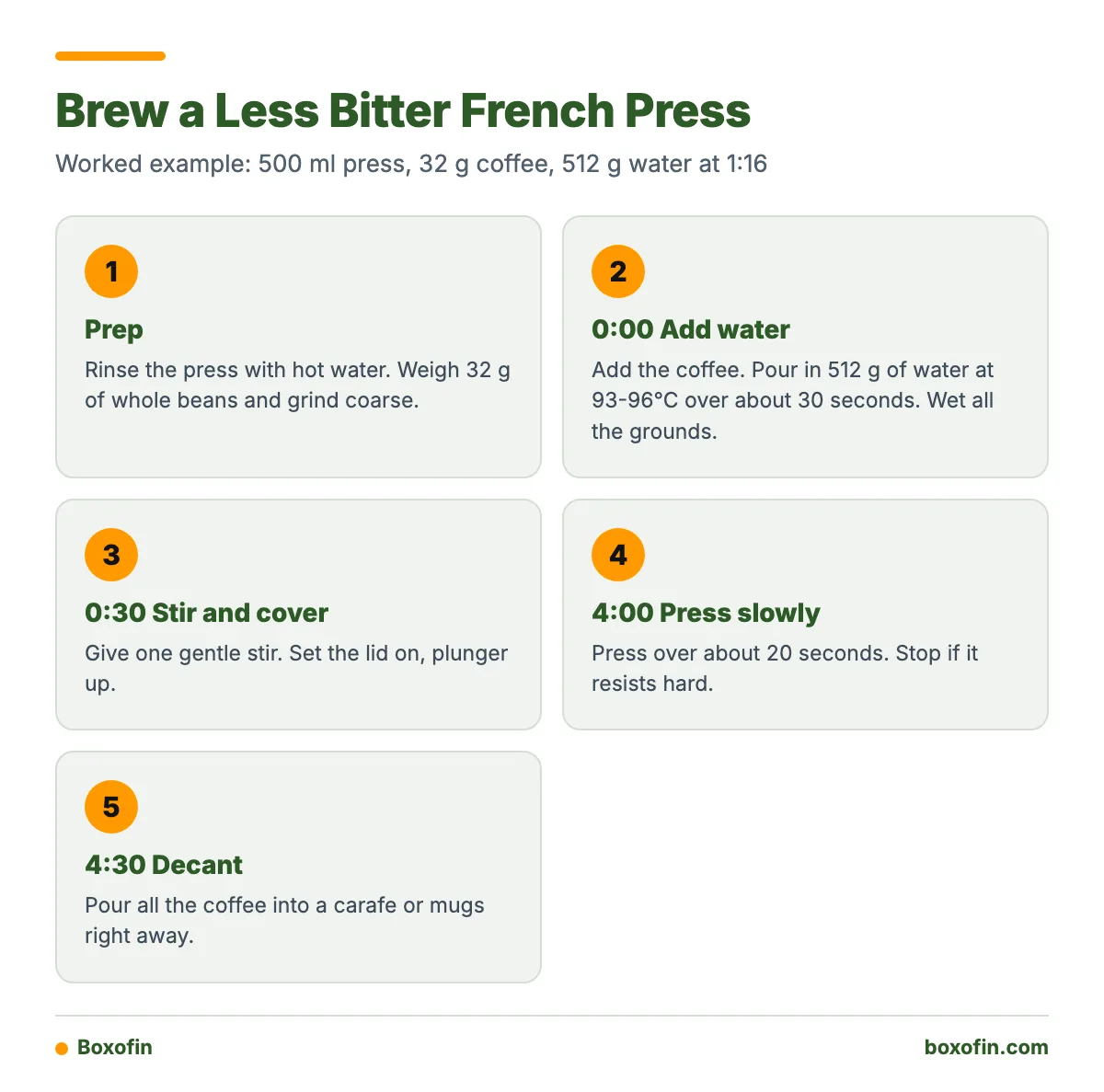
- Prep: Rinse the press with hot water. Weigh 32 g of whole beans and grind coarse.
- 0:00: Add the coffee. Pour in 512 g of water at 93-96°C over about 30 seconds. Wet all the grounds.
- 0:30: Give one gentle stir. Set the lid on, plunger up.
- 4:00: Press slowly over about 20 seconds. Stop if it resists hard.
- 4:30: Pour all the coffee into a carafe or mugs right away.
Adjust one thing at a time. If it is bitter, go coarser or stop at 3:30. If it is sour, go finer or run to 4:30.
Why does my French press coffee taste weak or watery?
Weak coffee is usually under-extracted or too diluted. The main causes are too little coffee, a grind that is too coarse, a steep that is too short, or water that is too cool.
Fix it in this order. First, add coffee and move from 1:17 toward 1:15. Next, grind one step finer. Then add 30 seconds to the steep. Check that the water was hot when it hit the grounds, since a cold beaker can pull the temperature down. Rinsing the press with hot water first helps.
One-variable tuning checklist
Changing three things at once tells you nothing. Use this list and change only one line per brew.
- Weigh coffee and water. Start at 1:16.
- Brew at 4:00 with water at 93-96°C.
- Taste after the cup cools a little. Write down the result.
- If bitter: grind one step coarser. Brew again.
- If still bitter: cut the steep by 30 seconds.
- If sour or weak: grind one step finer, then add 30 seconds.
- If it is thin but not sour: add coffee.
- Keep the setting that tastes best.
| Brew | Dose / water | Grind | Time | Taste notes |
|---|---|---|---|---|
| 1 | 32 g / 512 g | Setting __ | 4:00 | __ |
| 2 | __ | __ | __ | __ |
What do owners say?
Owners like
- A rich, full-bodied cup with oils that paper filters remove
- Simple to use, with no paper filters or electricity needed
- Forgiving once the grind and timing are dialed in
- Easy to make several cups at once
Common complaints
- Sludge and silt at the bottom of the cup
- A bitter or harsh cup with pre-ground or blade-ground coffee
- Coffee gets bitter if left sitting in the press
- The mesh filter is fiddly to clean and traps grounds
- Glass beakers can break, and the cup cools quickly
Summarised from owner reviews and long-term user reports; individual experiences vary.
Frequently Asked Questions
Why is my French press coffee bitter?
It is most likely over-extracted. Check the grind first and go coarser. Then check steep time, water temperature, and whether you decant right after pressing.
Why is my French press coffee so bitter even with a coarse grind?
A coarse setting on a blade grinder still makes fines. Water that is too hot, a dark roast, a long steep or coffee left in the press can also cause it. A dirty mesh filter with stale oils is another common culprit.
How to make French press coffee less bitter?
Grind coarser, steep for 4 minutes or less, use water at 93-96°C, and weigh your coffee at about 1:16. Pour all the coffee out right after pressing. Change only one variable per brew.
Why does my French press coffee taste weak?
The coffee is under-extracted or too diluted. Add more coffee, grind a step finer, or steep 30 seconds longer. Make sure the water is hot enough.
Why does my French press coffee taste so bitter and bad?
If it tastes bitter, see the over-extraction fixes above. If it tastes sour, flat or rancid instead, the cause is usually under-extraction, stale beans or a dirty filter. Use the diagnosis table to match the taste to the fix.
Why does my French press coffee taste bad or muddy instead of bitter?
Muddy coffee comes from too many fines and a hard plunge. Use a burr grinder, sieve out the dust, press slowly, and pour through a fine sieve if you want a cleaner cup.