
Most people treat a French press cold brew like hot coffee: fine grind, short wait, hard plunge. That gives you muddy, bitter coffee. Use coarse grounds and cold water instead, steep with the plunger up for 12 to 16 hours, then press slowly and pour off the brew.
Quick answer
A French press works well for cold brew. Mix coarse coffee with cold filtered water, steep in the fridge for 12 to 16 hours, press slowly, and strain again for a cleaner cup. Use 1:8 for concentrate or about 1:15 for ready-to-drink coffee.
- Best for strong iced drinks: 1:8 concentrate, diluted
- Best for drinking straight: about 1:15, no dilution
- Use coarse grounds, cold filtered water, and a 12 to 16 hour steep.
- 1:8 is a concentrate. About 1:15 is ready to drink. Do not mix them up.
- Press slowly, then filter again through paper or fine mesh to cut sediment.
- Your yield will be lower than the water you add, because grounds soak up liquid.
- Refrigerate and drink it soon. Homemade cold brew is not shelf-stable.
- Can you use a French press for cold brew?
- What coffee-to-water ratio should you use?
- How do you make cold brew in a French press?
- How long should it steep, and where?
- How do you press without sediment?
- How should you serve and dilute it?
- How long does it last?
- Troubleshooting
- What do owners say?
- Frequently Asked Questions
Can you use a French press for cold brew?
Yes, and it is one of the cheapest ways to do it. Cold brew is commonly made by soaking coarse-ground coffee in water for about 12 to 24 hours, then straining it. A French press is already a coarse-grind soaking vessel with a built-in strainer.
The plunger separates grounds from liquid in one move. You need no electricity and no special cold-brew maker. The weak spot is the metal filter, which lets fine particles through. We cover the fix below.
What coffee-to-water ratio should you use for French press cold brew?
Start with 1:8 by weight for concentrate, or about 1:15 for ready-to-drink coffee. Many recipes blur these two. The result is coffee that is far too strong, or far too weak.
| Style | Ratio | Coffee | Water | How to serve |
|---|---|---|---|---|
| Concentrate | 1:8 | 60 g | 480 ml | Dilute with water or milk |
| Ready to drink | about 1:15 | 40 g | 600 ml | Pour over ice, no dilution |
Should French press cold brew be a concentrate or ready to drink?
Pick concentrate if fridge space is tight and you like to adjust strength each glass. Pick ready to drink if you want to pour and go.
If you drink it with milk or lots of ice, then brew 1:8 concentrate.
If you drink it black and cold, then brew about 1:15.
If you are not sure, then start with 1:8 and dilute to taste.
Capacity check: how much will you actually get?
Ground coffee soaks up water. A common rule of thumb is about twice its weight. Grounds also float and swell, and the plunger needs room to move. As a planning guide, fill to about 80% of the press’s listed volume. The yields below use that rule at 1:8.
| Press size (listed) | Water | Coffee | Approx. concentrate after pressing |
|---|---|---|---|
| 350 ml (12 oz) | 280 ml | 35 g | about 210 ml |
| 600 ml (20 oz) | 480 ml | 60 g | about 360 ml |
| 1,000 ml (34 oz) | 800 ml | 100 g | about 600 ml |
These are estimates. Sediment and the liquid left in the grounds shave off a bit more, so plan for a little less than the table shows.
How do you make cold brew in a French press?
Grind, add water, stir, wait, press, filter. That is the whole method.
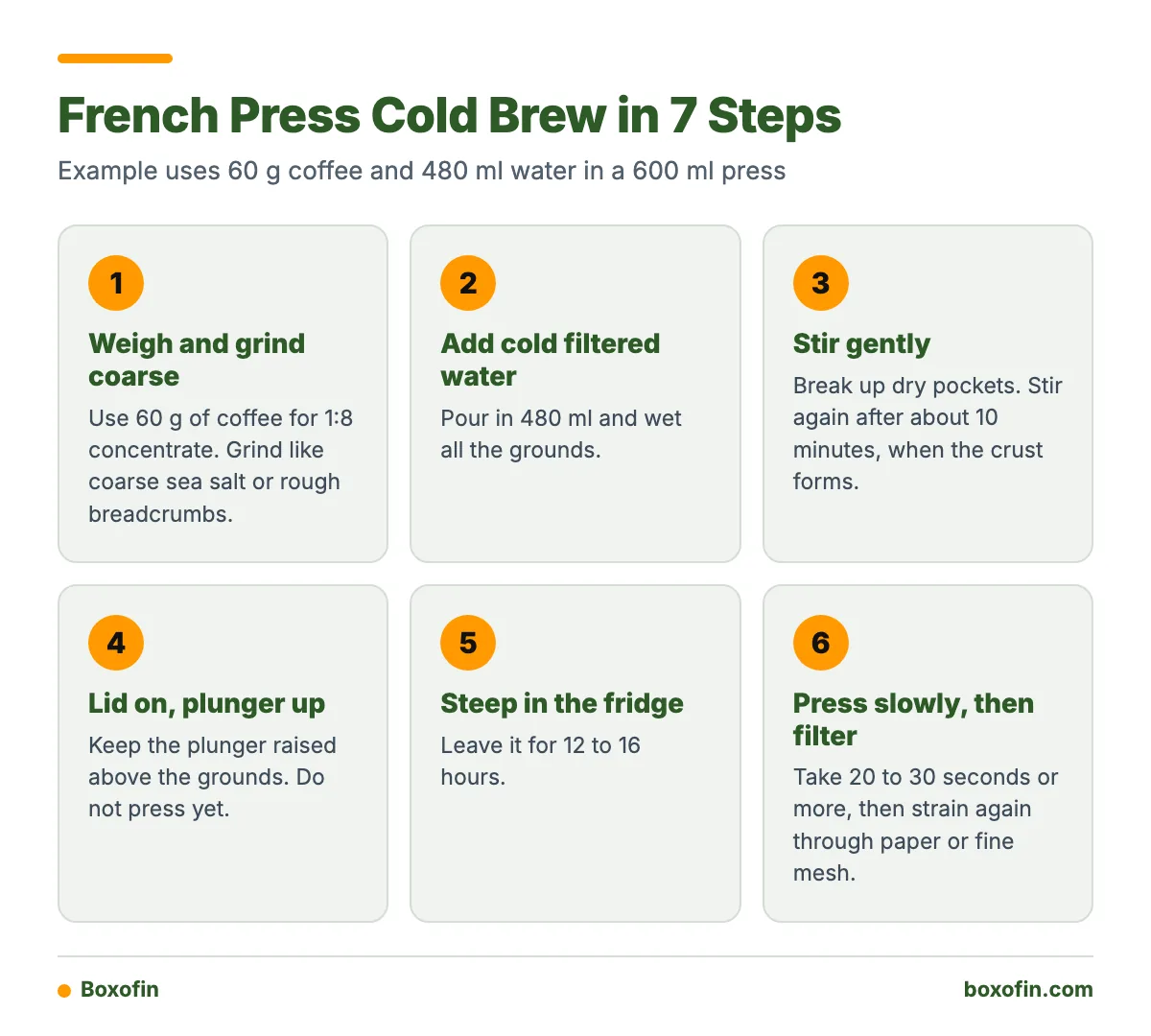
- Clean the press. Wash it and your hands first. Food-safety guidance for cold brew stresses clean hands and equipment.
- Weigh the coffee. Use 60 g for the 600 ml press and 1:8 concentrate.
- Grind coarse. Think coarse sea salt or rough breadcrumbs. Fine grounds slip through the mesh and over-extract.
- Add cold filtered water. Pour in 480 ml. Wet all the grounds.
- Stir gently. Break up dry pockets. Do this again after about 10 minutes, when the crust forms.
- Lid on, plunger up. Keep the plunger raised above the grounds. Do not press yet.
- Steep in the fridge. Leave it 12 to 16 hours.
- Press slowly, then strain. Details follow below.
How coarse should the coffee grounds be?
Coarse, the same setting you would use for hot French press coffee. If your grinder has a number scale, go to the coarsest or one step finer. Pre-ground “French press” coffee works too. Fresh whole beans ground just before brewing taste brighter.

How long should French press cold brew steep?
Most home recipes steep French press cold brew for roughly 12 to 16 hours. That is a good default. Go longer and you risk a woody, harsh taste, especially at 1:8.
Research is worth knowing here. A pilot study on cold brew definition, extraction, and evaluation found that extraction past about 7 hours was typically not necessary under its test conditions. Flavor and method vary, and many home brewers like the fuller taste of a longer steep. So treat 7 hours as the floor for a lighter cup, and 12 to 16 as the usual range.
Should cold brew steep in the refrigerator or at room temperature?
The refrigerator is the safer choice. Common French press recipes use the fridge for the full steep. Cold slows extraction a little, so stay near the 16 hour end if you brew chilled. Food-safety guidance also says to store cold brew in the refrigerator. A countertop steep is a bigger risk, so keep it short if you ever do it.
How do you press and filter the coffee without getting sediment?
Press slowly, taking 20 to 30 seconds or more, then pour through a second filter. The metal mesh of a French press can let fine particles through. A paper filter or fine mesh strainer catches them.
- Lower the plunger gently. A fast plunge stirs up the grounds and makes the brew gritty.
- Pour off steadily. Do not shake the press. Leave the last bit of muddy liquid behind.
- Filter again. A paper filter in a pour-over cone gives the cleanest cup. It is slow, so be patient. A fine mesh strainer is quicker but leaves a little more body.
Do not leave the grounds sitting in the press after pressing. Pour the coffee out right away, or it keeps extracting.
How should French press cold brew be served and diluted?
Serve ready-to-drink batches over ice. Dilute concentrate first. Here is a worked example: mix 240 ml of 1:8 concentrate with 240 ml water or milk. You get roughly 480 ml of serving-strength coffee, a 1:1 dilution.
Taste it, then adjust. Prefer it bolder? Use 2 parts concentrate to 1 part water. Ice melts and thins the glass, so go a bit stronger if you add a lot.
- Black: 1:1 with cold water, over ice.
- With milk: 1:1 with milk, or a little less milk for a stronger cup.
- Simple upgrade: Add a splash of vanilla syrup, or freeze coffee into ice cubes to avoid watering it down.

How long does homemade French press cold brew last?
Drink it soon. Research on cold brew recommends making it fresh and consuming it the same day when possible. The same study warns that longer storage can raise contamination risk and change the taste. Homemade cold brew is not processed like bottled coffee.
Food-safety reporting on pathogens in cold brew, including a Canadian Food Inspection Agency survey and a University of Georgia extension article, backs up the basics: clean equipment, cold storage, and prompt use.
- Pour the finished coffee into a clean, lidded jar or bottle. A glass press is awkward to fit in the fridge, so do not store it in the press.
- Keep it refrigerated at all times.
- Plan to finish a batch within a few days at most, and sooner is better. Toss it if it smells sour or off.
Troubleshooting weak, bitter, cloudy, or gritty cold brew
| Problem | Likely cause | Fix |
|---|---|---|
| Weak | Ratio too loose, grind too coarse, steep too short | Use more coffee, or steep closer to 16 hours |
| Too bitter or woody | Steeped too long, grind too fine | Cut steep time, grind coarser |
| Gritty | Fast press, fine grounds | Press slowly, filter again through paper |
| Cloudy | Fine particles, stirred sediment | Do not shake it, use a paper filter |
| Overly strong | Concentrate served undiluted | Dilute 1:1 or brew at about 1:15 |
What do owners say?
Owners like
- It uses equipment many people already own
- Preparation is simple, with no electricity or special cold-brew maker
- Large batches can be made at once
- The plunger makes separating grounds straightforward
- It produces a smooth, low-acidity-style coffee when brewed correctly
Common complaints
- Metal mesh filters let sediment and fine particles into the coffee
- Pressing too quickly disturbs grounds and makes the brew gritty
- Glass carafes can be awkward to store in a refrigerator
- Grounds and sediment reduce capacity, so the final yield is lower than the water volume
- Long steeping can taste overly strong or woody if the ratio is not adjusted
Summarised from owner reviews and long-term user reports; individual experiences vary.
Frequently Asked Questions
How to use French press cold brew?
Add coarse grounds and cold filtered water to the press, stir, and leave the plunger up. Steep in the fridge for 12 to 16 hours. Press slowly, strain again, and dilute if you made concentrate.
How to French press cold brew coffee?
Use about 60 g of coffee to 480 ml of water for concentrate, or 40 g to 600 ml for ready-to-drink coffee. Steep, press gently, and pour into a clean container. Keep it cold.
Can you use French press for cold brew?
Yes. A French press holds the grounds during the steep and separates them afterward. Add a paper or fine-mesh filter to catch the sediment the metal screen misses.
How to do French press cold brew?
Weigh your coffee, grind it coarse, add cold water, and stir. Refrigerate for 12 to 16 hours, then press slowly and filter. Store it in a lidded jar in the fridge and drink it soon.
How to French press cold brew?
Follow the same steps: coarse grind, cold water, long cold steep, slow press, second filter. Choose 1:8 for a concentrate you dilute, or about 1:15 for coffee you drink as is.
Sources