An induction range is an electric range that heats magnetic cookware with an electromagnetic field, while a gas range burns natural gas or propane in an open flame. If you are a homeowner or renter picking a new range, the short answer is this: induction is faster, more efficient and easier to clean, but it needs compatible pots and a 240-volt circuit. Gas works with almost any pot and needs a gas line.
- An induction range is electric. It does not use gas.
- “Induction gas range” is a mixed-up term. You buy one or the other.
- Induction cookware works on gas. Gas-only cookware, like aluminum or copper, often does not work on induction.
- Most gas kitchens lack the 240-volt circuit an induction range needs.
- Induction boils water faster and wastes less heat. Gas gives you a live flame and works in a power outage for the burners.
What “Induction Gas Range” Really Means
People search for “induction gas range,” “induction gas stove” and “induction gas cooker” all the time. These phrases mash two different technologies together. Induction and gas are separate ways to cook. No range is both.
| Term you see | What it usually means |
|---|---|
| Induction gas range / stove | A mistake. Most often it means an induction range (electric) or a gas range. |
| Induction cooker | A portable single or double induction burner that plugs into an outlet. |
| Induction range | A freestanding or slide-in range with induction burners and an electric oven. |
| Dual fuel range | Gas burners on top, electric oven below. This is the real “mix” of the two. |
So, is an induction range gas or electric? Electric. Does an induction range use gas? No.
How Each Range Heats Food
A gas burner lights a flame. The flame heats the pot, and the pot heats the food. Plenty of heat escapes around the pot into your kitchen.
An induction burner has a copper coil under a glass-ceramic surface. When you turn it on, the coil creates a magnetic field. That field makes the metal in a compatible pan produce heat itself. The glass does not heat directly. It only warms from the hot pan sitting on it. That is why the surface cools fast once you lift the pot.
Side-by-Side Comparison
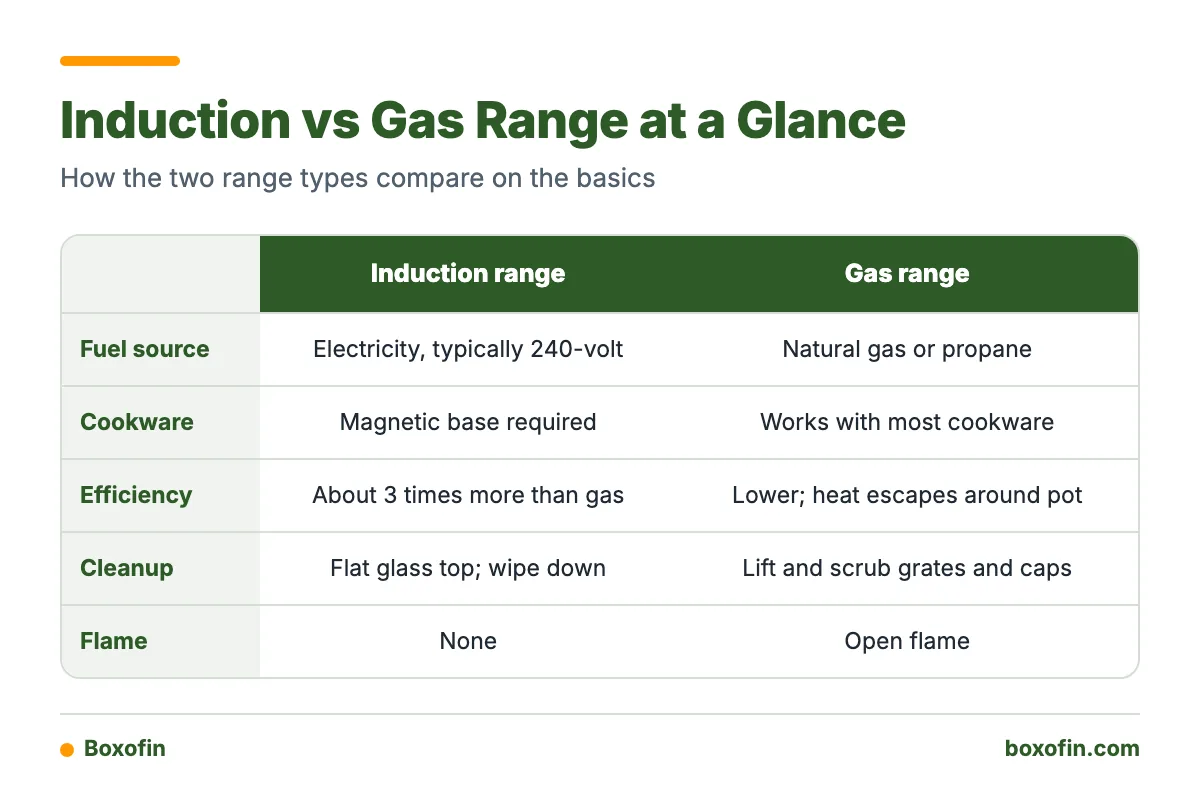
| Feature | Induction range | Gas range |
|---|---|---|
| Fuel source | Electricity, typically a 240-volt line | Natural gas or propane |
| Cookware | Magnetic base required | Works with most cookware |
| Speed | Very fast; water can boil 20 to 40 percent faster than on even strong gas burners in some testing | Fast, but slower than induction on most pots |
| Efficiency | About three times more efficient than gas, per common consumer guidance | Lower; much heat escapes around the pot |
| Cleanup | Flat glass top; wipe down | Grates and burner caps to lift and scrub |
| Flame | None | Open flame |
| Installation | Needs the right circuit | Needs a gas line and venting |
Cookware: What Works on Which
Induction only heats pans a magnet will grab. Cast iron, enameled cast iron and many stainless steel pans work. Pure aluminum, copper and glass do not, unless they have a magnetic plate in the base.
The magnet test
Hold a magnet to the bottom of the pot. If it sticks strongly, the pot will work on induction. A weak pull often means weak or uneven heating.
Can induction cookware be used on a gas range?
Yes. Gas does not need magnetic cookware, so pots labeled for induction work fine on a gas stove. The same goes for the question “can induction vessels be used on gas stove?” They can. Just check that flat-bottom pans sit steadily on the grates.

Kitchen Hookups You Need
This is where many buyers get surprised. Gas ranges need natural gas or propane service. Induction ranges run on electricity and typically need a 240-volt line. Most kitchens set up for gas do not already have the right circuit.
- Kitchen has a gas line and no 240-volt outlet: Gas is the easy swap. Induction means hiring an electrician.
- Kitchen has a 240-volt outlet and no gas: Choose induction or a standard electric range.
- Kitchen has both: Pick by cooking style and cookware.
- Renting: Check your lease before any wiring or gas work. A portable induction cooker needs only a standard outlet and avoids that.
Have an electrician confirm the circuit size listed in the manual of the exact model you choose.
Performance, Efficiency and Air Quality
Speed and control
Induction heats and cools quickly. Turn the dial down and the heat drops almost at once. Many models hold very low temperatures well, which helps with sauces and melting chocolate. Gas gives you a visible flame, so many cooks judge heat by eye. Charring peppers or toasting a tortilla over a flame is easy on gas and not possible on induction.
Efficiency and heat
Consumer guidance puts induction at about three times more efficient than gas. Less wasted heat means a cooler kitchen in summer. The U.S. Department of Energy’s guide to induction covers the switch in more detail.
Safety and air
Gas burners release combustion byproducts into the room, so run the vent hood every time. Induction makes no flame and no combustion fumes. The surface still gets hot from the pan, so treat it with care. Some people with pacemakers are told to keep distance from induction fields, so ask a doctor if that applies to you.
From the Shop
Buyers frequently mention two surprises after switching to induction: a faint fan or buzzing noise on some pans, and the need to replace a few old pots. Both are common and usually minor. Cookware that fails the magnet test is the bigger cost.
Cost and a Worked Example
Prices change by brand and features, so check current listings. As a general pattern, induction ranges tend to cost more up front than basic gas ranges, though the gap has narrowed in mid-range models. The bigger swing is installation.
Here is a simple worked example for a home that has gas today and wants induction:
| Cost item | Stay with gas | Switch to induction |
|---|---|---|
| New range | Gas range price | Induction range price (often higher) |
| Electrical work | None | Possible new 240-volt circuit by an electrician |
| Gas line | Already in place | Unused; may be capped |
| Cookware | Keep current pots | Replace any that fail the magnet test |
| Running cost | Gas bill | Electric bill, but with less wasted heat |
Add up each line with real quotes. A home that already has a 240-volt outlet near the range may switch with little extra cost. One that needs a new circuit may not. Consumer Reports shares lessons from one gas-to-induction switch worth reading before you start.

Which Should You Choose?
Which is better, induction or gas range? Neither wins for everyone. Match the range to your kitchen and habits.
- Choose induction if you want fast boiling, easy cleanup, a cooler kitchen and no combustion fumes, and you have or can add the circuit.
- Choose gas if you love open-flame cooking, own lots of non-magnetic pans, or cannot add a 240-volt line.
- Renters: keep the existing range, or try a portable induction cooker first.
- Remodelers: plan the hookup before you buy. Running a new circuit is easiest while walls are open.
First-Time Buyer Checklist
- Check what hookup sits behind your current range: gas, 240-volt or both.
- Test every pot with a magnet.
- Measure the cutout width, usually 30 inches for standard ranges.
- Confirm venting and hood strength.
- Read the manual for circuit and clearance requirements.
- Get written quotes for any electrical or gas work.
- Compare models in the KitchenAid induction vs. gas comparison and other buying guides.
Frequently Asked Questions
What is an induction gas range?
It is not a real product category. The phrase mixes two different types. You likely want either an induction range (electric) or a gas range. A dual fuel range pairs gas burners with an electric oven.
What is induction gas stove?
Same confusion. An induction stove is electric and heats magnetic pans with a magnetic field. A gas stove burns gas. People who search this often mean induction cooktops.
What is induction gas cooker?
Usually it means a portable induction cooker. It plugs into an outlet and uses no gas.
Can induction cookware be used on gas range?
Yes. Gas heats any sturdy pan, including magnetic ones.
Can induction vessels be used on gas stove?
Yes. Induction-ready vessels work on gas. The reverse is not always true, since non-magnetic pots fail on induction.
Is induction range gas or electric?
Electric. It runs on a 240-volt connection in most homes.
Does induction range use gas?
No. It needs no gas line at all.