Hand-wash a French press with warm water and mild dish soap unless the manual clearly says a part is dishwasher safe. Remove the grounds first, take the plunger apart, rinse every piece, then wash, rinse again and let everything dry. It takes a few minutes and keeps old coffee oils from spoiling your next cup.
Quick answer
Scrape out the grounds, disassemble the plunger, rinse all parts, wash with warm water and mild dish soap, rinse well, and air dry. When the manual is unclear, hand-wash.
- Best for daily use: the two-minute checklist below
- Best for oily film or odors: a weekly deep clean
- Best when unsure about the dishwasher: hand washing
- Never pour wet grounds straight down the sink. They build up and clog drains.
- Take the plunger apart every time so the layered filter gets rinsed, not just the visible mesh.
- Mild dish soap is the safe default unless the manufacturer says otherwise.
- Dishwasher safety differs by part: glass, frame, lid, seals and finish are not all treated the same.
- Do a quick clean after every use and a deeper clean when you see film, smell staleness, or feel grit.
- How do you clean a French press after use?
- How should you remove wet coffee grounds without clogging the sink?
- How do you clean the French press filter and plunger?
- Can you wash a French press with soap?
- Can you wash a French press in the dishwasher?
- How do you remove coffee oils, stains, and odors?
- How often should you clean a French press?
- How should you dry and reassemble a French press?
- Is a French press hard to clean?
- What do owners say?
- Frequently Asked Questions
How do you clean a French press after use?
Remove the grounds, rinse, disassemble, wash, rinse again, dry and reassemble. A routine clean takes about 2-3 minutes. Standard cleaning guides, such as this step-by-step French press cleaning guide, follow the same order.
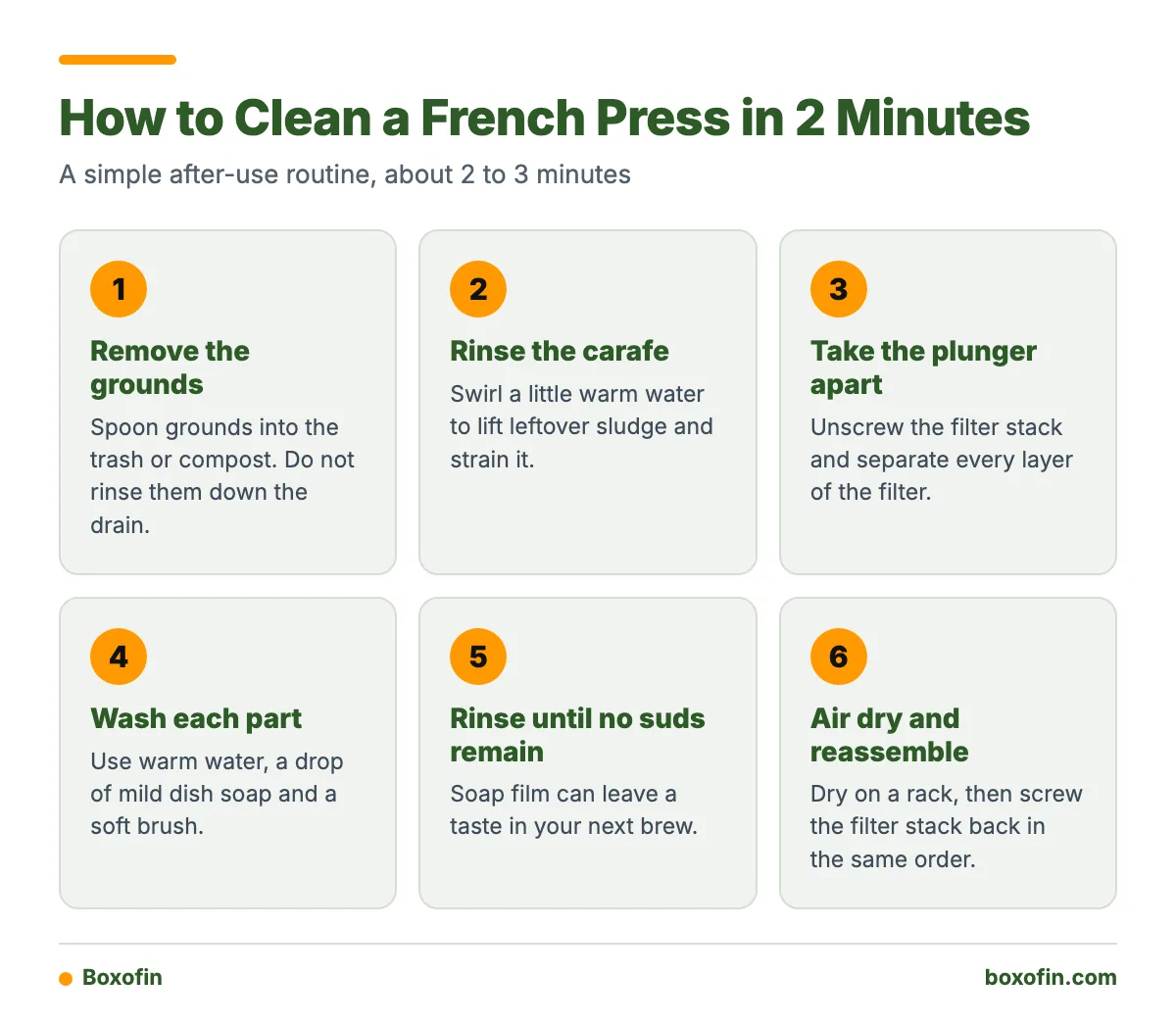
Two-minute after-use checklist
- Pull out the plunger and lid.
- Remove the grounds (see the next section).
- Rinse the carafe and filter with warm water.
- Unscrew and separate the filter parts.
- Wash each part with warm water and a drop of mild dish soap.
- Rinse until no suds remain.
- Dry on a rack, then reassemble.
How should you remove wet coffee grounds without clogging the sink?
Scoop them into the trash or compost instead of rinsing them down the drain. Used grounds can accumulate in pipes and clog drains.
Here is a low-mess method:
- Spoon out the thick layer with a silicone spatula.
- Add a little water to the carafe and swirl to lift the leftover sludge.
- Pour that slurry through a small mesh strainer set over a bowl or compost bin.
- Tap the strainer out, then rinse the carafe in the sink.

How do you clean the French press filter and plunger?
Unscrew the plunger and separate every layer of the filter. Coffee hides between the mesh screen, the spring plate and the cross plate. Owners often report that grounds trapped behind filters make cleanup fiddly, and rinsing only the visible mesh leaves that coffee behind.
- Unscrew the rod or base to release the filter stack.
- Note the order of the pieces so you can rebuild it.
- Rinse each piece under warm running water, then scrub gently with a soft brush.
- Check the mesh by holding it up to the light. Blocked holes will show.
Can you wash a French press with soap?
Yes, mild dish soap is the recommended choice unless the manufacturer says otherwise. Use warm water, a small drop of soap and a soft sponge or bottle brush. Rinse thoroughly, because soap film can leave a taste in the next brew.
Should you clean a French press with soap after every use?
No. A hot-water rinse and disassembly after every use is the minimum. Add soap when the press feels oily, or when you finish for the day. Many owners use soap daily, and that is fine if you rinse well.
Can you wash a French press in the dishwasher?
Sometimes. Some models and components are dishwasher safe, while frames, lids, insulated bodies, seals and painted finishes may need hand washing. Follow the manufacturer’s instructions. If they are unclear, hand-wash.
| Component | Hand-wash | Dishwasher | Caution |
|---|---|---|---|
| Glass carafe | Yes | Only if the maker allows it | Can chip or break when it hits dishes or racks, so secure it |
| Stainless steel body | Yes | Check the manual | Insulated bodies often need hand washing |
| Plastic parts | Yes | Top rack, if allowed | Heat can warp thin pieces |
| Mesh filter | Yes, with a brush | Check the manual | Grounds can stay trapped in layers |
| Seals and gaskets | Yes | Usually avoid | May wear faster; remove if possible |
| Painted or coated frame | Yes | Usually avoid | Finish may fade or peel |
Glass carafes can break against other dishes or hard surfaces, in the dishwasher or on the drying rack, so place them carefully.

How do you remove coffee oils, stains, and odors?
Use a deeper clean when warm water and soap are not enough. Mix a little baking soda with water into a paste, scrub the carafe and filter parts gently, then rinse until the water runs clear. Check your manual before using vinegar or soaking coated parts.
| Problem | Likely cause | Fix |
|---|---|---|
| Gritty coffee | Grounds stuck behind filter layers | Disassemble fully and brush each piece |
| Stale odor | Old oils or damp parts | Baking soda scrub, rinse, dry fully |
| Oily film | Soap-free rinsing only | Wash with warm water and mild dish soap |
| Blocked mesh | Fine grounds in the holes | Rinse backward and use a soft brush |
| Water trapped in lid | Lid not taken apart | Separate lid parts, shake out, air dry |
Worked example: a standard glass press
Pour out the coffee, spoon out the grounds, and swirl a little water through a strainer (30 seconds). Unscrew the filter and rinse the pieces (30 seconds). Wash the carafe and parts with warm soapy water (45 seconds). Rinse, then set everything on a rack (15 seconds). Stainless-steel and insulated models follow the same steps, but check the dishwasher rules first, and avoid scratching the inner wall.
How often should you clean a French press?
Do a quick clean after every use and a deeper clean about once a week if you brew daily. Clean sooner when you see an oily film, smell staleness or notice more grit in the cup.
How should you dry and reassemble a French press?
Let each part air dry fully, then screw the filter stack back in the same order. Trapped moisture can leave a musty smell. Store the plunger loosely seated so air can circulate.
Is a French press hard to clean?
Not really. It has few parts, but the layered filter can be fiddly. Once you take it apart each time, the job becomes quick.
What do owners say?
Owners like
- Simple daily cleanup when the plunger and filter are easy to disassemble
- Double or multi-layer filters that reduce sediment in the cup
- Stainless-steel models that avoid the fragility of glass
- Dishwasher-safe components that make routine washing quicker
Common complaints
- Coffee grounds trapped behind or inside multi-layer filters
- Fiddly plunger and mesh hardware that requires disassembly
- Glass carafes breaking after contact with dishes, racks, or hard surfaces
- Tight filters or airlocks that make plunging and cleaning more difficult
- Fine sediment remaining in the cup with standard mesh filters
Summarised from owner reviews and long-term user reports; individual experiences vary.
Frequently Asked Questions
How do you clean a French press?
Remove the grounds, take the plunger apart, rinse every part, wash with warm water and mild dish soap, rinse again and let it dry.
How to clean a French press filter?
Unscrew the filter stack, separate each layer, rinse under warm water and brush gently. Check that the mesh holes are clear before you reassemble.
Is a French press hard to clean?
No, but the layered filter takes a minute to disassemble. Many owners find that step the most fiddly part.
How often should you clean a French press?
Rinse and disassemble it after every use. Do a deeper clean weekly, or sooner if you notice film, odor or grit.
Can you wash a French press in the dishwasher?
Only if the manufacturer says so for that part. Frames, lids, insulated bodies, seals and painted finishes often need hand washing. Secure glass so it cannot knock against other items.
Can you wash a French press with soap?
Yes. Use mild dish soap and warm water unless the manufacturer says otherwise, and rinse thoroughly so no soap taste remains.