The Ninja food-processor bowl with its stacked chopping blade is the right tool for chopping, and short pulses are the right technique. Cut food into small, even pieces, fill the bowl only partway, and tap the pulse button instead of holding it down. A standard pitcher can chop in small batches, but the results are less even.
Quick answer
Use the food-processor bowl and chopping blade. Cut food into 1-inch pieces, fill the bowl about one-third to one-half full, and pulse in 1-second bursts, checking often. Stop when the pieces look right.
- Best for onions, salsa, nuts: food-processor bowl
- Best for a small handful of herbs: single-serve cup
- Best when you have no bowl: pitcher, small batches
- The processor bowl chops more evenly than a pitcher.
- Pulse for about 1 second at a time. Never hold the button.
- Underfilled bowls often chop unevenly, based on owner reviews.
- Add liquid only when you want a sauce, not chunks.
- Hold the blade by the shaft. It is extremely sharp.
- Which Ninja attachment should I use for chopping?
- Can I chop vegetables in a regular Ninja blender pitcher?
- How full should the Ninja bowl or pitcher be?
- How long should I pulse a Ninja blender when chopping?
- How do I chop onions without making onion puree?
- Worked example: chunky salsa
- Should I add water or oil when chopping?
- Why does my Ninja blender chop unevenly?
- How do I safely remove and clean the chopping blade?
- What do owners say?
- Frequently Asked Questions
Which Ninja attachment should I use for chopping?
Use the food-processor bowl with the stacked chopping blade if your model includes one. Its wide, shallow shape keeps food near the blades, so pieces stay more uniform than in a tall pitcher.
| Part | Best foods | Expected texture | Liquid needed? |
|---|---|---|---|
| Food-processor bowl | Onions, peppers, salsa, nuts, breadcrumbs | Most even, from coarse to fine | No |
| Single-serve cup | Herbs, garlic, small handfuls | Fine to mixed | Rarely |
| Full pitcher | Small batches of soft vegetables | Uneven, easy to over-process | Sometimes, for sauces |
Can I chop vegetables in a regular Ninja blender pitcher?
Yes, with limits. A pitcher is tall and narrow, so food near the top may stay uncut while the bottom turns to mush. Use small batches of about one to two cups, pulse briefly, and shake or stir between bursts. Expect less even results than with the processor bowl.

How full should the Ninja bowl or pitcher be?
Fill the bowl about one-third to one-half full, and never past the max line. Owner reviews repeatedly mention uneven chopping when the bowl is underfilled or the food sits in one clump. A tiny load just bounces around. A packed bowl leaves the top layer untouched.
Prep matters too. Cut food into roughly 1-inch pieces of similar size. Large chunks jam the blade. Mixed sizes give mixed results.
How long should I pulse a Ninja blender when chopping?
Start with 1-second pulses. Open the lid after every few pulses and look. Short bursts let food fall back onto the blade between cuts. Holding the button spins food into a wet paste fast.
| Food | Starting pulses | Check at |
|---|---|---|
| Onion | 3 to 5 one-second pulses | After 3 |
| Salsa vegetables | 4 to 6 one-second pulses | After each 2 |
| Nuts | 5 to 8 one-second pulses | After 4 |
| Herbs | 2 to 4 short pulses | After 2 |
These are starting points, not fixed rules. Motors and blade shapes differ by model, so adjust as you watch.
How do I chop onions without making onion puree?
Quarter the onion, pulse in 1-second bursts, and stop while a few pieces still look too big. Onions are full of water, so they turn to liquid quickly. Pulse, scrape, pulse again. Chop only one or two onions at a time.
From the Shop
Think of the blade like a knife that works fast. If you can see pieces, stop. Once juice pools at the bottom, you have gone too far and cannot undo it.
Worked example: chunky salsa
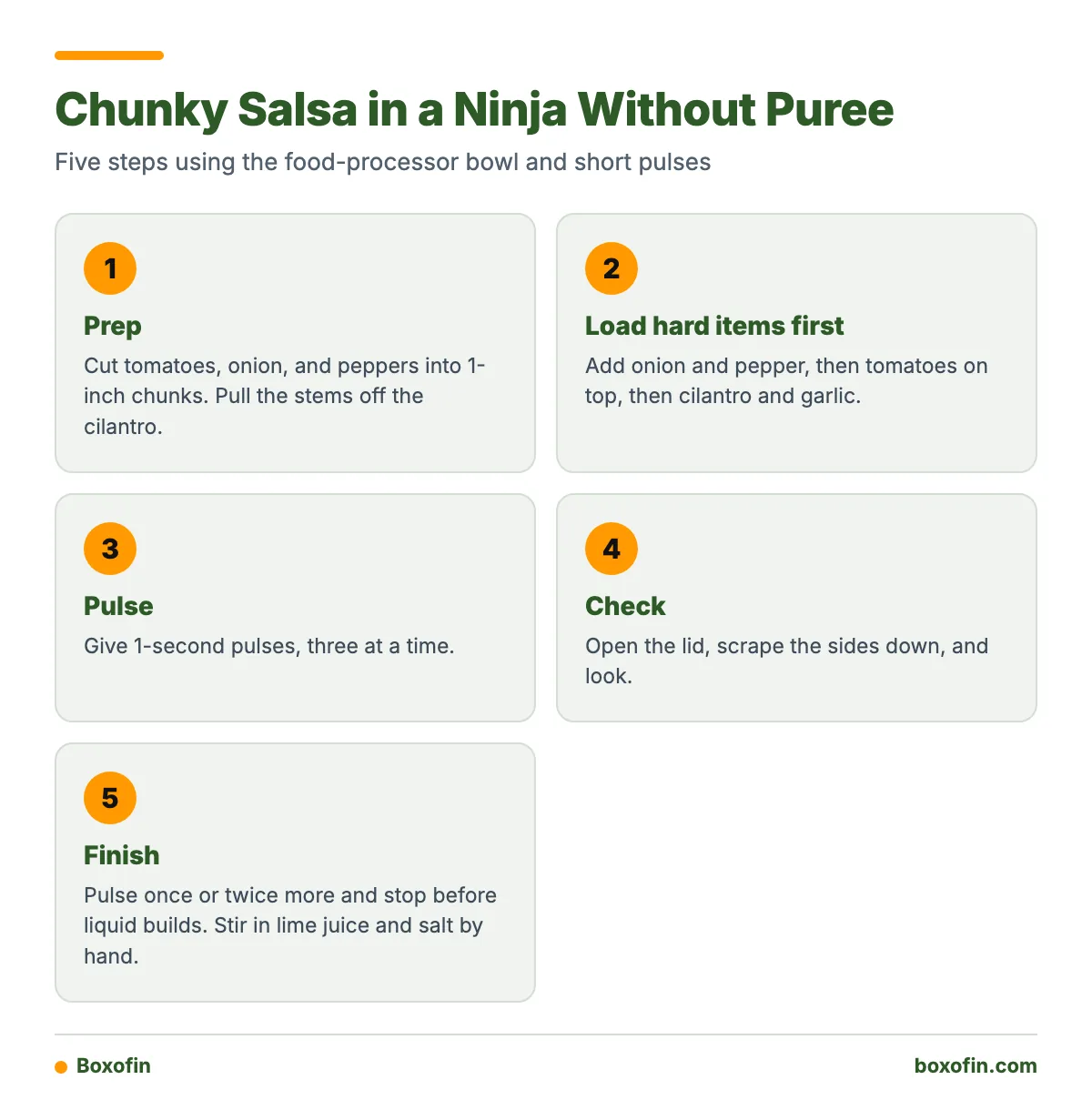
- Prep: Cut tomatoes, onion, and peppers into 1-inch chunks. Pull the stems off the cilantro.
- Load hard items first: Add onion and pepper to the bowl, then tomatoes on top, then cilantro and garlic.
- Pulse: Give 1-second pulses, three at a time.
- Check: Open the lid, scrape the sides down, and look.
- Finish: Pulse once or twice more. Stop before liquid builds. Stir in lime juice and salt by hand.

Should I add water or oil when chopping?
Skip it for chopping. Liquid lifts food off the blade and pushes it toward a puree. Add oil or water only when you want a sauce, like pesto. Add it a little at a time, after the solids are already chopped.
Can a Ninja blender chop nuts, herbs, garlic, and meat?
Owner reports say the food-processor attachment handles chopped nuts, pesto, and breadcrumbs. Nuts need short pulses, or they turn to butter. Garlic and herbs do best in the small cup or alongside other ingredients. For meat, check your manual first, and chill it and cut it small. Ninja does not state meat limits in the brief, so follow your model’s guidance.
Why does my Ninja blender chop unevenly?
The usual causes are a bowl that is too empty, a bowl that is too full, or pieces that vary in size. Use this checklist.
| Problem | Likely cause | Fix |
|---|---|---|
| Puree | Long pulses, too much liquid | Use 1-second pulses, drop the liquid |
| Uneven pieces | Mixed sizes, tiny load | Cut evenly, add more food |
| Food stuck to sides | Wet or sticky load | Stop, scrape, redistribute |
| Top layer uncut | Overloaded bowl | Split into two batches |
| Blade jams | Huge or hard chunks | Cut smaller, remove some food |
How do I prevent ingredients from sticking to the sides?
Unplug or power off, open the lid, and scrape down with a spatula. Never reach in with the blade in place. Do this every few pulses.
How do I safely remove and clean the chopping blade?
Owners describe the stacked blades as extremely sharp, so treat them like a knife. Unplug the unit first. Take off the lid, then lift the blade out by its center shaft, keeping fingers away from the edges. Do this before you empty the bowl, so you never dig around a hidden blade.
- Lock the lid fully before pulsing. Some models are tricky to align, so listen for the click.
- Wash the blade with a long-handled brush, not your hand.
- Check seals, lids, and bowls for cracks and wear. Replace damaged parts.
What do owners say?
Owners like
- Strong motor power for vegetables, herbs, ice, frozen fruit, salsa, pesto, and breadcrumbs
- Convenient multi-purpose food-processor and blender attachments
- Easy cleanup compared with some conventional blenders
- Useful for quick chopping, mincing, and dicing
- Some owners report years of regular use without major problems
Common complaints
- The machine is very loud during operation
- Some food-processor attachments chop unevenly, especially with small or poorly distributed loads
- Pitchers, bowls, seals, spindles, or lids may crack, wear, or need replacement
- Blades are exceptionally sharp and can cause cuts during washing or unpacking
- Some models can be difficult to align or lock before operation
Summarised from owner reviews and long-term user reports; individual experiences vary. You can read more buyer feedback in these Ninja BN801 owner reviews at Lowe’s.
Frequently Asked Questions
Which Ninja attachment should I use for chopping?
Use the food-processor bowl with the stacked chopping blade. It gives the most even pieces. The small cup works for herbs and garlic.
Can I chop vegetables in a regular Ninja blender pitcher?
You can, in small batches with brief pulses. Results are less even than in the processor bowl.
How long should I pulse a Ninja blender when chopping?
Start with 1-second pulses and check the food after every few. Stop once the pieces reach the size you want.
Should I add water or oil when chopping?
No, not for chunky results. Liquid pushes food toward puree. Add it only for sauces, and only after chopping.
Why does my Ninja blender chop unevenly?
Common reasons are an underfilled or overfilled bowl, mixed piece sizes, and food clumped in one spot. Cut evenly, fill the bowl one-third to one-half, and scrape the sides between pulses.
How do I safely remove the Ninja chopping blade?
Unplug the unit, remove the lid, and lift the blade by its center shaft. Keep fingers away from the edges, and take the blade out before emptying the bowl.