A full-size Ninja pitcher suits families, ice, and frozen drinks, while a 24-ounce personal cup suits one smoothie at a time. Pick by use case first, then check capacity, blade setup, and cleaning. If your Ninja already won’t work, test power, seating, lid alignment, and blockage before you blame the motor.
Quick answer
Choose the Ninja that matches your usual batch, not the biggest number on the box. Full-size pitchers handle family batches and ice. Personal cups handle single servings. Kitchen systems add chopping and dough.
- Best for families: 72-ounce pitcher
- Best for one person: 24-ounce personal cup
- Best for cooks: food-processor system
- Decide on batch size and recipes before you compare watts.
- A 72-ounce pitcher can have a 64-ounce maximum liquid capacity. Plan around the lower number.
- Portable models need extra caution with thick or frozen mixtures and battery life.
- When a Ninja won’t run, check outlet, seating, lid, blade blockage, ingredient order, liquid, and overload, in that order.
- Owner reports are mixed on durability. Expect leaks, cracked lids, and hard-to-clean corners on some units.
- How do I choose the right Ninja blender for my needs?
- Ninja blender types compared
- What Ninja blender capacity do I need?
- Is a higher wattage Ninja blender always better?
- Which Ninja blender is best for smoothies and frozen fruit?
- Three real-world examples
- Are Ninja blender parts dishwasher-safe and easy to replace?
- How do I get my Ninja blender to work when it will not start?
- Why isn’t my Ninja blender blending?
- Why does my Ninja blender stop or jam with frozen fruit?
- Noise, storage, warranty, and long-term cost
- Model-selection checklist
- What do owners say?
- Frequently Asked Questions
How do I choose the right Ninja blender for my needs?
Start with what you blend most often and how many people you serve. Then match that to a pitcher, a personal cup, a portable bottle, or a kitchen system.
Ask these questions in order:
- How many servings do you make at once?
- Do you blend ice and frozen fruit daily?
- Do you need to chop, process, or mix dough?
- Will you carry the blender with you?
- How much cleaning effort will you tolerate?
Ninja blender types compared
Ninja sells four broad styles. Based on the specifications and listings, they differ most in batch size, portability, and extras. Figures below come from the manufacturer’s listings cited in this guide. Where none is given, check the product page.
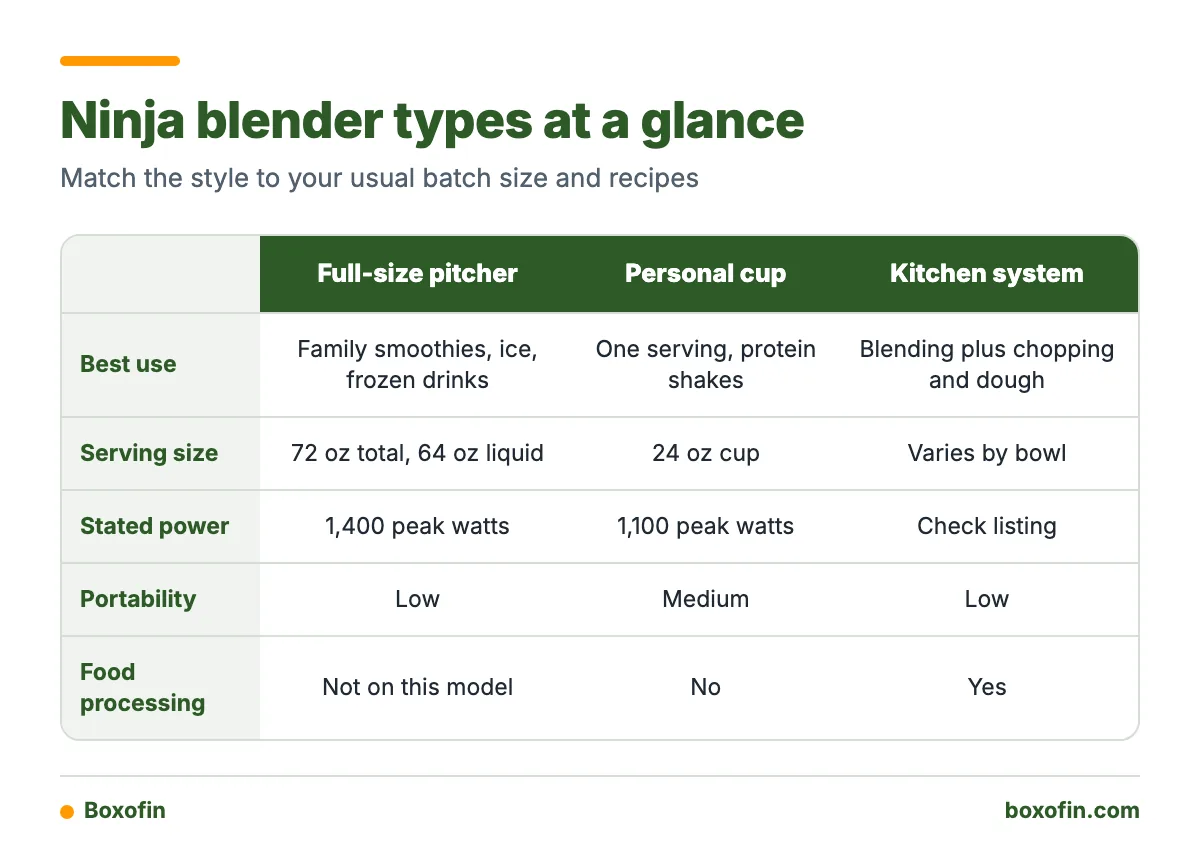
| Type | Best use | Serving size | Stated power | Container | Portability | Food processing | Cleaning | Likely drawbacks |
|---|---|---|---|---|---|---|---|---|
| Full-size pitcher (e.g., BN701) | Family smoothies, ice, frozen drinks | 72 oz total, 64 oz liquid | 1,400 peak watts | Large pitcher | Low | Not on this model | Blade stack and lid need care | Bulky, louder, seals can leak |
| Personal (e.g., Nutri Blender Pro) | One serving, protein shakes | 24 oz cup | 1,100 peak watts | Single-serve cup | Medium | No | Small parts, quick rinse | Small batch only |
| Portable, cordless | Travel, gym, office | Single bottle | Check listing | Bottle | High | No | Easy to rinse | Battery and thick-mix problems |
| Kitchen system | Blending plus chopping and dough | Varies by bowl | Check listing | Pitcher plus bowl | Low | Yes | More parts | More parts to store and wash |

What Ninja blender capacity do I need?
Pick capacity by usable liquid volume, not the number printed on the pitcher. The Ninja Professional Plus BN701 is advertised as a 72-ounce pitcher with a listed maximum liquid capacity of 64 ounces.
Here is a simple batch calculation:
- One personal cup: 24 ounces for one serving.
- One full pitcher of liquid: 64 ounces.
- 64 ÷ 24 = about 2.7 personal cups.
- If each person drinks 16 ounces, 64 ÷ 16 = 4 servings.
So a household of one or two rarely needs the pitcher. A family of four often does. Remember that ice, fruit, and greens take up room too, so the fill line matters.
Is a higher wattage Ninja blender always better?
No. Wattage is only one piece. The BN701 lists 1,400 peak watts and a personal Nutri Blender Pro lists 1,100 peak watts, but the gap in what they can do comes mostly from container size, blade configuration, and the recipe.
Peak watts describe a short burst, not steady output. A big motor will still struggle if you overload the pitcher or skip the liquid.
Which Ninja blender is best for smoothies and frozen fruit?
For daily frozen-fruit smoothies, a full-size pitcher with a crushing blade setup is the safer pick, and a personal cup works well for single servings. Owner reviews repeatedly praise Ninja blenders for ice, frozen fruit, smoothies, and protein powder.
Other uses shift the choice:
- Ice and frozen drinks: full-size pitcher.
- Soups: check that your model’s manual allows hot liquids.
- Nut butters and smoothie bowls: thick mixes strain any motor, so pick a model with a tamper or food-processor bowl if you can.
- Chopping and dough: kitchen system.
How much liquid should I add to a thick smoothie or smoothie bowl?
Start with enough liquid to cover the bottom blades, then add more if the mix stops moving. Add a little at a time. Use the maximum fill line as a hard limit. Smoothie bowls need less liquid, so blend in small batches and use pulse.
Three real-world examples
If you make one smoothie a day: choose a 24-ounce personal cup. It rinses fast and fits small counters.
If a family makes frozen drinks: choose the 72-ounce class. Plan on 64 ounces of liquid per batch, about four 16-ounce servings.
If you cook as much as you blend: choose a kitchen system with a food-processor bowl for chopping and dough.
Are Ninja blender parts dishwasher-safe and easy to replace?
Many removable parts are marked dishwasher-safe, but this varies by model, so check your manual before loading anything. Blade assemblies are sharp. Handle them by the base.
Owners often mention that food collects in corners and around blades, and that seals and lids can crack or leak. Replacement parts are sold for many models, but a leaking container sometimes means replacing the whole container. Check part availability before you buy.

How do I get my Ninja blender to work when it will not start?
Check the safety lock first. Most Ninjas will not run unless the container and lid are seated correctly. Follow this order:
- Outlet and power: plug into a different outlet and check the cord.
- Container seating: remove it, line it up, and press it down until it settles.
- Lid alignment: turn the lid until it locks fully.
- Blade blockage: unplug, then check for stuck fruit or ice.
- Ingredient order: liquid first, soft items next, ice and frozen items last.
- Liquid level: add liquid if the mix is a solid block.
- Overload: remove some contents and try again.
If the unit stays dead after steps 1 through 3, it is likely an assembly or power fault, not a jam. Portable models should also be fully charged first.
Why isn’t my Ninja blender blending?
The motor may be running while the blades spin in an air pocket, or the load may be too thick, too full, or packed in the wrong order. Listen to the sound. A loud whirr with no movement points to a stuck mixture. Silence points to the lock or power.
Fixes that often help:
- Unplug, then stir with a spatula to break up the pocket.
- Add a splash of liquid.
- Cut large fruit into smaller pieces.
- Stay under the maximum fill line.
- Use short pulses before a full run.
Why does my Ninja blender stop or jam with frozen fruit?
Frozen fruit packs tightly around the blades when there is too little liquid. Some units may also stop to protect the motor. Portable models get extra attention here. Reports mention charging failures, stopping mid-blend, and trouble with thick or frozen mixtures.
Noise, storage, warranty, and long-term cost
Full-size pitchers are louder and need more cabinet space. Personal cups are compact, and portable bottles store easily. Check the warranty length on the product page. Owners report mixed results over time. Some say they use a Ninja reliably for six to ten years or more, while others report failures within months or soon after the warranty ends.
Budget for replacement lids, seals, and cups. Those small parts often decide the true cost of ownership.
Model-selection checklist
- Servings per batch: 1, 2, or 4 or more?
- Usable liquid capacity, not just total size
- Frozen fruit or ice daily?
- Need for chopping, dough, or processing?
- Presets, pulse, and Auto-iQ wanted?
- Dishwasher-safe parts, per the manual
- Replacement parts available
- Counter and cabinet space
- Warranty length
What do owners say?
Owners like
- Strong performance with ice, frozen fruit, smoothies, and protein powder
- Powerful motor and quick blending
- Useful versatility when a model includes food-processing attachments
- Some owners report reliable use for six to ten years or longer
- Convenient personal cups for single servings and on-the-go use
Common complaints
- Containers or seals may leak and sometimes require replacing the whole container
- Lids or plastic parts can crack or come apart
- Food can collect in corners or around blades, making cleaning difficult
- Blades may jam with very thick or frozen mixtures, especially in portable models
- Some portable units reportedly lose charge, stop mid-blend, or fail within a short period
Summarised from owner reviews and long-term user reports; individual experiences vary.
You can read more owner feedback on BestCompany’s Ninja reviews and Lowe’s reviews for the Ninja BC151EM.
Frequently Asked Questions
How to choose ninja blender?
Start with batch size and recipes. Choose a 72-ounce class pitcher for families and ice, a 24-ounce personal cup for one serving, or a kitchen system if you also chop and make dough. Then check blade design, presets, cleaning, and parts availability. Do not choose on peak watts alone.
Why isn’t my ninja blender blending?
The mixture is often too thick, overfilled, or packed in the wrong order, leaving air around the blades. Unplug it, stir, add liquid, and reduce the load. If the motor makes no sound at all, check the container and lid lock instead.
How to get ninja blender to work?
Plug it into a working outlet, reseat the container, and twist the lid fully into place. Then check for blade blockage, fix the ingredient order, add liquid, and remove excess contents. Portable models also need a full charge.
Sources