Ninja personal cups and Ninja full-size pitchers do different jobs, and that split decides whether you will like the blender. Ninja blenders are good for smoothies, crushed-ice drinks, frozen desserts, sauces and soups. Models with processor attachments also chop and mix dough. This guide shows which type fits which job.
Quick answer
Ninja blenders are best at smoothies, ice and frozen drinks. Match the format to the job: cups for one serving, a pitcher for batches, a processor bowl for chopping and dough.
- Best for one daily smoothie: personal-cup models
- Best for family batches: 64-to-72-ounce pitcher
- Best for chopping and dough: blender-food-processor systems
- Ninja blenders are strongest with frozen fruit, ice, smoothies and frozen drinks.
- Three formats exist: personal cups, full-size pitchers and blender-food-processor systems.
- Watts alone do not predict results. Blade design, capacity and ingredients matter too.
- Parts are not universally interchangeable. Check your exact model and part number.
- Common complaints are hard-to-clean blade assemblies, cracked parts and dulling blades.
- What are Ninja blenders good for?
- Why are Ninja blenders good at crushing ice?
- What is the difference between Ninja blenders?
- Which Ninja blender is better?
- Are Ninja blenders interchangeable?
- Are Ninja parts dishwasher-safe and easy to clean?
- Are Ninja blenders worth it?
- What limitations should buyers know?
- Decision checklist
- What do owners say?
- Frequently Asked Questions
What Are Ninja Blenders Good For?
Ninja blenders are good for smoothies, frozen drinks, crushed ice, sauces and soups. Models with a food-processor bowl add chopping and dough mixing.
Smoothies are the main job. Frozen fruit, leafy greens and ice all go in together. Frozen cocktails and milkshakes work the same way.
What are Ninja blenders good for besides smoothies?
Sauces, salsas, dips, soups and batters are common uses in a full-size pitcher. Processor-bowl models chop onions, nuts and vegetables, and can mix dough. Personal cups also work for dressings and small sauce batches.
Can Ninja blenders make nut butter, sauces, soups or dough?
Sauces and soups: yes, in the pitcher. Dough: only on models with a processor attachment. Nut butter is the hardest task. It is a thick mixture that needs steady power and often a pause to scrape the sides. Higher-powered processor systems suit it better than personal cups. Check your manual before trying it.
Why Are Ninja Blenders Good at Crushing Ice and Frozen Fruit?
Ninja builds its blenders around ice and frozen ingredients. The blade assemblies are stacked, with several blades at different heights, and the motor bases are powerful for their price class. Together they break hard frozen pieces into small bits.
Power ratings vary a lot. Ninja lists the BL250 series from 550 to 700 watts, depending on the model. The BL640 Nutri Ninja Blender DUO uses a 1,200-watt base, according to Ninja’s BL640 FAQ. The NN210C is also listed at 1,200 watts and 1.6 horsepower.
What Is the Difference Between Ninja Blenders?
The difference between Ninja blenders comes down to format. Many comparisons lump them together. Separate them by job instead.
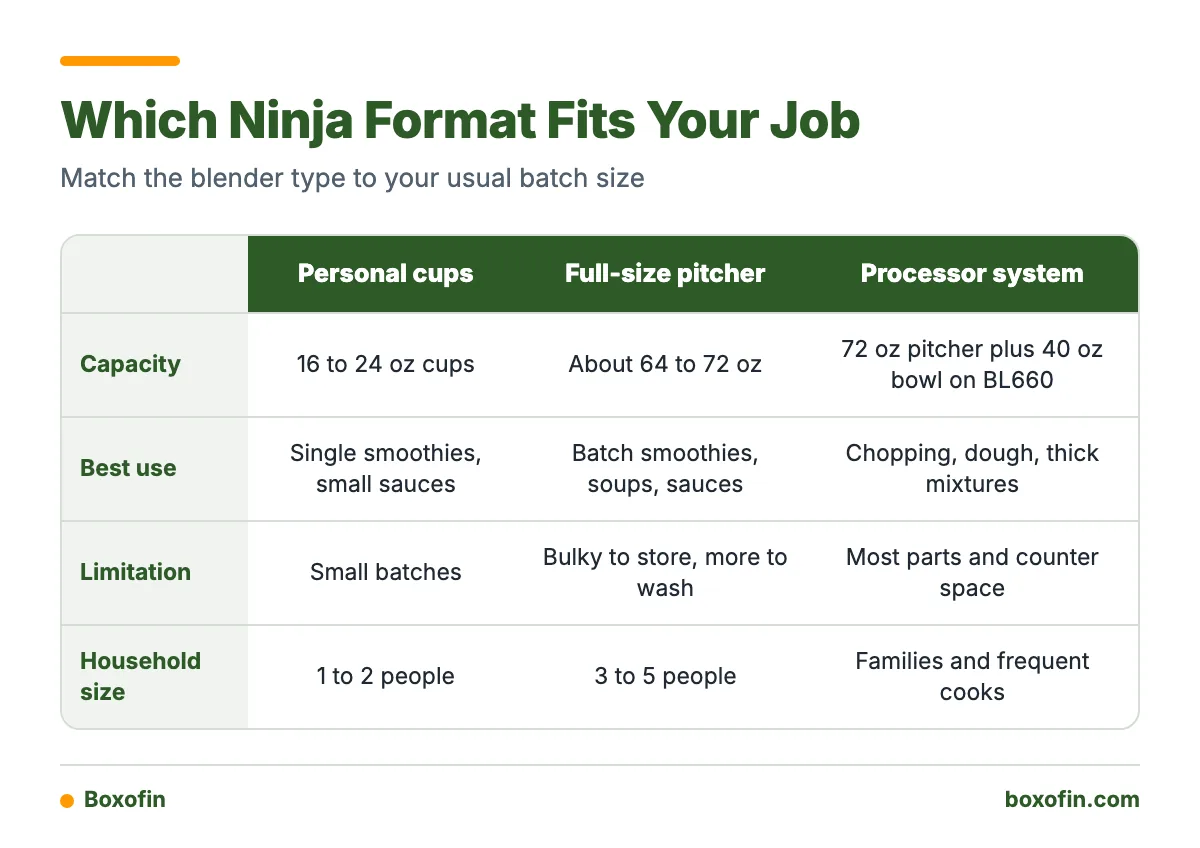
| Type | Typical capacity | Best use | Limitations | Household size |
|---|---|---|---|---|
| Personal cups | 16 to 24 oz cups | Single smoothies, small sauces | Small batches. Large frozen pieces may need more than one cycle. | 1 to 2 people |
| Full-size pitcher | About 64 to 72 oz | Batch smoothies, frozen drinks, soups, sauces | Bulky to store. More to wash. | 3 to 5 people |
| Blender-food-processor system | 72 oz pitcher plus a 40 oz bowl on the BL660 | Chopping, dough, thick mixtures, plus drinks | Most parts and most counter space | Families and frequent cooks |

How much capacity and power do different Ninja blender types provide?
The BL660 system includes a 72-ounce pitcher, a 40-ounce processor bowl and 16-ounce single-serve cups, per Ninja’s BL660 FAQ. The BL640 includes a 72-ounce pitcher, two 24-ounce cups and five Auto-iQ programs. Its 24-ounce cups have a maximum liquid line at 22 ounces, so fill to the line, not the brim.
Auto-iQ programs are preset pulse, blend and pause patterns. They help beginners get repeatable results without watching the timer.
Which Ninja Blender Is Better?
The better one is the one that matches your usual batch size. Follow this logic:
- If you make one smoothie a day, choose personal cups.
- If you make frozen drinks or soup for several people, choose a 64-to-72-ounce pitcher.
- If you also chop, mix dough or make thick sauces, choose a blender-food-processor system.
Which Ninja blender is better for smoothies, frozen drinks or family batches?
Here is a worked example. A solo user drinks one 16-ounce smoothie each morning. A 16-ounce or 24-ounce cup fits, blends in one cycle, and goes straight to the dishwasher. A pitcher would be too big for that small amount.
A family of four wants one 16-ounce frozen drink each. That is 64 ounces. The pitcher fill line sits below its full listed size, so expect to blend in two rounds or pour smaller servings. With cups you would run four separate cycles. The pitcher is clearly faster for this household. If the same family also makes sauces and chops vegetables, the processor system covers all of it.
Are Ninja Blenders Interchangeable?
Not universally. Ninja states that the BL640 attachments are not interchangeable. Compatibility exists only inside defined series. For example, Ninja’s BL490 FAQ says one grinder works across the BL480, BL490, BL640 and BL680 Auto-iQ series. That does not mean it fits every Ninja base.
Accessory-compatibility check
- Find the model number on the bottom of the base or in the manual.
- Find the part number on the cup, lid or blade, or in the parts list.
- Confirm both against Ninja’s support page for your series before buying.
- Do not assume a lid or blade from a similar-looking model will seal or lock.
Are Ninja Blender Parts Dishwasher-Safe and Easy to Clean?
Ninja states that removable cups, bowls, blades, attachments and lids are dishwasher-safe on specified models. Rack placement differs by part, so follow your manual. The motor base is different. It must never be put in water or the dishwasher. Wipe it with a damp cloth.
Easy is a different question. Blade assemblies and seals have narrow gaps where residue can sit. Rinse right after blending, and take the seal apart if your model allows it.

Are Ninja Blenders Worth It?
They are worth it if you blend frozen items often. A basic blender can handle soft fruit and liquids, but ice and frozen fruit are where cheaper models tend to struggle. Ninja’s strength is that tough job, plus the choice of cup and pitcher formats.
They are less worth it if you only make the occasional sauce or soft drink. A simple blender may do the job with less storage and less cleaning.
Why are Ninja blenders good, and is Ninja blenders good value?
Based on the specifications and owner patterns, the value is in the combination: strong frozen performance, multiple formats and dishwasher-safe parts. The tradeoff is long-term durability, which owners describe as mixed.
What Limitations Should Buyers Know Before Purchasing?
- Cleaning: blade assemblies and seals can trap residue.
- Cracks: some owners report cracked lids, cups or bowls after long use.
- Dull blades: blades can wear, and attachments can fail over time.
- Large frozen chunks: personal models may need extra cycles.
- Parts confusion: compatibility differs by series.
On safety: keep hands away from blades, unplug before assembling, and never overfill past the max line.
Decision Checklist
- Servings: one person or a group?
- Frozen ingredients: daily, or rarely?
- Chopping or dough: if yes, pick a processor system.
- Counter space: pitchers and bases take room.
- Dishwasher use: confirm which parts are dishwasher-safe for your model.
- Replacement parts: note the model and part numbers now.
What do owners say?
Owners like
- Strong performance with smoothies, frozen fruit and ice
- A useful mix of personal cups and a larger pitcher on dual-format models
- Dishwasher-safe removable parts on many models
- Some report reliable use for several years with frequent weekly use
- Food-processor attachments that go beyond drinks
Common complaints
- Blade assemblies and seals that are hard to clean, with residue or mold worries
- Cracked lids, cups or bowls after extended use
- Blades that dull or attachments that fail over time
- Personal models that struggle with large frozen pieces or need more than one cycle
- Confusing replacement-part compatibility
Summarised from owner reviews and long-term user reports; individual experiences vary.
Frequently Asked Questions
What are Ninja blenders good for?
Smoothies, crushed ice, frozen drinks, sauces and soups. Processor-attachment models also chop and mix dough.
What is the difference between Ninja blenders?
Mainly format: personal cups for single servings, pitchers of about 64 to 72 ounces for batches, and blender-food-processor systems for thicker food prep. Motor power and presets also vary by model.
Are Ninja blenders worth it?
Yes for frequent frozen blending and mixed-use kitchens. Occasional users may do fine with a basic blender.
Are Ninja blenders interchangeable?
Only within defined series. Ninja says BL640 attachments are not interchangeable. Verify your model and part number first.
Why are Ninja blenders good?
They handle ice and frozen fruit well, offer several formats, and many have dishwasher-safe removable parts.
Is Ninja blenders good?
Generally yes for smoothies and frozen drinks. Owner reports on long-term durability and cleaning are mixed, so choose the format you will actually use.
Which Ninja blender is better?
Cups for one daily smoothie, a 64-to-72-ounce pitcher for families, and a food-processor system if you also chop or make dough.
Sources