Ninja blenders are loud because they use strong, high-speed motors and sharp blades built to smash ice and frozen fruit, so a steady roar is normal. A new rattle, grinding sound or shaking base is different. It usually means the cup is too full or too empty, the blades are blocked, a part is not seated right, or the blade assembly or drive gear is wearing out. This guide shows you how to tell normal noise from a fault, how to run Ninja’s own water test, and how to make the noise easier to live with.
Quick answer
A steady, loud roar is normal for a Ninja, especially with frozen food. If the sound changed suddenly, stop, add water until the cup is half full, refit the parts and check that the blades spin, as Ninja advises. Grinding, a burning smell or blades that will not turn mean you should stop and contact Ninja.
- Ninja says loud noise is normal because the motor base is powerful, especially with frozen ingredients.
- The sound changing matters more than the volume. Grinding, squealing and new rattles point to a problem.
- Ninja’s first test: add water until the cup is half full, refit the blades and cup, run a program and check that the blades spin.
- Owners say single-serve and to-go cups often sound louder than the main pitcher.
- Never cover or box in the motor base to quiet it. It needs airflow to stay cool.
- No standard decibel ranking of Ninja models exists in Ninja’s published guidance, so treat any “quietest Ninja” claim with care.
- Is a loud Ninja blender normal, or is something wrong?
- Why is my Ninja blender so loud when making smoothies?
- Why is my Ninja blender so loud now?
- How can I tell which part is causing the noise?
- Why does my Ninja blender vibrate or move on the counter?
- Is a Ninja blender loud enough to damage hearing?
- How to make a Ninja blender quieter
- Which Ninja blender is the quietest?
- When should I stop and contact Ninja support?
- What do owners say?
- Frequently Asked Questions
Is a loud Ninja blender normal, or is something wrong?
A loud Ninja is normal. Ninja itself says the noise comes from its powerful motor base and gets louder with frozen ingredients.
The motor spins the blades very fast. Fast blades push air, hit ice and shake the container, and all of that makes sound. So the question is not “Is it loud?” It is “Does it sound different from before?”
Use this simple rule. If the sound has been the same since the day you bought it, it is almost always normal. If it has changed (new grinding, a squeal, a rattle or more shaking), something has moved, worn or jammed.
Why is my Ninja blender so loud when making smoothies?
Smoothies are loud because frozen fruit and ice are hard. The blades hit solid chunks again and again, and each hit sends noise through the cup and the base.
Thick mixes make it worse. When the drink is too thick, the blades can spin in an air pocket. This is called cavitation, which means the blades whirl in empty space instead of pulling food down. The motor speeds up, the pitch rises, and you get a high scream with little blending.
Can frozen fruit, ice, or an underfilled cup make a Ninja blender louder?
Yes on all three. Frozen pieces are hard and noisy. An underfilled cup leaves the blades with little to grab, so they spin fast and loud. An overfilled cup packs food so tight it cannot move, which strains the motor.
- Add liquid first, then soft foods, then frozen items on top (or follow the order in your manual for cups that blend upside down).
- Stay between the fill lines printed on the cup.
- Let frozen fruit sit for a few minutes so the outside softens.
- Use the pulse button to break big chunks before a full program.

Why is my Ninja blender so loud now when it used to sound normal?
A blender that suddenly gets louder usually has a part that is loose, blocked or worn. The motor itself is rarely the first thing to check.
Common causes include:
- Parts not seated right. A blade assembly that is not fully screwed on, or a cup that is not locked into the base, will rattle.
- Something stuck. A chunk of ice or a fruit pit wedged near the blades makes a knocking sound.
- Worn drive gear. The drive gear (also called the coupling) is the toothed part that links the motor to the blades. If the teeth get rounded, it grinds or clicks.
- Worn bearings. Bearings are the small parts that let the blades spin smoothly. When they dry out or wear, you may hear a squeal.
- Worn rubber parts. Gaskets and rubber feet harden and crack over time, which adds rattle and vibration.
Owner reports over the long term mention worn safety sensors, jammed or seized blade mechanisms, worn rubber or coupling parts, burning smells and noise that grows over time. These are reports from some owners, not failures every unit will have. They do show which parts to check first.
How can I tell whether the blade assembly, drive gear, or motor is causing the noise?
Match the sound to the table below, then run the safe first test. Always unplug the blender before touching the blades or gears.
| What you hear or see | Likely cause | Safe first test |
|---|---|---|
| Steady, loud roar, same as always | Normal motor at high speed | None needed. Add a little liquid if it seems to struggle. |
| High scream, little blending | Air pocket (cavitation), too little liquid | Stop, add liquid, pulse a few times. |
| Rattling | Cup or blade assembly not seated, loose chunk inside | Unplug, remove and refit the cup and blades firmly. |
| Grinding or clicking | Worn drive gear, debris in the coupling | Unplug. Look at the gear teeth on the base and the blade part for rounding, cracks or plastic shavings. |
| Squealing | Dry or worn bearings in the blade assembly | Unplug. Turn the gear under the blade part by hand. Stiffness or rough spots suggest wear. |
| Buzz or hum, blades not turning | Jam, overload, or the safety lock not engaged | Unplug, clear the jam, then run the water test below. |
| Base walks across the counter | Uneven load, dirty or worn feet, slick counter | Clean the feet, check the surface is level, blend a smaller batch. |
Here is a quick way to narrow it down. If the noise stays when you try a different cup and blade assembly on the same base, the base or its gear is the likely source. If the noise goes away with a different cup, the original blade assembly is the problem. Blade assemblies are sold as spare parts, so this is often a cheaper fix than a new blender.
Ninja’s water-and-blade test
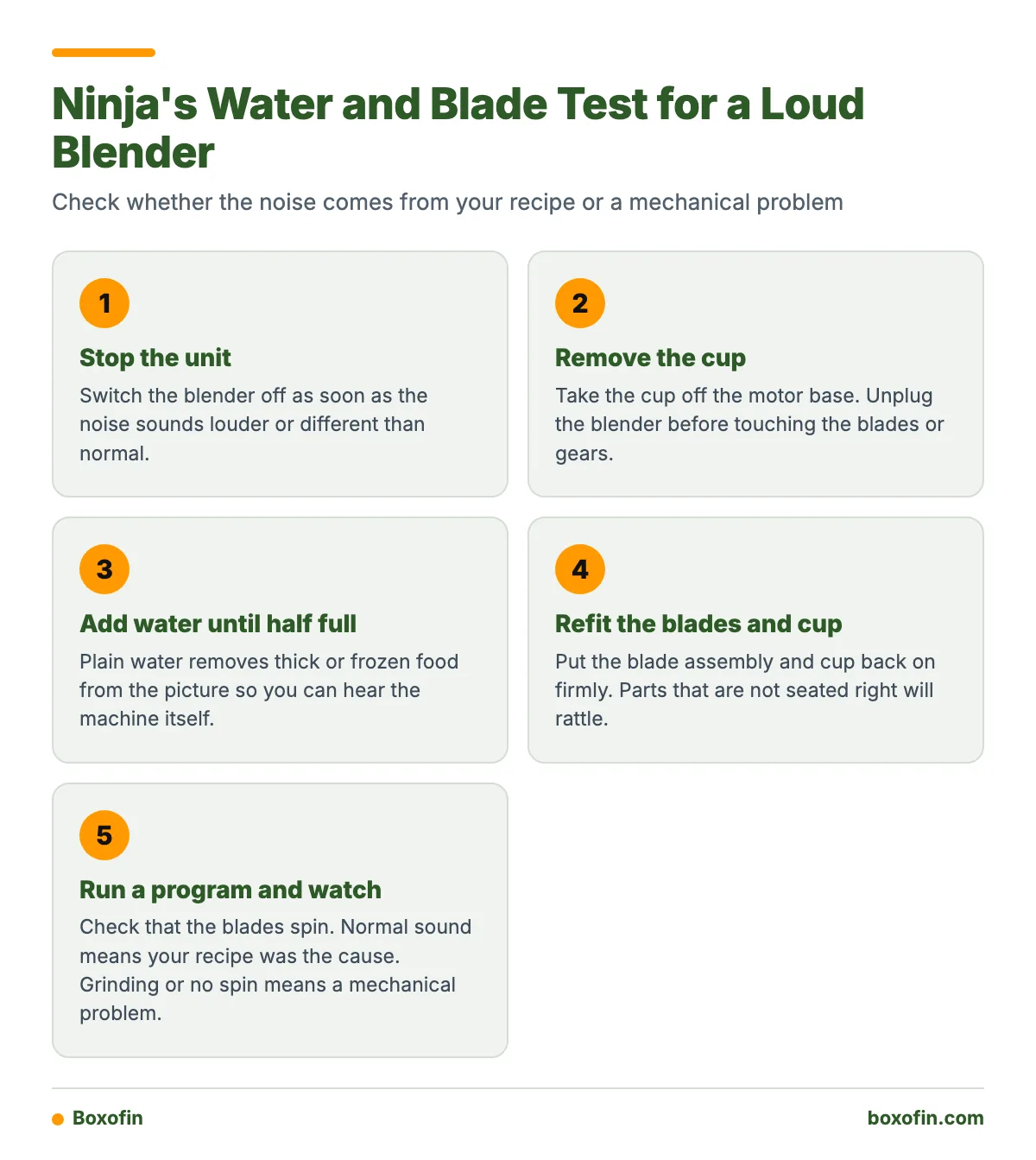
For noise that seems louder than normal, Ninja gives a clear sequence in its official TWISTi blender support FAQs:
- Stop the unit.
- Remove the cup.
- Add water until the cup is half full.
- Put the blade assembly and cup back on.
- Run a program and check that the blades spin.
Why it works: plain water removes thick or frozen food from the picture. If the blender sounds normal with water, your recipe was the cause. If it still grinds, rattles or the blades do not spin, you have a mechanical problem.
Why does my Ninja blender vibrate, rattle, or move on the counter?
Vibration comes from an uneven load. A big frozen chunk on one side makes the spinning blades wobble, and the whole base shakes.
Many Ninja bases have suction cups or rubber feet. Owners often say these keep the base steady, but they do not cut the motor sound itself. Dust, grease or flour on the feet stops them from gripping. Wipe them with a damp cloth and dry them. Use a clean, flat surface. If the base still walks with plain water inside, check for cracked feet or a bent blade.
Is a Ninja blender loud enough to damage hearing?
Short daily use is unlikely to harm an adult’s hearing on its own, but it adds to all the other loud noise in your day. One published review measured a Ninja Twisti at about 100 dB while making a smoothie. That is one review of one model, not a standard rating for every Ninja.
For comparison, the U.S. National Institute for Occupational Safety and Health (NIOSH) sets a recommended limit of 85 dBA over 8 hours. For every 3 dB higher, the safe time halves. At 100 dBA, that works out to about 15 minutes a day.
Do the maths for two 60-second smoothies: 2 minutes ÷ 15 minutes = about 13% of that daily allowance. The measurement distance in the review is not known, so your real level may be higher or lower. Keep young children back from the blender, and use earplugs if you are sensitive to noise or blend often.
What can I do to make a Ninja blender quieter without blocking ventilation?
You cannot make a Ninja silent. You can make each blend shorter and stop the sound spreading through counters and walls.
- Blend for less time. Soften frozen fruit, add liquid, and pulse first so the full program finishes faster.
- Use the main pitcher for ice. Owners report the single-serve and to-go cups sound louder.
- Move it away from shared walls. Sound and shaking travel through the counter into the wall.
- Leave space around the base so air can move in and out.
- Pick your time. Blend when neighbors or babies are less likely to be asleep.
Worked example
A person in an apartment makes two frozen smoothies a day on a stone counter next to a shared wall. Each one runs for 60 seconds.
Per week: 2 smoothies × 60 seconds × 7 days = 840 seconds, or 14 minutes of loud blending.
They let the fruit soften for five minutes, add liquid first and pulse before blending. That cuts each run to about 30 seconds. New weekly total: 2 × 30 × 7 = 420 seconds, or 7 minutes. That halves the time the neighbors hear it.
Next, they move the blender to a counter spot away from the shared wall and keep a few inches of open space around the base. The blender is just as loud in the room, but less shaking reaches the wall. Use your own numbers: blends per day × seconds per blend × 7.

Which Ninja blender is the quietest?
No single model can be named the quietest based on fair, side-by-side tests. Ninja’s support pages explain why its blenders are loud, but they do not rank models by decibels. Compare by type instead.
| Ninja type | Likely noise | Good for | Skip it if |
|---|---|---|---|
| Full-size pitcher blender | Loud, especially with ice. More room lets food move, which helps avoid the scream of an air pocket. | Families and big batches | You only make one drink at a time and have little counter space. |
| Personal or single-serve cup models | Owners report these sound louder than the main pitcher. | Quick one-person drinks | Noise is your top worry and you blend a lot of ice. |
| TWISTi models | One review measured about 100 dB making a smoothie. | Very thick blends that need the twist tool | You expect a quiet machine. |
If quiet matters most, look for a blender that lists a decibel rating and says how it was measured, including the distance. A “quiet” blender is still loud. Decibel claims measured from different distances cannot be compared.
For most noise-sensitive homes, the best choice is to keep a full-size Ninja you already own, use the big pitcher for frozen drinks, and shorten your blend times.
When should I stop using the blender and contact Ninja support?
Stop right away if you smell burning, see smoke, or the blades will not spin after you clear a jam. Use this checklist:
- Noise unchanged since purchase: Normal. Keep using it.
- Noise suddenly increased: Unplug, reseat the parts and run Ninja’s half-full water test.
- Blades not spinning: Unplug and clear any jam. If they still do not spin with water, contact Ninja.
- Burning smell: Stop, unplug and let it cool. If it happens again, stop using it and contact Ninja.
- Visible wear (rounded gear teeth, cracked cup, leaks under the blades): Replace that part before using it again.
- Strong shaking even with plain water: Check the feet and blades. If it continues, contact Ninja.
What do owners say?
Owners like
- Strong, powerful blending
- Smoothies and frozen drinks done fast
- Handy automatic programs
- Suction cups or rubber feet that keep the base steady
- Good results for the price
Common complaints
- Very loud, sometimes compared to power tools
- Noise is worse with single-serve or to-go cups
- The sound can be upsetting in apartments or around small children
- Some report rattling, shaking or more noise as parts wear
- Hard cleaning and very sharp blade parts
Summarised from owner reviews and long-term user reports; individual experiences vary.
The pattern is clear: loudness is a near-universal comment, while rattling and worn parts show up in some reports, not all. This roundup of how customers feel about Ninja appliances reflects the same mix of praise for power and complaints about noise.
Frequently Asked Questions
Why is my Ninja blender so loud?
Its motor is powerful and spins the blades very fast, and Ninja says this noise is normal, especially with frozen ingredients. If the sound is new or different, check for a loose cup, a jam or worn parts, then run the half-full water test.
Why is my Ninja blender so loud now?
A sudden change usually means a part is not seated right, something is stuck near the blades, or the drive gear, bearings or rubber parts are wearing. Unplug it, refit the cup and blades, and test with water until the cup is half full.
Why is my blender so loud?
Any high-speed blender is loud because fast blades hit hard food and shake the container. Too little liquid, big frozen chunks and small cups all make it louder. Add liquid first and pulse before you blend.
Why do people on Reddit say the Ninja blender is so loud?
Owners often describe Ninja blenders as extremely loud while also praising how well they blend. The noise is a common trait of the design, not a sign that every unit is faulty.
Which Ninja blender is the quietest?
There is no fair, side-by-side decibel ranking to name one. Owners say single-serve cups sound louder than the main pitcher, and one review measured a TWISTi at about 100 dB. If noise matters most, choose a model with a stated decibel rating and test distance.
Sources