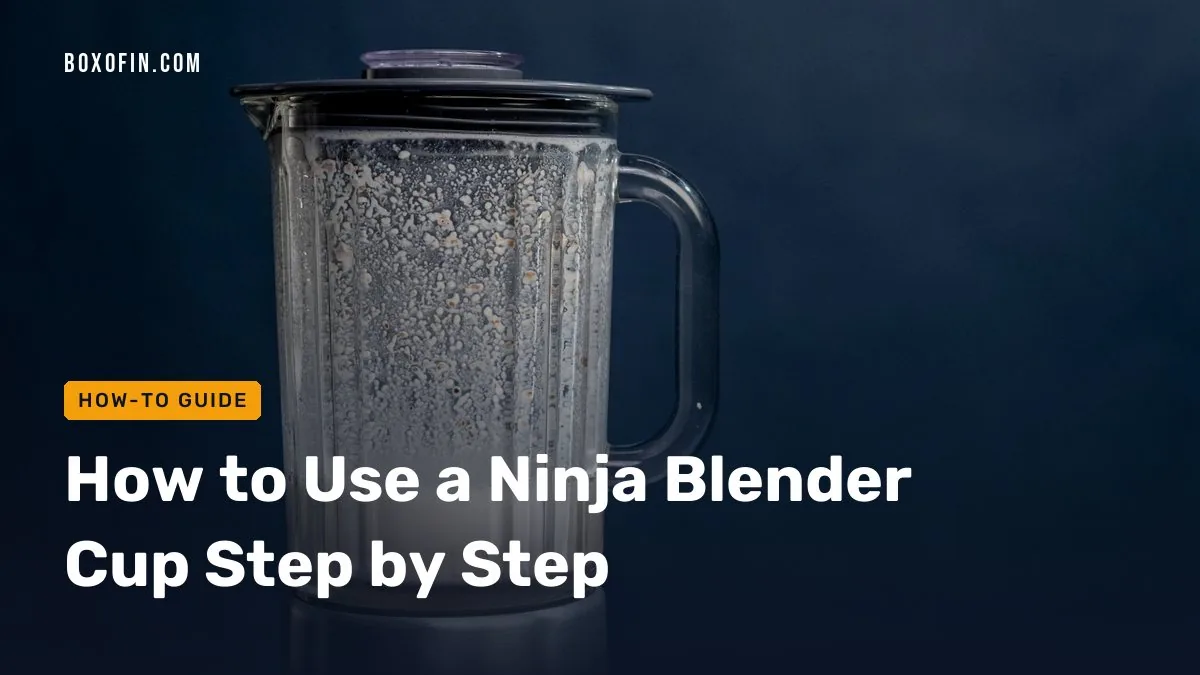
Many owners overfill the cup, skip the click on the base, and then blame the blender when it leaks or will not start. Do it in this order instead: keep ingredients below the MAX LIQUID line, tighten the blade assembly, flip the cup over, and turn it clockwise on the motor base until it clicks. When the blend is done, remove the blade assembly and fit a lid before you drink or store it.
Quick answer
Fill the cup below MAX LIQUID, screw on the blade assembly, invert the cup, and lock it on the base with a clockwise turn. Blend, then swap the blade for a storage or to-go lid. Dishwasher, freezer, and microwave rules change by model, so check your manual.
- Never fill past the MAX LIQUID line.
- The cup must align with the base slots and click into place.
- The blade assembly is not a lid. Remove it before drinking or storing.
- Top-rack dishwasher use is common, but freezer and microwave use vary by model.
- Remove blades before washing and handle them with great care.
- What are the parts of a Ninja cup set?
- How do you use a Ninja blender cup?
- How full can you fill a Ninja single-serve cup?
- How do you attach a Ninja blender cup to the motor base?
- How do you use a Ninja blender bottle after blending?
- Can Ninja blender cups go in the dishwasher?
- Freezer and microwave rules
- Troubleshooting
- What do owners say?
- Frequently Asked Questions
What are the parts of a Ninja cup set?
Most single-serve sets have three kinds of pieces, and mixing them up causes most problems.
- Cup: holds the ingredients and the drink.
- Blade assembly: the sharp unit that screws onto the cup for blending only.
- Storage lid or to-go lid: the cap you use after blending, in place of the blade.
The motor base stays dry and never goes in water.
How do you use a Ninja blender cup?
Add ingredients, tighten the blade assembly, invert the cup, lock it on the base, and start the right program. Run through this checklist before every blend:
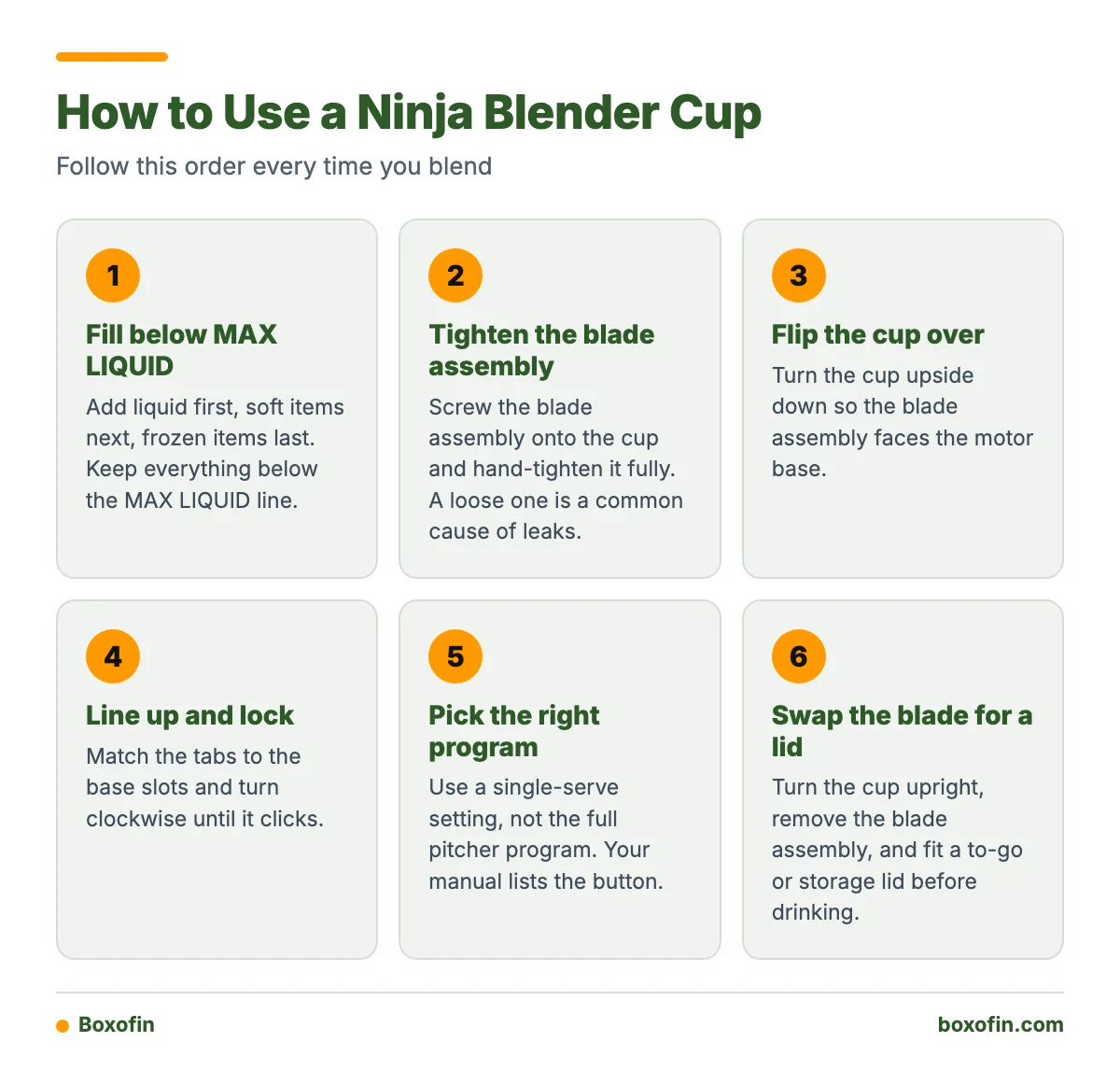
- The motor base sits dry and level on the counter.
- Ingredients are below the MAX LIQUID line.
- The blade assembly is tightened onto the cup.
- The cup is turned upside down.
- The tabs line up with the base slots.
- The cup is turned until it clicks into place.
Then pick the program that matches the attached cup. A single-serve cup needs a single-serve setting, not the full pitcher program. Your manual lists which button to press.
How full can you fill a Ninja single-serve cup?
Stop at the MAX LIQUID line. Ninja’s BN400 instructions say not to fill past it. Going over risks leaks, pressure, and poor blending.
Worked smoothie example
Order matters. Liquid goes in first, soft items next, frozen items last. Here is a sample build, with amounts that are only an illustration:
| Step | Ingredient | Why this order |
|---|---|---|
| 1 | Milk or juice, about half the cup’s depth | Sits near the blade and helps it spin freely |
| 2 | Half a banana and a handful of spinach | Soft items blend easily once liquid moves |
| 3 | A scoop of frozen berries | Frozen pieces on top push everything down |
| 4 | Check the line | Everything must stay below MAX LIQUID |
If the pile reaches the line before you add the berries, take something out. Do not squeeze it in.

How do you attach a Ninja blender cup to the motor base?
Screw the blade assembly onto the cup, flip the cup over, line up the tabs with the base slots, and rotate it clockwise until it clicks. That click is the proof it is locked.
If the blender will not start, the cup is usually sitting on the base but not turned far enough. Lift it off, check the tabs, and try again.
How do you use a Ninja blender cup attachment?
The “attachment” is the blade assembly. It screws on before blending and comes off afterward. Hand-tighten it fully, because a loose assembly is a common cause of leaks.
How do you use a Ninja blender bottle after blending?
Turn the cup upright, unscrew the blade assembly, and fit the to-go or storage lid. Only then drink or carry it.
Skipping the blade removal is the step many guides leave out. The blade assembly has exposed blades and is not made for drinking. Pour out any stuck bits with the blade off, and keep it away from your hands.
Lid-safety comparison
| Piece | Use it for | Never use it for |
|---|---|---|
| Blade assembly | Blending while locked on the base | Drinking, carrying, storing |
| Storage lid | Keeping a drink in the fridge or, on some models, the freezer | Blending |
| To-go lid | Sipping on the move | Blending |
If you want to save it for later: remove the blade, fit the storage lid, and refrigerate.
If you want to blend again: keep the blade on and lock the cup back on the base.
Can Ninja blender cups go in the dishwasher?
Usually yes, but check your model. The BL660 FAQ recommends placing the single-serve cup, blades, attachments, and lids on the top rack (BL660 FAQ). The BN400 FAQ says all parts except the motor base are dishwasher safe, with the blade assembly and lid removed from the container first (BN400 FAQ).
Is a Ninja blender cup dishwasher safe on the top rack?
Yes, top rack is the common placement. Keep it away from the heating element at the bottom.
Why should the blade assembly be removed before washing or storing the cup?
Ninja recommends removing blades before dishwasher cleaning and handling them with extreme caution. Separate parts also wash cleaner, since water and food hide where the blade meets the cup. A removed blade is also safer to reach for than one left inside a full sink.
Freezer and microwave rules
Can Ninja blender cups go in the freezer?
Only if your model says so. The BL250 FAQ states its container and storage lid are freezer safe (BL250 FAQ). For other series, look in your manual. Never freeze with the blade assembly attached.
Can Ninja blender cups go in the microwave?
It depends on the series. The BL660 FAQ permits the single-serve cup in a microwave but advises against heating liquid to boiling. Blades, attachments, and lids must stay out. Some series, including the BL640, state that no parts are microwave safe (BL640 FAQ).
Is a Ninja blender cup microwave safe?
Not as a blanket rule. Use the table below as a model check, then confirm in your own manual.
| Model | Top-rack / dishwasher | Freezer | Microwave |
|---|---|---|---|
| BN400 | All parts but the base, blade and lid removed first | Check manual | Check manual |
| BL660 | Cup, blades, attachments, lids on top rack | Check manual | Cup only, no boiling liquid; no blades, attachments, or lids |
| BL640 | Remove blades first; handle with care | Check manual | No parts microwave safe |
| BL250 | Check manual | Container and storage lid freezer safe | Check manual |
“Check manual” means the brief’s sources did not state it, not that the answer is no.
Troubleshooting leaks, stuck lids, and no start
- Leaks: the blade assembly was not fully tightened, or the cup was overfilled. Drain it, retighten, and drop below MAX LIQUID.
- Will not start: the tabs are not aligned with the base slots, or the cup has not been rotated to the click.
- Blade hard to loosen: owners often report this after blending. Let the cup sit a moment, then grip the cup firmly and turn the assembly counterclockwise.
- Lid hard to close: some owners say repeated dishwasher washing makes lids stiffer over time. Check that the rim is clean and dry.
What do owners say?
Owners like
- The compact single-serve design is convenient for smoothies and saves counter space.
- Dishwasher-safe cups and lids make routine cleaning easy.
- The cup turns into a portable drinking container after blending.
- Blending in the serving cup means less cleanup and fewer transfers.
Common complaints
- Leaks happen when lids or blade assemblies are not tightened correctly.
- Dishwasher washing can make lids harder to close over time.
- Blades and lids can be hard to loosen after blending.
- The motor is often described as very loud.
- Water can stay trapped in recessed parts after dishwasher cleaning.
Summarised from owner reviews and long-term user reports; individual experiences vary.
Frequently Asked Questions
How to use ninja blender cup?
Add ingredients below the MAX LIQUID line, tighten the blade assembly, flip the cup, and turn it clockwise on the base until it clicks. Choose the single-serve program, blend, then replace the blade with a lid.
How to use ninja blender cup attachment?
The attachment is the blade assembly. Screw it on by hand before blending and remove it afterward. Never drink from a cup with the blade assembly attached.
How to use ninja blender bottle?
After blending, remove the blade assembly and fit the to-go lid. Tighten it fully to avoid leaks, and wash the pieces separately.
Can ninja blender cups go in dishwasher?
Generally yes. Ninja’s BL660 and BN400 FAQs describe top-rack or dishwasher-safe cups and lids. Remove the blade assembly first and wash it with care.
Is ninja blender cup dishwasher safe?
On the models covered here, yes, with the blade assembly removed. Place items on the top rack when your manual advises it.
Can ninja blender cups go in freezer?
Some can. The BL250 container and storage lid are freezer safe, but other series vary. Check your manual and take the blade assembly off first.
Can ninja blender cups go in microwave?
It depends on the series. The BL660 single-serve cup is allowed, without boiling liquid. Blades, attachments, and lids are not. On the BL640, no parts are microwave safe.
Is ninja blender cup microwave safe?
Only on some models. Confirm in your manual before heating anything, and never microwave the blade assembly or lids.
How to use ninja cup blender?
Follow the six-step checklist above: dry base, ingredients below MAX LIQUID, blade tightened, cup inverted, tabs aligned, and a click into place. Then blend and swap the blade for a lid.
Sources