Most Ninja blender pitchers, cups, lids and blade assemblies can go in the dishwasher, but the motor base never can. Put the approved parts on the top rack, take the blades out of the container first, and check your owner’s guide, because the rules change from model to model. This guide shows what goes where for the BN750, BL610, BL660, NN210C and Ninja Blast, and how to clean the rest by hand.
Quick answer
Ninja’s containers, cups, lids and blade assemblies are usually top-rack dishwasher safe. The motor base is not, so wipe it with a damp cloth instead. On Ninja Blast portable blenders, only the vessel and sip lid go in the dishwasher, and Ninja says not to use a heated cycle.
- Pitchers, cups, lids and blade assemblies are usually dishwasher safe on full-size Ninja blenders.
- The motor base holds the electrics. Never put it in the dishwasher or under water.
- Use the top rack, where the heat is lower.
- Remove the blade assembly from the container before loading it.
- Ninja Blast parts should skip heated cycles, and the Blast base cannot go in the dishwasher.
- What does Ninja mean by dishwasher safe?
- Which Ninja blender parts can go in the dishwasher?
- Which dishwasher rack should Ninja blender parts use?
- Should I remove the blades before putting the container in the dishwasher?
- How do the rules differ by Ninja model?
- How should I clean a Ninja blender if I do not use a dishwasher?
- What are the signs of dishwasher damage?
- What do owners say?
- Frequently Asked Questions
What does Ninja mean by dishwasher safe?
It means the plastic and blade parts can handle a normal top-rack wash. It does not mean the whole blender. The motor base holds the motor, wires and controls, and water can ruin them.
Many websites just say “yes” without splitting these two apart. That is how people end up with a dead base. Think of it this way: anything that touches food can usually go in. Anything with a plug cannot.
Which Ninja blender parts can go in the dishwasher?
Here is the part-by-part picture for full-size Ninja blenders. It is based on Ninja’s owner’s guides and support pages.
| Part | Dishwasher safe? | Rack | Notes |
|---|---|---|---|
| Pitcher | Yes, on most models | Top | Remove the blade assembly first |
| Single-serve cup | Yes | Top | Unscrew the blade assembly first |
| Lids (pitcher, spout, sip) | Yes | Top | Open flip caps so water reaches inside |
| Blade assembly | Yes, on most full-size models | Top | Sharp, so handle by the top or shaft |
| Motor base | No | Never | Unplug and wipe with a damp cloth |
Can the Ninja blender pitcher go in the dishwasher?
Yes, on the BN750, BL610 and BL660. Lift out the stacked blade assembly first. Then place the pitcher upside down on the top rack.
Can Ninja blender cups and lids go in the dishwasher?
Yes. On the BN750, Ninja lists the single-serve cup, pitcher lid and spout lid as top-rack dishwasher safe, according to its BN750 Series FAQ page.
Can Ninja blender blades go in the dishwasher?
On full-size models, yes. The stacked blade (the tall blade with several sets of blades on one shaft) and the extractor blade (the short blade that screws onto a cup) both go on the top rack. Ninja Blast models are different. Their blades are part of the base, so you rinse them by hand.
Can I put the Ninja blender motor base in the dishwasher?
No. No Ninja model covered here allows it. Unplug the base and wipe it clean.
Which dishwasher rack should Ninja blender parts use?
Use the top rack. On most dishwashers, the heating element sits at the bottom, so the top rack stays cooler. Every Ninja guide in this article names the top rack for blender parts.
Can Ninja blender parts use the heated-dry cycle?
Not on Ninja Blast models. The BC100/BC150 Ninja Blast FAQs say the vessel and sip lid should not go through a heated cycle. For other models, check your guide. Turning heated dry off is a safe habit, because owners link high heat to warped plastic. Air-dry the parts instead.
Should I remove the blades before putting the container in the dishwasher?
Yes. Ninja’s BL610 and BL660 guides both tell you to take the blade assembly out of the container before washing. If the blade stays in, water can’t reach under it. Food gets trapped there.
Be careful. Ninja’s guides warn that stacked blade assemblies are loose and sharp once removed. Hold the stacked blade by the top of its shaft. Don’t reach into the pitcher with bare fingers.
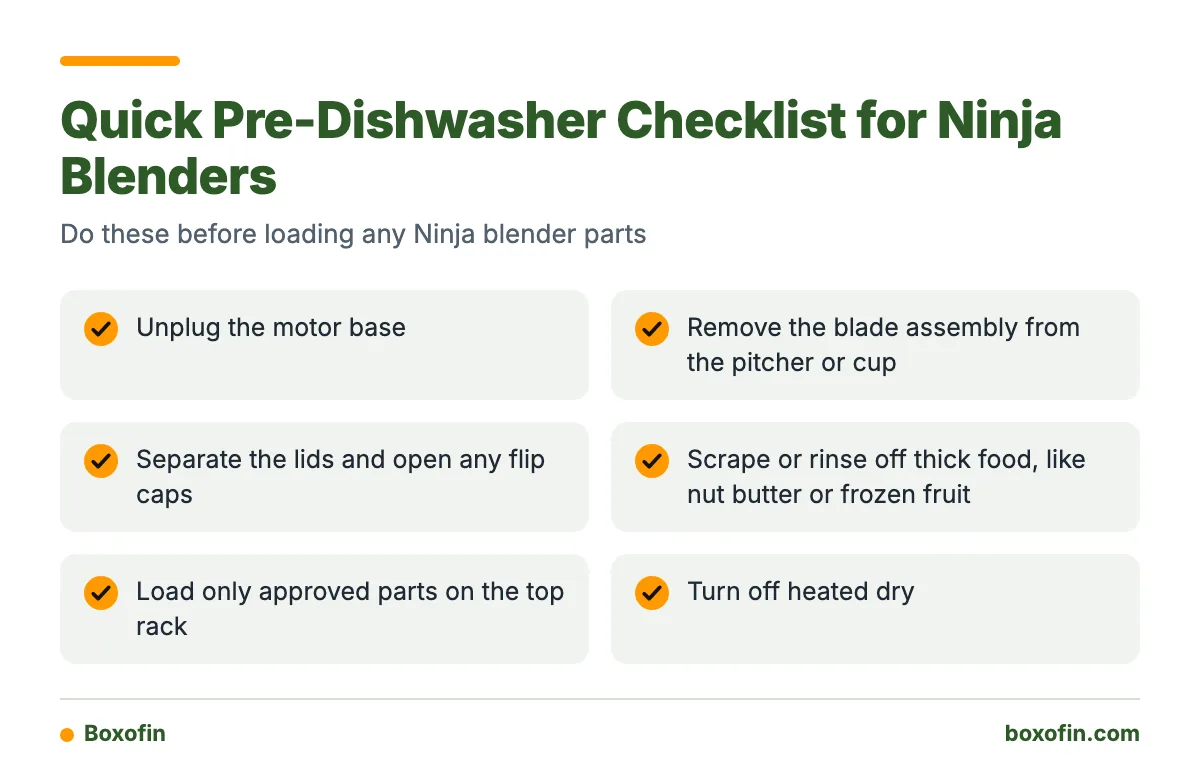
Quick pre-dishwasher checklist
- Unplug the motor base.
- Remove the blade assembly from the pitcher or cup.
- Separate the lids and open any flip caps.
- Scrape or rinse off thick food, like nut butter or frozen fruit.
- Load only approved parts on the top rack.
- Turn off heated dry.
Worked example
A BN750 owner makes a banana and peanut butter smoothie in the 72-ounce pitcher. Here is how the cleanup splits:
- Dishwasher, top rack (3 parts): the pitcher, the pitcher lid and the stacked blade assembly, after a quick rinse to clear the peanut butter.
- By hand (1 part): the motor base, wiped with a damp cloth after unplugging. A splash of smoothie near the buttons comes off with a cloth.
If the owner also used the single-serve cup, that adds 3 more top-rack parts: the cup, the extractor blade assembly and the spout lid. That makes 6 parts in the dishwasher, and the base is still the only thing washed by hand.
How do the rules differ by Ninja model?
Each series lists slightly different parts. This table pulls the rules from Ninja’s own guides.
| Model | Dishwasher-safe parts | Rack | Special rule |
|---|---|---|---|
| BN750 (Professional Plus DUO) | Pitcher, stacked blade, pitcher lid, single-serve cup, extractor blade, spout lid | Top | Base is not dishwasher safe |
| BL610 (Professional) | Pitcher, lid, blade assembly | Top for lid and blade | Remove blades first |
| BL660 (Professional) | Containers, lids, blade assemblies | Top recommended | Remove blades first |
| NN210C | Containers, lids, blade assemblies, blade discs | Top | Base is not dishwasher safe |
| BC100/BC150 (Ninja Blast) | Vessel and sip lid only | Top | No heated cycle. Base and blades are hand-clean only. |
Are Ninja Blast portable blender parts dishwasher safe?
Only the vessel and sip lid. The Blast’s blades are built into the motor base. So the base and blades must stay out of the dishwasher. Ninja also says not to submerge the base. You can rinse the blades and scrub them carefully with a brush.
If your blender has a separate pitcher or cup with a removable blade: remove the blade and load the parts on the top rack.
If the blade is fixed to a rechargeable base (like the Ninja Blast): put only the vessel and lid in the dishwasher, and use no heat.
If you can’t find your model number: hand-wash everything until you check the guide.
How can I check whether my specific Ninja model is dishwasher safe?
Look for the model number on the sticker under the motor base. Then search for it on Ninja’s support site and open the owner’s guide. Find the “Care and Maintenance” or “Cleaning” section. For example, the BL660 owner’s guide lists its dishwasher-safe parts and the top-rack advice.
How should I clean a Ninja blender if I do not use a dishwasher?
Use warm, soapy water and a long-handled brush. Wash the blade assembly with the brush, not a sponge, so your fingers stay away from the edges. Rinse and let everything air-dry.
For the motor base, unplug it first. Wipe it with a damp cloth, then dry it. Clean the area where the pitcher locks on, since drips collect there. Never pour water over the base.
Stuck-on residue: fill the pitcher halfway with warm water and add a drop of dish soap. Blend for a few seconds, then rinse. For smells from garlic or onion, soak the pitcher in warm water with a spoonful of baking soda, then wash as normal.

What are the signs of dishwasher damage?
Check your parts every few weeks. Watch for:
- Warped lids that no longer snap shut or seal
- Cloudy or cracked pitcher walls
- A blade assembly that no longer locks firmly into place
- Rust spots or loose blades
If you see any of these, stop using the part and order a replacement for your model. A warped lid can leak. A loose blade is unsafe.
What do owners say?
Owners like
- Pitchers, cups, lids and blades that go in the dishwasher make daily cleanup easy.
- Removable blades make it simpler to clean around them.
- Top-rack washing cuts down on scrubbing after smoothies and sauces.
Common complaints
- Sharp blade assemblies feel awkward and risky to handle.
- Food can stay stuck around blades and under lids when parts aren’t taken apart.
- Some people assume the motor base is dishwasher safe because the attachments are.
- High heat or heated dry may warp or wear out plastic parts early.
Summarised from owner reviews and long-term user reports; individual experiences vary.
Frequently Asked Questions
Can a Ninja blender go in the dishwasher?
The parts can, but the whole blender cannot. Containers, cups, lids and blade assemblies are usually top-rack safe. The motor base must be wiped by hand.
Can Ninja blender blades go in the dishwasher?
Yes, on full-size models like the BN750, BL610, BL660 and NN210C. Take them out of the container and place them on the top rack. Ninja Blast blades are attached to the base, so rinse and brush them by hand.
Which dishwasher rack should Ninja blender parts use?
The top rack. It sits farther from the heating element, which helps protect the plastic.
Can Ninja blender parts use the heated-dry cycle?
Ninja says Ninja Blast vessels and lids should not use a heated cycle. For other models, check your guide. Turning heated dry off is a simple way to protect plastic from warping.
Are Ninja Blast portable blender parts dishwasher safe?
Only the vessel and sip lid, on the top rack with no heat. The base, which holds the blades and battery, is not dishwasher safe and should not be submerged.
How can I check whether my specific Ninja model is dishwasher safe?
Find the model number under the motor base. Then look up that model’s owner’s guide or FAQ page on Ninja’s support site and read the cleaning section.
Sources