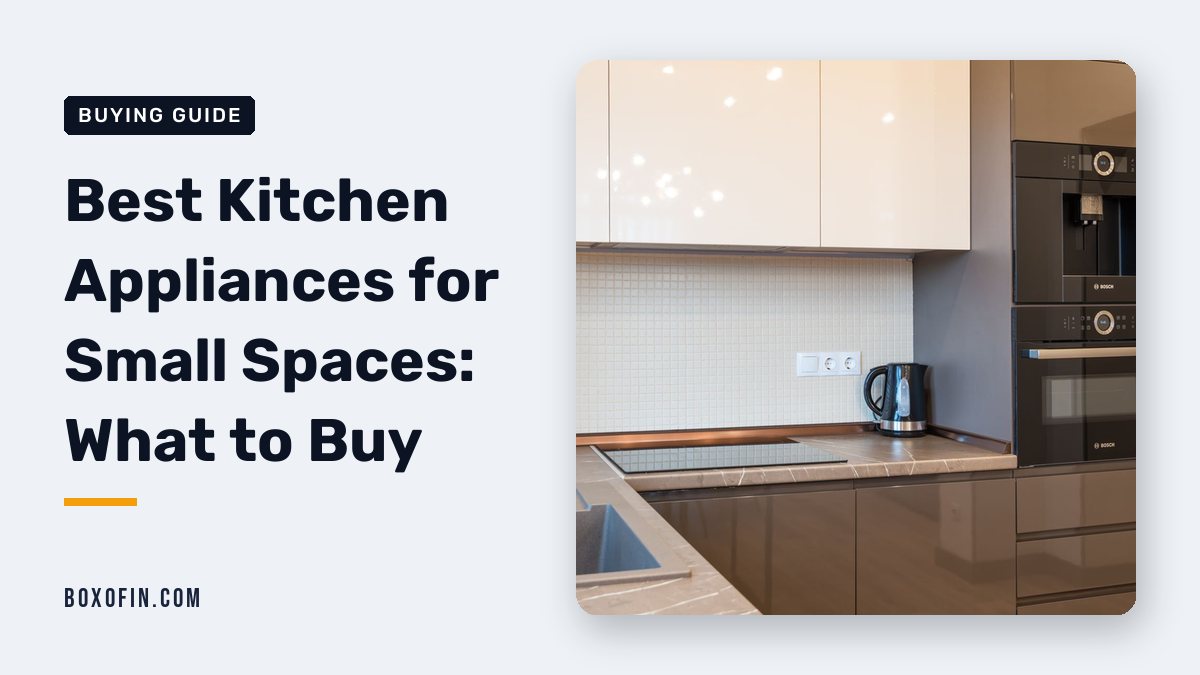
The best kitchen appliances for small spaces are compact, do more than one job, and match how many people you actually cook for. Choose slim or apartment-sized models, pick dual-purpose tools, and favor items that fit in a drawer or cabinet when you are not using them.
- Size appliances to your household, not to a showroom floor.
- Apartment ranges run about 20 to 24 inches wide. Apartment fridges save about 12 to 16 inches over standard ones.
- A microwave that doubles as a range hood removes one separate appliance.
- Give counter space only to what you use almost daily. Everything else goes in a drawer, cabinet, or on a shelf.
- Renters can still get most of these gains with countertop and freestanding models.
- Measure Before You Buy
- Sizes That Fit a Tight Kitchen
- Countertop Appliances: Which Are Worth It?
- Match Appliances to Your Household
- Footprint-and-Function Checklist
- Where to Store Small Appliances
- Worked Example: A 6-Foot Kitchenette
- What to Avoid Buying
- How to Make a Small Kitchen Work Better
- Where to Shop
- Frequently Asked Questions
Measure Before You Buy
Most small-kitchen mistakes happen before checkout. A fridge that fits the opening but blocks the door swing is still a bad fit.
Write down these numbers first:
- Width, depth, and height of every opening, plus the clear counter space you have left.
- Door swing. Check that the fridge, oven, and dishwasher can open fully.
- Outlets. Count them and note which ones sit near the counter. Many small kitchens have only two or three.
- Delivery path. Measure hallways, stairs, and doorways.
Sizes That Fit a Tight Kitchen
Big appliances take the most floor and wall space, so start there. Based on manufacturer specifications, these are the typical compact ranges:
| Appliance | Small-space size | What you gain |
|---|---|---|
| Range or stove | 20 to 24 inches wide (apartment size) | Fits narrow openings; fewer burners to clean |
| Refrigerator | Apartment size, about 12 to 16 inches narrower than standard | Frees room for a counter or cart |
| Microwave | Under 1 cu. ft. for compact models | Fits shelves and small counters |
| Dishwasher | Slim 18-inch or countertop model | Saves cabinet space |

Two tips on fit. First, a counter-depth refrigerator sits more flush with cabinets than a standard-depth one, which cuts visual bulk. Second, a microwave that doubles as a range hood means one less box on the counter. Whirlpool also shares layout ideas in its small kitchen design guide.
Wall oven plus cooktop, or a standard range?
A range is one unit, usually cheaper, and simple to install. A wall oven with a two-burner cooktop lets you split the pieces. The oven goes at eye level and the cooktop shrinks to a small strip. The tradeoff is cost and the need for a remodel. Renters should pick the range. Owners with a tiny layout may like the split setup.
Countertop Appliances: Which Are Worth It?
Multi-cookers, toaster ovens, and air fryers can replace several tools at once. They can also eat your counter. Here is the honest tradeoff.
- Toaster oven: Worth it for one or two people. It toasts, bakes, and reheats, so it can stand in for a full oven on most weeknights.
- Air fryer: Mini and small models are made for about one to four servings and can take up less than 12 inches of counter. Worth it if you cook small batches often. Skip it if a toaster oven with an air fry mode already does the job.
- Multi-cooker: Replaces a slow cooker, rice cooker, and steamer. Worth it if you cook soups, grains, and stews. Store it in a cabinet if you use it weekly rather than daily.
- Portable induction cooktop: Models can measure around 28 x 37 cm and weigh under 3 kg. It adds a burner when you need one, then slides away.
Consumer Reports also reviews space-saving countertop appliances if you want model-level comparisons.
Match Appliances to Your Household
Most lists skip this step. Cooking for one is very different from cooking for four. Use this table as a starting point, based on typical servings and footprints.
| Household | Best core setup | Best countertop add-ons |
|---|---|---|
| 1 person | Apartment fridge, 20 to 24 inch range or portable induction burner, compact microwave | Toaster oven or mini air fryer |
| 2 people | Apartment fridge, 24 inch range, microwave over the range, slim dishwasher | Toaster oven, multi-cooker stored in a cabinet |
| Family | Counter-depth fridge, 24 inch range, slim dishwasher | Small air fryer (up to four servings), multi-cooker, toaster oven |
If you often cook for guests, size up the fridge before you size up anything else. Cold storage is the hardest thing to borrow.
Footprint-and-Function Checklist
Before an appliance earns space, run it through this test.
- Do you use it most days? Yes: it can live on the counter. No: keep going.
- Do you use it weekly? Yes: give it a cabinet or shelf within easy reach.
- Do you use it a few times a year? Store it high, or in a closet or under the bed. Or skip it.
- Does another appliance already do the job? Yes: don’t buy it.
- Is it heavy and awkward to lift? Then it needs a low shelf or permanent spot, or it will never get used.
Where to Store Small Appliances
Where to put small appliances in a kitchen comes down to weight, size, and how often you reach for them. Shallow drawers about 4 to 6 inches deep can hold immersion blenders, small coffee grinders, and even some blender parts. Use this storage map:
| Appliance | Best home |
|---|---|
| Immersion blender, hand mixer | Shallow drawer |
| Coffee grinder, small chopper | Shallow drawer or low shelf |
| Multi-cooker, stand mixer | Lower cabinet (heavy items low) |
| Air fryer, toaster oven | Counter if used daily, otherwise a shelf |
| Waffle maker, blender pitcher | Upper cabinet or top of the fridge |
| Cutting boards, baking sheets | Vertical rack inside a cabinet |
Go vertical wherever you can. A wall rail, an over-the-door rack, or a shelf above the sink all add storage without touching the floor. Tasting Table has more ideas in its appliance storage roundup.
Worked Example: A 6-Foot Kitchenette
Six feet is 72 inches. This sample plan assumes the sink sits on a nearby wall. It is an example, not a fixed design.
| Position (left to right) | Width | What goes here |
|---|---|---|
| Apartment fridge | 24 in | Cold storage; narrower than a standard unit |
| Prep counter | 24 in | Toaster oven or air fryer, plus open space for chopping |
| Apartment range with over-range microwave | 24 in | Cooking, plus venting and reheating in one stack |
Total: 72 inches, no wasted gap. The prep counter sits between the cold and hot zones, which is where you do most of your work. Shallow drawers hold small tools, one lower cabinet holds the multi-cooker, and a wall rail holds pans.

What to Avoid Buying
- Single-job gadgets. Egg cookers, quesadilla makers, and similar tools rarely earn their space.
- Large stand mixers if you bake twice a year. A hand mixer does the job.
- Oversized air fryers or microwaves. Bigger capacity means a bigger footprint. Buy for the portions you actually cook.
- Duplicates. Two appliances that heat food the same way will fight for the same spot.
- Anything you cannot reach. If it lives behind three other items, you will stop using it.
How to Make a Small Kitchen Work Better
To manage a small kitchen space without clutter, clear the counters first. Keep only daily-use items out, and aim for at least one open stretch for prep.
- Keep the work triangle short. Fridge, sink, and stove should be a few steps apart.
- Match finishes. Appliances in one color look calmer and the room reads larger.
- Use flush fits. Counter-depth fridges and built-in microwaves keep lines clean.
- Add light. Under-cabinet lighting makes counters feel deeper.
- Use a rolling cart. It adds prep space when you cook and tucks away after.
Renters can do almost all of this with freestanding items. Choose a freestanding apartment range or fridge, a portable induction burner, and a countertop dishwasher, and nothing needs to be permanently changed.
Where to Shop
Home improvement stores, appliance dealers, and large online retailers all carry compact models. Wayfair, for example, offers a guide to choosing appliances for small kitchens. A few buying habits help wherever you shop:
- Filter by exact width, depth, and height, not by general category.
- Read buyer reviews for notes on noise, real-world capacity, and door swing.
- Check the return policy before you buy anything heavy.
- Confirm the delivery and haul-away terms.
Frequently Asked Questions
What are the best kitchen appliances for small spaces?
Look for apartment-sized ranges (20 to 24 inches wide), apartment fridges, compact microwaves under 1 cu. ft., toaster ovens, and small air fryers. Multi-function items beat single-purpose ones.
How to manage a small kitchen space?
Keep only daily-use items on the counter. Move weekly items into cabinets or drawers, and store rarely used items out of the kitchen. Use vertical racks and keep one open prep area.
How to store small appliances in a small kitchen?
Put light, small tools in shallow drawers, heavy appliances in lower cabinets, and occasional items on high shelves. Use the storage map above to assign each one a home.
How to utilize small kitchen space?
Use walls, cabinet doors, and the space above the fridge. Choose appliances that stack, like an over-range microwave, and add a rolling cart for extra prep room.
What are smart kitchen ideas for small spaces?
Pick dual-purpose appliances, use counter-depth models, match finishes, add under-cabinet lighting, and store items vertically. Renters can use portable induction burners and countertop dishwashers.
Is it best to pick kitchen appliances for small spaces by household size?
Yes, size matters most. One person can often manage with a toaster oven and a small fridge, while a family needs a larger fridge and a multi-cooker. Match capacity to real servings.
Where is the best place to buy small kitchen appliances?
Appliance dealers, home improvement stores, and big online retailers all stock compact models. The best place is the one that lets you filter by exact dimensions and offers easy returns.
Where to put small appliances in the kitchen?
Daily appliances can stay on the counter near an outlet. Weekly ones belong in a reachable cabinet or shelf. Seasonal ones go high, or out of the kitchen entirely.