Corded countertop Ninja blenders usually outlast portable cup-style models, but no Ninja blender comes with a guaranteed lifespan. Owner reports range from about one year to more than five years, depending on the model, how often you blend, and how you care for it. Warranties commonly cover defects for one year, and some products carry a five-year limited warranty.
Quick answer
Plan on roughly 1 to 5+ years, based on owner reports. Light users and full-size corded models sit at the long end. Daily heavy use and portable battery models sit at the short end. A warranty covers defects, not a set lifespan.
- Best for longevity: corded full-size models, used within their limits
- Shortest lifespan risk: daily-use portable models with batteries
- Real-world lifespan runs from about one year to more than five years.
- Warranty length varies by model. Check yours against your receipt.
- There is no lifetime warranty. Wearable parts and misuse are usually excluded.
- Check assembly, lid alignment, outlet, and cooling time before you call support.
- Replace the whole unit when repair costs approach the price of a new one.
- How long do Ninja blenders last?
- Warranty length is not lifespan
- Do Ninja blenders have a warranty?
- Does Ninja blender have a lifetime warranty?
- Why did my Ninja blender stop working?
- What to do when your Ninja blender stops working
- Pitcher, lid, blade, and seal problems
- How to make a warranty claim
- Repair or replace?
- How to make a Ninja blender last longer
- What do owners say?
- Frequently Asked Questions
How Long Do Ninja Blenders Last?
Most owners can expect about one to five years, and some report more than five years of regular use. Other owners describe failures after a year or less. That wide spread is real, and it comes from three things: product type, how often you use it, and how well you maintain it.
The ranges below are practical planning estimates drawn from that spread of owner reports. They are not manufacturer guarantees.
| Use pattern | Corded full-size | Personal cup style | Portable (battery) |
|---|---|---|---|
| Occasional (a few times a month) | 4 to 6+ years | 3 to 5 years | 2 to 4 years |
| Weekly | 3 to 5 years | 2 to 4 years | 1 to 3 years |
| Daily | 1 to 3 years | 1 to 2 years | 1 to 2 years |
Portable owners report battery, charging, and mid-blend shutdown problems. Those are different failures from a corded countertop motor wearing out, so do not judge one type by the other.

Why Warranty Length Is Not the Same as Lifespan
A warranty is a promise to handle qualifying defects for a set time. It is not a promise the blender will last that long. Ninja’s own warranty pages describe coverage for defects in materials and workmanship, not a guaranteed service life.
So a blender can fail in year two with no coverage, and another can run for year six with no claim ever made. Treat the warranty as protection against a bad unit, not a durability rating.
Do Ninja Blenders Have a Warranty?
Yes. Coverage depends on the exact model. Ninja publishes both a 5-Year Limited Warranty and a 1-Year Limited Warranty for eligible products.
| Item | 1-Year Limited | 5-Year Limited |
|---|---|---|
| Covers | Eligible defects | Defects in materials and workmanship |
| Conditions | Per Ninja’s terms | Normal household use, Owner’s Guide care, authorized retailer purchase |
| How to confirm | Check model and receipt | Check model and receipt |
Does Ninja Blender Have a Lifetime Warranty?
No. Based on Ninja’s published warranty pages, the longest standard coverage is five years, and it applies only to eligible products bought from authorized retailers. Both warranties come with conditions and exclusions.
Does the Ninja warranty cover a cracked pitcher, worn blade, or leaking seal?
Often not, if the cause is wear or misuse. A defect in materials or workmanship may qualify. A pitcher cracked by a drop, a blade dulled by years of ice, or a seal worn by normal use usually does not. Ninja decides case by case, so contact support with your model number and proof of purchase.
Why Did My Ninja Blender Stop Working?
Common causes fall into a few groups. Reports from owners and reviewers repeatedly mention these:
- Overheating or overload: thick or overfilled loads can trip protection, or cause a burning smell.
- Motor failure: the base hums, smells hot, or will not spin at all.
- Lid or latch defects: the blender will not start because it thinks the lid is open.
- Cracked or leaking pitchers: liquid drips into the base or out the bottom.
- Battery trouble (portable models): poor charging or shutdown mid-blend.
Loud operation is another common complaint. It can be normal for a powerful blender, but a new grinding or rattling noise points to a worn blade assembly or coupling.
What to Do When Your Ninja Blender Stops Working
Work through the checks below in order, from safest and simplest to warranty contact. Unplug the blender before touching the pitcher, blade, or base.
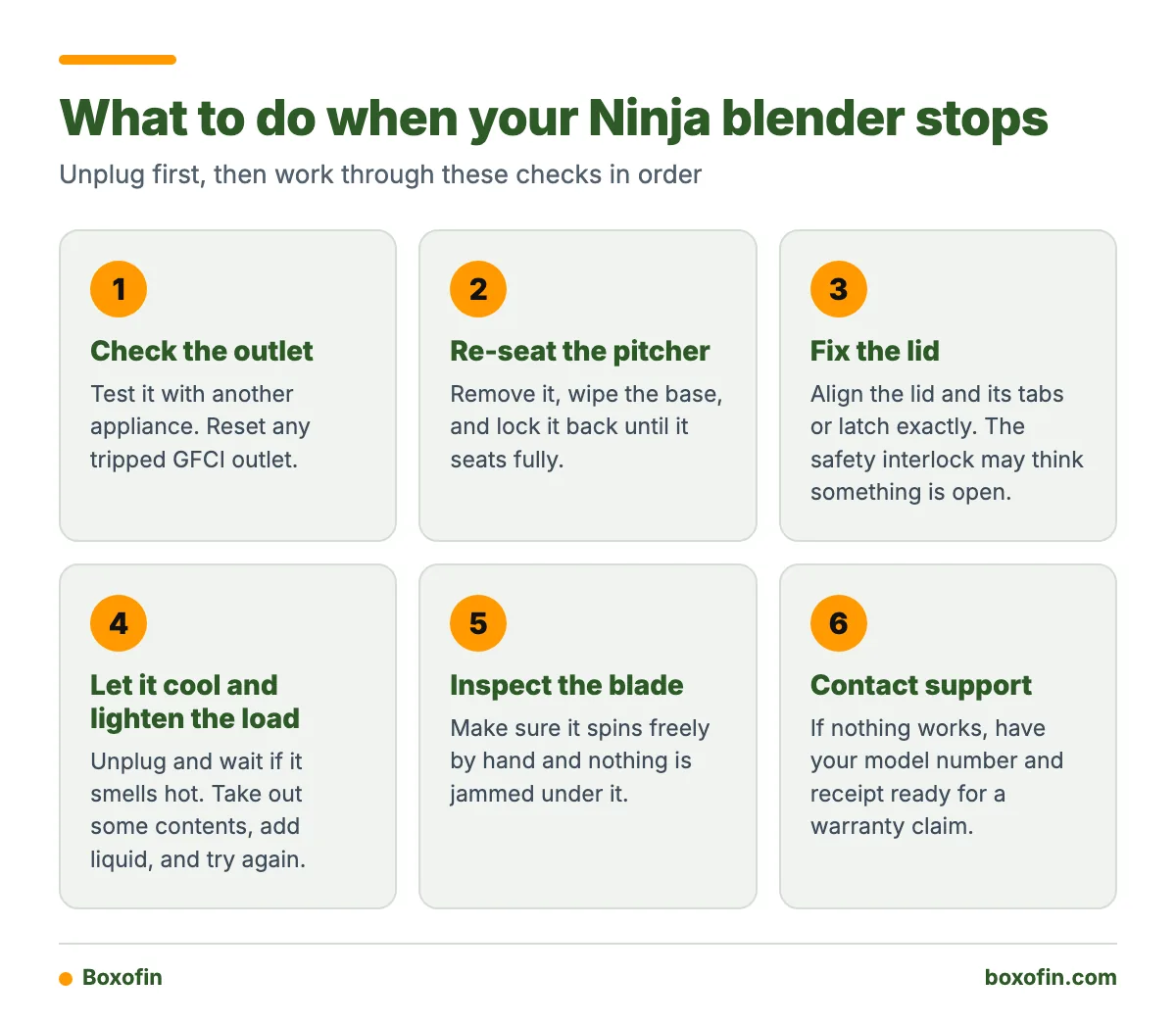
- Check the outlet. Test it with another appliance. Reset any tripped GFCI outlet.
- Re-seat the pitcher. Remove it, wipe the base, and lock it back until it seats fully.
- Fix the lid. Align the lid and its tabs or latch exactly. Many Ninja models will not run if the safety interlock thinks something is open.
- Let it cool. If it stopped mid-blend or smells hot, unplug it and wait. Check your Owner’s Guide for the cooldown time.
- Remove the load. Take out some contents, add liquid, and try again. Overloaded jars are a common cause.
- Inspect the blade. Make sure it spins freely by hand and nothing is jammed under it.
- Charge fully (portable models). Check the cable, port, and charge light.
- Contact support. If nothing works, move to a warranty claim.
How can I tell whether the motor, power base, blade assembly, or safety interlock failed?
| Symptom | Likely cause |
|---|---|
| Totally silent, no response | Safety interlock (lid or pitcher seating) or power issue | Works after cooling, stops again under load | Overload or thermal protection |
| Hums but blade does not turn | Blade assembly, coupling, or jam |
| Burning smell, weak spin | Motor wear or overheating |
| Leaks at the bottom | Seal or cracked pitcher |
The key difference: an interlock problem usually fixes itself when you reseat the parts. An overload problem clears after cooling. A true motor failure stays broken after both.
Pitcher, Lid, Blade, and Seal Problems
These parts take the most abuse. Heat, ice, and dishwashers wear plastic and rubber over time. Owners often report cracked pitchers, seals that start to leak, and lids that no longer lock cleanly.
If the base runs strongly but a part fails, replace the part. A new pitcher, lid, or blade assembly costs far less than a new blender.

How to Make a Warranty Claim
- Find your model number, usually on the base.
- Locate your receipt or order record. It shows the purchase date and confirms an authorized retailer.
- Note the symptom and what you already tried.
- Contact Ninja support. Ninja’s warranty pages list 1-866-826-6941 for support and warranty options.
Ninja’s five-year warranty requires use and care consistent with the Owner’s Guide. Follow the manual, and keep your proof of purchase.
Is It Worth Repairing a Ninja Blender or Replacing It?
Repair when the fix is a cheap part on a sound base. Replace when the motor is failing or the repair costs close to half of a new unit. That half-price line is a common rule of thumb, not a Ninja rule.
If the unit is within warranty and the defect is not misuse: use Ninja support.
If it is out of warranty and a pitcher, lid, seal, or blade is worn: replace that part.
If the motor smells burnt, stalls, or fails repeatedly and the unit is old: replace the whole blender.
Worked example
The prices below are illustrative only. Use your own numbers.
- Two-year-old unit, failed blade assembly: It is likely out of a one-year warranty. If a new blade assembly costs $25 and a new blender costs $90, the repair is about 28% of replacement. Replace the part.
- One-year-old unit, suspected motor defect: Check the warranty first. If you are inside the coverage window, have your receipt and call support. A new motor base would cost far more than the part above, so a claim beats paying out of pocket.
How Can I Make My Ninja Blender Last Longer?
Small habits add up. Based on typical manual guidance and the failure patterns above:
- Load correctly: liquid first, then soft items, then ice or frozen fruit on top. Do not overfill.
- Pulse thick mixes: short bursts reduce motor strain.
- Give it rest breaks: let it cool between heavy batches.
- Rinse right away: dried residue wears seals and jams blades.
- Dry the seal and base: never submerge the motor base.
- Check parts often: replace cracked pitchers or tired seals early.
- Charge portable models sensibly: use the supplied cable.
What do owners say?
Owners like
- Some report five or more years of regular use without problems.
- Strong blending of ice, frozen fruit, and smoothies.
- Personal and portable models are convenient and compact.
- Dishwasher-safe parts and easy cleanup.
- Powerful and durable in the early years.
Common complaints
- Cracked or leaking plastic pitchers and containers.
- Loud operation while blending.
- Blade assemblies, seals, or lids becoming unreliable.
- Motor overheating, burning smells, or unexpected stops.
- Portable models with charging, battery, or mid-blend shutdown problems.
Summarised from owner reviews and long-term user reports; individual experiences vary.
Frequently Asked Questions
How long do Ninja blenders last?
Owner reports range from about one year to more than five years. Corded full-size models used lightly last longest. Daily use and portable battery models tend to last shortest.
Does Ninja blender have a lifetime warranty?
No. Ninja’s published warranties run one year or five years for eligible products, with conditions and exclusions. Check the exact terms for your model.
What to do when your Ninja blender stops working?
Unplug it and check the outlet, pitcher seating, lid alignment, and cooling time. Remove some of the load and retry. If it still fails, contact Ninja support with your model number and receipt.
Do Ninja blenders have a warranty?
Yes. Eligible models carry a one-year or five-year limited warranty covering defects. Coverage depends on the model and on buying from an authorized retailer.
Why did my Ninja blender stop working?
Common causes are overheating from heavy loads, a lid or safety latch not seated, a worn blade assembly or seal, a failing motor, or battery trouble on portable models. Start with the simple checks above before assuming the motor has failed.