
Add liquid first, stay under the fill line, and put frozen ingredients in last. Those three habits solve most Ninja blender problems, and picking the right model for your recipes handles the rest. This guide covers loading order, frozen fruit, cleaning, noise, stalls, and how personal, full-size, and portable Ninjas differ.
Quick answer
Load liquid first, soft items next, frozen items last, and never pass the fill line. Pulse before a full blend, and pause to redistribute if ingredients stick. Match the blender to your batch size.
- Best for single servings: personal cup models, compact and quick to rinse
- Best for ice and family batches: full-size pitcher models
- Best for on-the-go: portable models, with limited capacity
- Order matters: liquid, soft ingredients, greens, then frozen items on top.
- Overfilling and too little liquid cause most stalls.
- Remove the blade assembly from the container before washing.
- Ninja blenders are loud, so plan your countertop setup.
- Choose by servings and recipes, not by peak wattage claims alone.
- What order should ingredients go into a Ninja blender?
- How much liquid should I add?
- Why does my Ninja blender struggle with frozen fruit or ice?
- Pulse, manual speeds, and Auto-iQ
- What is the difference between Ninja personal, full-size, and portable blenders?
- Which Ninja blender is best for your recipes?
- How do I clean a Ninja blender safely and quickly?
- Why are Ninja blenders so loud?
- How should I handle blades, stalls, and hot smells?
- What do owners say?
- Frequently Asked Questions
What order should ingredients go into a Ninja blender?
Liquid goes in first, soft ingredients next, leafy greens after that, and frozen ingredients last. The liquid sits near the blades and keeps them moving. Frozen pieces on top push everything down as they break up.
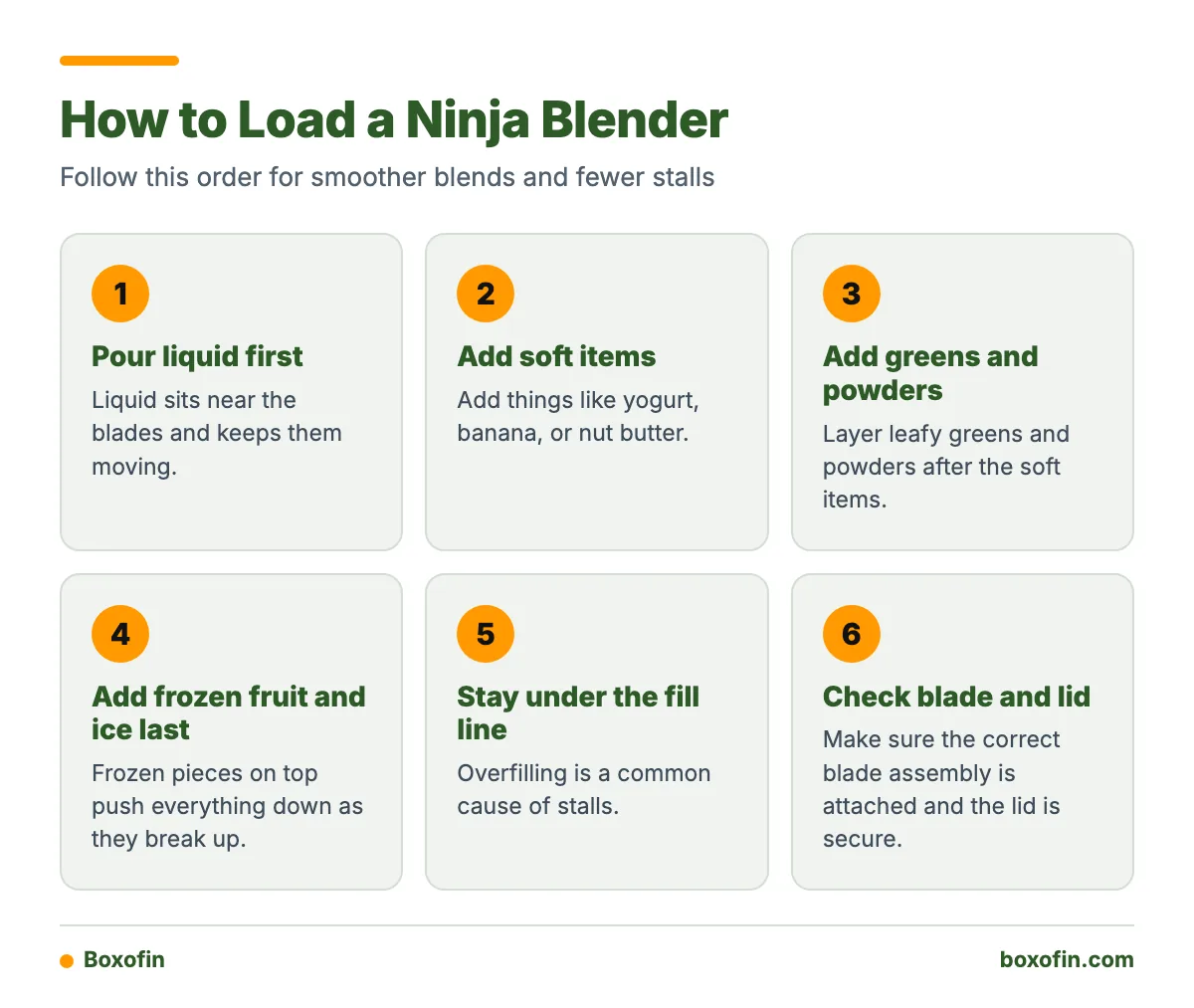
Use this pre-blend checklist every time:
- Pour liquid in first.
- Add soft items such as yogurt, banana, or nut butter.
- Add greens and powders.
- Add frozen fruit and ice last.
- Do not go past the fill line.
- Check the correct blade assembly is attached and the lid is secure.
With personal cups, the cup is flipped onto the base. So the last thing you add ends up closest to the blades once it is inverted. Many owners miss this. In practice, that means the “top” layer in the cup becomes the bottom layer in use. Follow your manual for the exact loading direction on your model.

How much liquid should I add to a Ninja blender?
Add enough liquid to let the contents move and circulate, then add more a splash at a time if the mix stops turning. Ninja does not publish a single ratio for every recipe, so use the fill lines as your limit and thickness as your guide.
A thick smoothie needs more liquid than a thin one. Frozen fruit, protein powder, and oats all soak up liquid. If the blades spin but nothing moves, you need more liquid, not more time. Stop, add a small amount, and try again.
Why does my Ninja blender struggle with frozen fruit or ice?
Usually the load is too dense, too full, or too dry. Frozen pieces can form a bridge over the blades, leaving an air pocket underneath. The blades spin freely while nothing drops down. Owners also report stalls when frozen ingredients sit too long or are packed in without enough liquid.
Worked example: a frozen smoothie in a 20-ounce cup
- Pour in liquid, such as milk, to cover the bottom.
- Add a spoonful of yogurt and half a banana.
- Add a handful of spinach.
- Add frozen berries last, staying under the fill line.
- Secure the lid and pulse a few times first.
- Pause. Turn the unit off and redistribute the contents by shaking or, if your model allows, opening it and stirring.
- Blend again. If it still stalls, add a splash of liquid. Do not force an overpacked cup.
Tips for greens, nuts, and thick mixtures
- Leafy greens: blend them with the liquid first, then add frozen fruit.
- Nuts: start with a short pulse, and add liquid before a long run.
- Thick mixtures: work in stages, and stop to scrape down rather than running the motor hard.
- Ice: full-size models are better suited to ice-heavy recipes, based on how they are designed and what owners report.
Pulse, manual speeds, and Auto-iQ
Pulse first to break big pieces apart, then switch to a continuous setting. Auto-iQ programs, on models that have them, run a preset pattern of pulsing, pausing, and blending, so you do not have to time it yourself. Manual speeds suit recipes the presets do not cover.
Short bursts also help the motor. Long, heavy runs on a dense mix are a common route to stalls and hot smells.
What is the difference between Ninja personal, full-size, and portable blenders?
Personal models suit single servings, full-size models suit larger batches and ice-heavy recipes, and portable models trade capacity and sustained power for convenience. The design changes your technique, not just your portions.
| Type | Practical capacity | Best recipes | Portability | Cleaning | Limits |
|---|---|---|---|---|---|
| Personal | Single cups, such as 20 ounces | One smoothie, shakes, sauces | Take the cup with you | Easy rinse; blade needs care | Small batches, easy to overpack |
| Full-size | Pitcher, such as 72 ounces | Family batches, frozen drinks, ice, soups | Stays on the counter | More parts, larger to wash | Bulky, loud, overkill for one serving |
| Portable | Small, built-in cup | Light smoothies, quick drinks | Easiest to carry | Quick warm-water rinse | Less capacity and sustained power |
Serving calculation
A representative full-size Ninja pitcher is marketed as 72 ounces, with a 64-ounce maximum liquid capacity, per the retailer listing data. A 20-ounce personal cup is its total volume, and you need headroom in it too. Even so, 64 divided by 20 is 3.2, so the pitcher’s liquid line holds a little more than three cups’ worth of volume. For a family of four, one pitcher batch can replace several personal-cup runs.
Peak wattage claims are on the box, but they do not tell the full story. Capacity, container size, and blade configuration affect results just as much.
Which Ninja blender is best for smoothies, frozen drinks, soups, or single servings?
If you make one smoothie a day: choose a personal cup model.
If you cook for a family or crush ice often: choose a full-size pitcher.
If you blend at the gym or office: choose a portable model, and keep recipes light.
If you want soups: use a pitcher, and follow the manual’s hot-liquid guidance for your model.
Before you buy, ask three questions. How many servings do I make at once? Do I use ice or frozen fruit daily? Where will I store it? Lowe’s lists many Ninja blenders in a single place, so you can compare sizes on its Ninja blender page.
How do I clean a Ninja blender safely and quickly?
Rinse right after use, then run a quick soap-and-water pulse. For the BL640 series, Ninja recommends 2 to 3 drops of dish soap, warm water filled halfway, and 5 to 10 pulses, per the BL640 FAQ.
For the portable Blast Max, Ninja specifies warm, not hot, water up to the MIN LIQUID line and one small drop of dish soap, per its portable blender FAQ.
Keep the motor base separate. Wipe it with a damp cloth and never put it in water or the dishwasher. Only the removable parts get washed.
Can Ninja blender cups, lids, pitchers, and blades go in the dishwasher?
On many models, yes, but placement rules differ. Ninja’s BN400 FAQ says containers, lids, and blade assemblies are dishwasher safe, but you should remove the blade assembly from the container first. For the BL640, Ninja recommends the top rack for blades, cups, and lids. The BN750 instructions say top rack only, after separating all parts.
- Separate every part before loading.
- Use the top rack.
- Dry fully before reassembling, since damp parts make lids harder to screw on.
- Check your own model’s manual first.
Why are Ninja blenders so loud, and how can I reduce the noise?
High-speed motors, hard ice, and thin plastic containers all make noise. Food Republic’s coverage of owner feedback mentions a Twisti test that put Ninja blender noise at about 100 decibels, and loud operation is a repeat complaint in owner reports.
You cannot silence it, but you can soften it:
- Place the base on a folded towel or rubber mat.
- Keep it away from cabinet walls that echo.
- Use shorter blends, and let liquid do some of the work.
- Crush ice in a pulse burst, not a long run.
- Blend before others are asleep or on a call.

How should I handle Ninja blades and a blender that smells hot or stalls?
Stop, unplug, and let it cool. A stall or a hot-plastic smell usually means the motor is working too hard, often from an overpacked container or too little liquid.
- Turn the blender off and unplug it.
- Remove the container and check for ingredients jammed against the blades.
- Take out some of the contents, and add liquid.
- Check the blade assembly is seated and the lid is on correctly.
- Let the motor rest before trying again.
Always handle blade assemblies by the base or with a utensil, and never reach into a container with the base plugged in. If a burning smell returns on a light load, stop using it and contact Ninja support. Some owners report smells and early part failures.
For stuck lids, wipe off moisture and avoid over-tightening. Condensation can make lids hard to turn.
What do owners say?
Owners like
- Smooth results and fast blending for smoothies.
- Strong ice crushing in full-size models.
- Dishwasher-friendly removable cups, lids, and blades on many models.
- Reliable daily use for several years, according to some owners.
- Good performance for the price.
Common complaints
- Very loud, especially with ice or frozen ingredients.
- Blade assemblies and narrow cups can be hard to clean thoroughly.
- Lids or cups can be hard to screw on or remove when wet or condensed.
- Stalls when frozen ingredients sit too long or are packed without enough liquid.
- Some burning-plastic smells and premature part failures.
Summarised from owner reviews and long-term user reports; individual experiences vary.
Frequently Asked Questions
What are the best ninja blender tips and tricks?
Add liquid first, then soft ingredients, then frozen items. Stay under the fill line, pulse before a full blend, and pause to redistribute if the mix sticks. Wash the parts soon after use so residue does not harden.
What is the difference between ninja blenders?
The main differences are size, power delivery, and design. Personal models make single servings in a cup, full-size models use a large pitcher for batches and ice, and portable models are small and cordless-style for travel. Check capacity, blade assembly, and cleaning needs, not only wattage.
Can I put the whole Ninja blender in the dishwasher?
No. Only the removable cups, lids, pitchers, and blade assemblies may go in, and many manuals say top rack only. Wipe the motor base with a damp cloth.
Why does my Ninja blender stall?
Most stalls come from overfilling, too little liquid, or frozen chunks bridging over the blades. Turn it off, unplug it, remove some contents, add liquid, and restart with short pulses.
Are Ninja blenders really that loud?
Yes. Owners often describe them as very loud, and one Twisti test reported about 100 decibels, as covered by Food Republic. A mat under the base and shorter blends help.
Sources