Most people compare these two brewers by asking which one is better, and that question has no single answer. A French press suits drinkers who want a larger batch of fuller-bodied, oilier coffee with few steps. An AeroPress is faster, easier to clean, easier to carry, and makes a smoother cup with no grit. It is also not a French press: it adds a paper micro-filter and air pressure to the mix.
Quick answer
Pick the French press if you brew for two or more people and like a heavy, rich cup. Pick the AeroPress if you drink one cup at a time, want a clean cup, or travel. Match the brewer to your routine, not to a universal ranking.
- Best for batches: French press, for several cups at once
- Best for one cup: AeroPress, for speed and easy cleanup
- Best for travel: AeroPress, for its compact size
- A French press steeps coffee and filters it through metal mesh. That leaves oils and some fine sediment in the cup.
- An AeroPress combines immersion, a paper micro-filter, and air pressure. The result is smoother and less gritty.
- French press grind can work in an AeroPress, but it usually needs to go finer, toward medium-fine.
- The French press wins on batch size. The AeroPress wins on speed, cleanup, and portability.
- Weak, watery AeroPress coffee usually points to a recipe problem, not a bad brewer.
- What’s the difference between a French press and an AeroPress?
- Is an AeroPress a French press?
- Does AeroPress coffee taste like French press coffee?
- Can I use French press grind for an AeroPress?
- Side-by-side comparison
- How do you use a French press and an AeroPress?
- Which one is better for one person or multiple cups?
- Which brewer is easier to clean and travel with?
- Is an AeroPress better than a French press?
- What do owners say?
- Frequently Asked Questions
What’s the difference between a French press and an AeroPress?
The core difference is filtration. A French press uses a metal mesh plunger. An AeroPress pushes coffee through a paper micro-filter with air pressure. That one change shapes the taste, the cleanup, and the size of the batch.
How a French press works
You add coarse grounds and hot water to a glass or steel carafe. The coffee steeps, a full immersion brew, for several minutes. Then you press a mesh screen down to trap the grounds at the bottom. Oils and fine particles pass through the mesh. That is why French press coffee feels heavy on the tongue.
How an AeroPress works
The AeroPress is a plastic chamber with a plunger. You add medium-fine grounds and water, stir, then press the plunger down. According to the manufacturer, the process combines rapid immersion, a paper micro-filter, and air pressure, and a typical brew takes about a minute. You can read the maker’s own take in its AeroPress vs French Press comparison.
Is an AeroPress a French press?
No. They share the word “press” and both use a plunger, but the designs differ. A French press holds coffee in a large carafe and filters with metal mesh at the end. An AeroPress is a small, sealed chamber. It forces water through a paper filter. So “is french press and aeropress the same” has a short answer: they are not.
Does AeroPress coffee taste like French press coffee?
Partly. Both are immersion-style brews, so both can taste full-bodied. The AeroPress cup is smoother and cleaner, because the paper micro-filter removes grit. A paper AeroPress filter gives a less gritty cup than the metal mesh normally used in a French press, according to the manufacturer.
Body, oils, and sediment
French press coffee carries more oils and fine particles. Many drinkers love that thick, rich feel. Others find it muddy. AeroPress coffee has less oil on top and almost no sediment. Flavors tend to read as sharper and more distinct.
Strength
“Strong” can mean two things. If you mean heavy body, the French press usually delivers it. If you mean concentrated flavor, the AeroPress can do that too. You can use more coffee and less water, then dilute the result like an americano. It is flexible, but it takes some tuning.
Can I use French press grind for an AeroPress?
Yes, but expect to adjust. AeroPress recommends a medium-fine grind for its best brewing experience, which is finer than a typical French press setting. Its Brewing help article covers grind and temperature starting points.
Coarse grounds have less surface area. In a short AeroPress brew, water does not pull out enough flavor. The cup comes out weak, thin, or sour. You have three ways to fix it:
- Grind finer. Move toward medium-fine. This is the best fix.
- Steep longer. Add extra time before pressing.
- Stir more. Agitation helps coarse grounds give up flavor.
Grind conversion at a glance
| Brewer | Grind | Look and feel | What happens if wrong |
|---|---|---|---|
| French press | Coarse | Like coarse sea salt | Too fine: bitter, muddy, hard to press |
| AeroPress | Medium-fine | Like table salt to fine sand | Too coarse: weak, watery, sour |
Going the other way is worse. Medium-fine grounds in a French press pass through the mesh and clog it. You get sludge and a hard plunge.
Side-by-side comparison
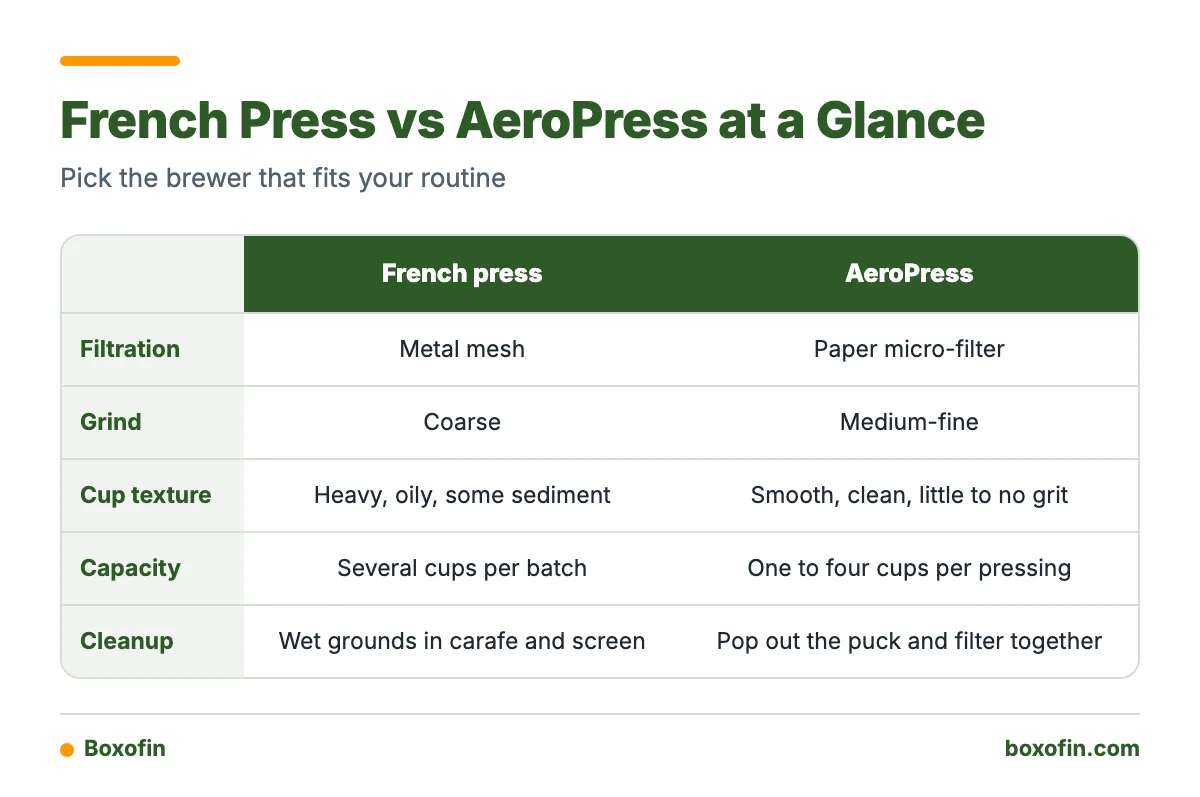
| Feature | French press | AeroPress |
|---|---|---|
| Brew method | Full immersion, metal mesh | Immersion plus air pressure, paper filter |
| Typical time | Longer steep, often around 4 minutes | About a minute to just under two minutes in common recipes |
| Grind | Coarse | Medium-fine |
| Filtration | Metal mesh | Paper micro-filter |
| Cup texture | Heavy, oily, some sediment | Smooth, clean, little to no grit |
| Capacity | Several cups per batch | One to four cups per pressing, depending on recipe |
| Cleanup | Wet grounds in carafe and screen | Pop out the puck and filter together |
| Portability | Bulky, glass can break | Compact, lightweight plastic |
| Best user | Households, batch drinkers | Solo drinkers, travelers, tinkerers |

How do you use a French press and an AeroPress?
Both are simple once you know the order of steps. Here are the basic methods. Start with water just off the boil for the French press. For the AeroPress, the maker suggests about 175°F (80°C) for dark roasts and 185°F (85°C) for medium and light roasts as starting temperatures.
French press, step by step
- Warm the carafe with hot water, then empty it.
- Add coarse-ground coffee. A common starting ratio is about 1 part coffee to 15 parts water by weight.
- Pour in hot water and stir gently.
- Set the lid on top with the plunger up. Steep for around 4 minutes.
- Press the plunger down slowly and evenly.
- Pour right away. Coffee left on the grounds keeps extracting and turns bitter.
AeroPress, step by step
- Place a paper filter in the cap and rinse it with hot water.
- Set the chamber on a sturdy mug and add medium-fine grounds.
- Pour in water and stir for a few seconds.
- Insert the plunger and press gently until you hear a hiss.
- Dilute with hot water if you want a longer cup.
The maker’s getting started guide shows the standard method and the inverted method.
Worked example: one cup versus a batch
A commonly published AeroPress recipe uses 17 g of coffee and 220 g of water, with a total brew time of just under two minutes. That works out to about 1 part coffee to 13 parts water. It makes one strong mug.
Now scale a French press to a family batch. At a 1:15 ratio, 60 g of coffee needs 900 g of water. That fills about three to four mugs. Brew time is longer, and you clean a full carafe of wet grounds.
To serve three people with an AeroPress, you would press three times. At around two minutes each, that takes more hands-on time than one French press batch. For one drinker, the opposite is true. You waste nothing and skip the big cleanup.
Which one is better for one person or multiple cups?
The AeroPress is better for one person. The French press is better for multiple cups. AeroPress instructions state that one pressing makes one to four cups, depending on the recipe and cup size. In practice, the chamber is small, and the stronger recipes make one or two servings.
If you brew for one person every morning, choose the AeroPress.
If you brew for two to four people at once, choose the French press.
If you do both, own both. They cost little compared with most coffee machines.
Which brewer is easier to clean and travel with?
The AeroPress wins both. You push the plunger and the puck of grounds with its paper filter pops out into the trash or compost. A quick rinse finishes the job. A French press leaves wet grounds in the carafe and around the mesh screen. You must scoop them out, rinse them, and often take the screen apart.
Durability and portability
The AeroPress is lightweight plastic and compact. It fits in a bag for the office, a camping trip, or a hotel room. A glass French press can crack if dropped. Steel versions are sturdier, but they are still larger and heavier. Long-term owners often report that AeroPress units stay usable for many years.
Environmental notes
The French press uses no paper, so it creates less ongoing waste. The AeroPress needs paper filters, which are small and cheap. Some are reusable if you buy a metal disc, though that brings back some of the oils and sediment.

Is an AeroPress better than a French press?
Not in every case. This is the answer to “what’s better french press or aeropress.” An AeroPress is better for speed, clean cups, travel, and easy cleanup. A French press is better for batch brewing, simple technique, and a thick, rich body.
Cost and accessories
Both are affordable. The French press needs nothing extra beyond a kettle and a grinder. The AeroPress needs paper filters on a regular basis. A metal filter, a scale, and a sturdy mug are useful add-ons for either one. A burr grinder helps most, because both brewers punish uneven grounds.
Best choice by use case
| Situation | Better pick | Why |
|---|---|---|
| Home, shared mornings | French press | Several cups in one batch |
| Home, solo drinker | AeroPress | One cup, quick cleanup |
| Office desk | AeroPress | Compact, easy to rinse |
| Travel and camping | AeroPress | Light and tough |
| Beginners | French press | Fewer variables to tune |
| Heavy, rich coffee | French press | Oils pass through the mesh |
| Clean, grit-free coffee | AeroPress | Paper micro-filter |
Decision checklist
- Choose a French press for fuller body and batch brewing.
- Choose an AeroPress for speed, clarity, portability, and low sediment.
- Brewing mostly for one? AeroPress.
- Hate washing wet grounds? AeroPress.
- Want the simplest routine with no paper? French press.
What do owners say?
Owners like
- AeroPress owners repeatedly praise the clean, low-sediment coffee.
- AeroPress cleanup is described as quick and simple, because the used puck and paper filter can be discarded together.
- Many owners praise the AeroPress’s portability and compact size for travel, offices, and camping.
- Long-term owners frequently report durable AeroPress units that stay usable for many years.
- French press owners value the fuller body, the visible brewing process, and the ability to make several cups at once.
Common complaints
- Some AeroPress owners find the capacity too small for serving several people.
- Some say AeroPress coffee tastes weak or watery until the grind, dose, steep time, or dilution is adjusted.
- Some users consider AeroPress brewing more technique-sensitive and more involved than a French press.
- French press users commonly dislike sediment or grit in the cup.
- French press cleanup is often considered messier, because wet grounds remain in the carafe and filter assembly.
Summarised from owner reviews and long-term user reports; individual experiences vary.
Frequently Asked Questions
What’s the difference between French press and AeroPress?
A French press steeps coarse grounds in a carafe and filters through metal mesh. An AeroPress steeps medium-fine grounds briefly, then pushes the coffee through a paper filter with air pressure. The French press makes a heavier cup in bigger batches. The AeroPress makes a cleaner cup, one to a few servings at a time.
Is AeroPress a French press?
No. Both use a plunger, but the AeroPress is a small sealed chamber with a paper micro-filter. A French press is a large carafe with a metal mesh screen. The brewing method and cup are different.
Is French press AeroPress the same?
They are not the same. They are two separate brewers. Some people search for “french press aeropress” hoping for a hybrid, but no standard product combines them. The AeroPress does borrow the immersion idea from the French press.
Is AeroPress better than French press?
It depends on what you need. The AeroPress is better for one cup, speed, travel, and easy cleanup. The French press is better for several cups and a rich, oily body. Is French press or AeroPress better for you? Check your serving size and taste preference first.
Can I use French press grind for AeroPress?
You can, but the result is often weak or under-extracted. AeroPress recommends a medium-fine grind. If you only have coarse grounds, steep longer, stir more, or grind finer when possible.
Does AeroPress taste like French press?
Somewhat. Both can be full-bodied. The AeroPress is smoother, because the paper filter removes grit and many oils. The French press tastes heavier and can leave sediment at the bottom of the mug.
How to use French press AeroPress methods?
For a French press, add coarse grounds and hot water, steep about 4 minutes, then press slowly. For an AeroPress, add medium-fine grounds and water, stir, then press for about a minute of total brew time. The step-by-step lists above cover both.
Sources