Smart thermostats usually do save money, but the savings are modest for most homes and close to zero for some. Studies show gains from a few percent to low double digits, and gas-heated homes tend to see the clearest results.
- Smart thermostats can cut heating and cooling costs, but the amount depends on your home, climate, fuel, and habits.
- Manufacturer claims (up to 23% to 26% for ecobee) are higher than most independent billing studies.
- Gas-heated homes show steadier savings. Electric-heated homes showed no consistent savings in one large utility-backed analysis.
- Most of the savings come from automation, not from Wi-Fi itself.
- A $130 to $250 thermostat can pay back in about one to three years in the right home.
- Quick Answer
- How Smart Thermostats Create Savings
- Manufacturer Claims vs. Independent Studies
- Gas Heat vs. Electric Heat
- How ecobee Says It Saves Money
- When Savings Will Be Small
- Payback and Break-Even Example
- Factors That Change Your Savings
- How to Estimate Your Own Savings
- Common Misconceptions
- Frequently Asked Questions
Quick Answer: Do Smart Thermostats Save Money?
Yes in most cases, but not in every home. Based on published studies, a realistic expectation is single digits to low double digits on heating and cooling costs. Your home may land at either end.
A smart thermostat works best when the old setup wasted energy. Think of a house heated all day with nobody home, or a manual thermostat nobody ever adjusts. If you already turn the temperature down every time you leave, you have less to gain.
How Do Smart Thermostats Save Money?
The savings come from running your HVAC system less when it is not needed. Four features do most of the work:
- Schedules: The thermostat sets back the temperature while you sleep or work, then restores comfort before you return.
- Occupancy sensing: Sensors detect that nobody is home and shift to an energy-saving setpoint.
- Remote control: You can change settings from your phone when plans change, so the house does not condition an empty space all day.
- Learning and reports: Some models adjust to your routine and show run-time data so you spot waste.
Do Wi-Fi Thermostats Save Money, or Is It Mostly Automation?
It is mostly automation. Wi-Fi is the delivery method. A basic programmable thermostat with a well-built schedule can capture much of the same savings. The difference is that people often never set up or maintain a programmable schedule. Smart models make setup easier and add sensors and app control, which is why they tend to stick.
Heating, Cooling, or Both?
Both. A smart thermostat controls the whole system, so setbacks in winter cut furnace run time and setups in summer cut air conditioner run time. One Cadmus study cited by ACEEE reported Nest users cut heating gas use by about 13.4% and cooling electricity by 16.1% in one program. That is one program, not a universal number.

Manufacturer Claims vs. Independent Studies
Many articles repeat the biggest number they can find. The gap between marketing and measured billing data is worth seeing side by side.
| Source | What it reports | Type |
|---|---|---|
| ecobee | Up to 23% to 26% savings on heating and cooling; about $250 to $284 per year in the U.S. | Manufacturer claim |
| Cadmus study (cited by ACEEE) | Nest: about 13.4% less heating gas and 16.1% less cooling electricity in one program | Program evaluation |
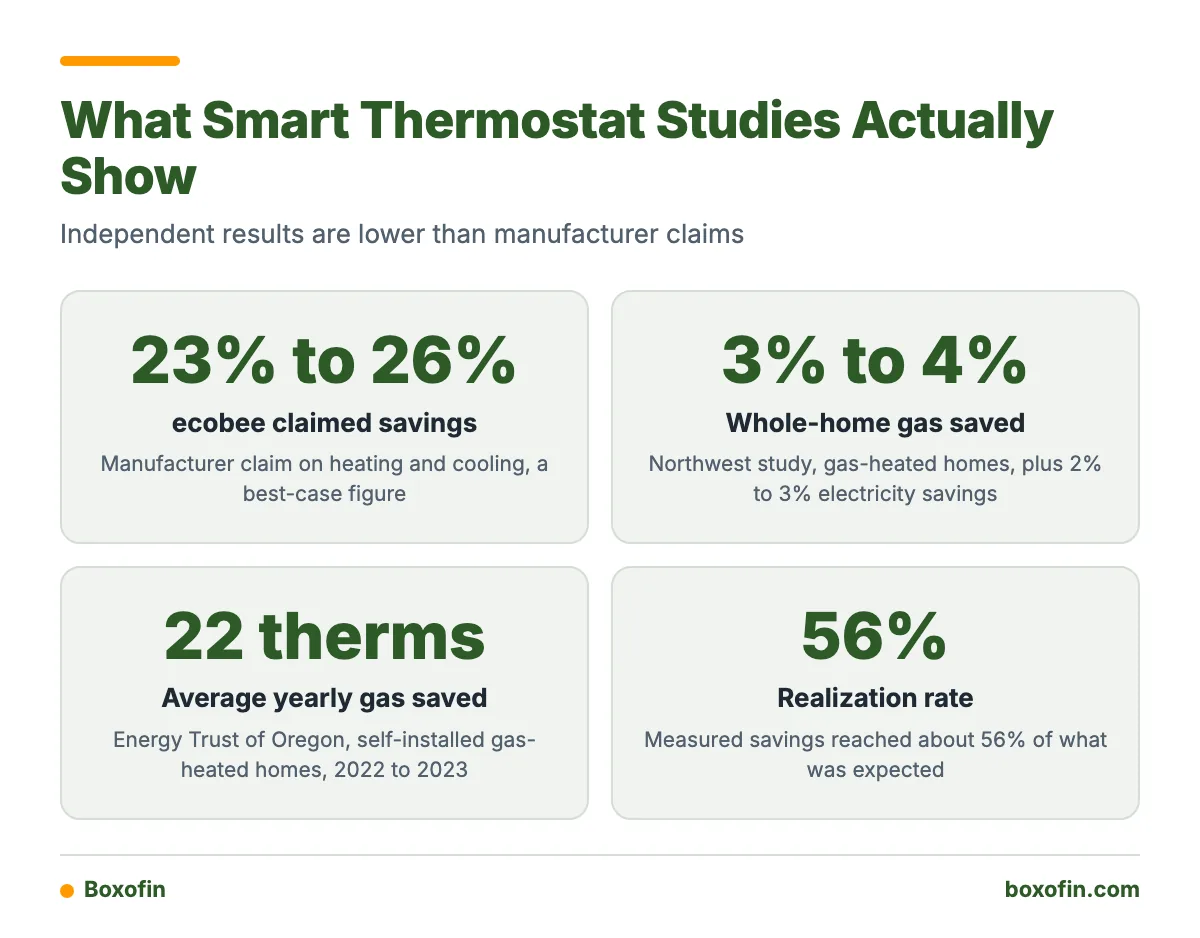
| Northwest Smart Thermostat Research Study | 3% to 4% of whole-home gas use saved in gas-heated homes, plus 2% to 3% electricity savings | Independent research |
| Energy Trust of Oregon | Average of 22 therms per year in self-installed, gas-heated homes (2022 to 2023); no consistent electric savings in electric-heated homes | Utility billing analysis |
Notice the pattern. Percentages measured against heating and cooling alone look bigger than percentages measured against the whole-home bill. Always check what the number is a percentage of.
Do Smart Thermostats Save Money in Every Home? Gas vs. Electric Heat
No. Fuel type is one of the biggest dividing lines. In the Energy Trust analysis, natural gas homes showed real, measurable savings. Electric-heated homes did not show consistent or statistically significant electricity savings.
There are plausible reasons for this, though the report is the source for the result, not for these explanations. Electric resistance and heat pump systems can respond differently to deep setbacks. Heat pumps in particular may switch on backup heat to recover from a big temperature drop, which can erase the savings. If you have a heat pump, look for a thermostat built to manage recovery smoothly.
How Does the ecobee Smart Thermostat Save Money?
ecobee says its thermostats save up to 23% to 26% on heating and cooling, about $250 to $284 per year in the U.S., depending on model and analysis basis. The company also says some models may pay for themselves in about six months to one year. See the maker’s page on its Wi-Fi-enabled smart thermostats.
The savings mechanisms are the same ones listed above: scheduling, occupancy detection, remote sensors that read temperature in rooms you actually use, and app-based control. Treat the percentage as a best-case marketing figure. The independent results in the table are lower, so plan around those.
When a Smart Thermostat Is Unlikely to Save Much
- You already use a programmed schedule and stick to it.
- Your home is small, well insulated, and rarely needs heating or cooling.
- Someone is home all day and prefers a steady temperature.
- You have electric resistance heat or a heat pump and use deep setbacks that trigger backup heat.
- Your climate is mild and your bills are already low.
A thermostat cannot save a large share of a small bill. Ten percent of $400 a year is $40.

Can a Smart Thermostat Pay for Itself? A Break-Even Example
It can. Here is a simple, illustrative calculation. These are example numbers, not measured results. Swap in your own.
- Add up your yearly heating and cooling cost. Example: $1,200.
- Pick a savings rate. A cautious pick is 5% to 10%.
- Multiply. 5% is $60 per year. 10% is $120 per year.
- Divide the thermostat price by annual savings.
| Yearly HVAC cost | Savings rate | Yearly savings | Thermostat price | Payback |
|---|---|---|---|---|
| $1,200 | 5% | $60 | $130 | About 26 months |
| $1,200 | 10% | $120 | $130 | About 13 months |
| $1,200 | 10% | $120 | $250 | About 25 months |
| $2,000 | 10% | $200 | $250 | About 15 months |
Higher bills shorten the payback. Cheaper models shorten it too. Utility rebates can cut the price further, so check your provider before you buy. Some of the models you may see include the ecobee Smart Thermostat Essential and the Smart Thermostat Premium.
Factors That Change Your Savings
- Climate: More heating and cooling hours mean more to save.
- Habits: A house that was always kept at one temperature gains the most.
- Occupancy: Empty hours during the workday are where setbacks pay off.
- Rate plans: With time-of-use pricing, shifting run time away from peak hours can lower the bill beyond simple run-time cuts.
- Home envelope: Leaky or poorly insulated homes lose temperature fast, so setbacks save less.
- Install quality: Wrong wiring or settings can cancel the gains.
How to Estimate Your Own Savings
Use this checklist. The more boxes you check, the more likely you are to save.
- If you heat with natural gas, savings are more likely.
- If you leave the house empty 8 or more hours a day, savings are more likely.
- If you never change your thermostat now, savings are more likely.
- If your yearly heating and cooling bill is over $1,000, payback will be faster.
- If you have electric heat or a heat pump, expect smaller or uncertain savings and pick a model with good heat pump controls.
- If your bill is low and your schedule is already tight, skip it unless you want comfort features.
Then pull last year’s bills, pick the heating and cooling share, and apply the 5% to 10% range from the table above. That gives you a fair, cautious estimate.
Common Misconceptions and Limits
- “It saves money automatically.” It only saves if it gets set up well and your habits give it room to work.
- “Bigger percentages are real.” Claims are often best-case and measured against a narrow base.
- “Any brand is the same.” The Energy Trust analysis found consistent results across brands, so the home matters more than the logo.
- “Turning the heat way down saves more.” Deep setbacks can trigger backup heat on some systems.
Frequently Asked Questions
How do smart thermostats save money?
They cut the time your heating and cooling run when nobody needs it. Schedules, occupancy sensors, and remote control do the work.
How does ecobee smart thermostat save money?
ecobee uses scheduling, room sensors, occupancy detection, and app control. The company says savings can reach 23% to 26% on heating and cooling. Independent studies found lower numbers, so plan for less.
Do smart thermostats save money reddit?
Online discussions are mixed. People who never managed their thermostat before often report noticeable drops. People who already adjusted it by hand often see little change. That matches the published research, which shows savings depend on the home and habits.
Why do smart thermostats save money?
They reduce wasted run time. Heating and cooling an empty house, or holding a comfort temperature overnight, costs energy. Automation removes much of that without daily effort.
Does smart thermostat save money?
In many homes, yes. The Northwest study found 3% to 4% whole-home gas savings in gas-heated homes. Energy Trust found an average of 22 therms per year in self-installed gas homes. Results in electric-heated homes were less consistent.
Do smart thermostats save money?
Usually, though not by a huge amount. Expect modest savings that can repay the purchase within a few years if your bills are moderate to high.
Do wifi thermostats save money?
Wi-Fi itself does not save energy. The scheduling, sensing, and ease of use that come with it do. A well-used programmable thermostat can save close to the same amount, but many people never program one.