
To use a French press, add coarse-ground coffee to the carafe, pour in water at about 93°C (200°F), steep for around 4 minutes, then press the plunger down slowly. Grind size and the coffee-to-water ratio decide most of the result, so start with 1 gram of coffee to 16 grams of water and adjust from there.
Quick answer
Use coarse coffee, water just off the boil (about 93°C), and a 1:16 ratio, such as 20 g of coffee to 320 g of water. Let it steep about 4 minutes, plunge slowly, and pour all of it right away so it does not over-extract.
- Coarse grounds matter most. Fine pre-ground coffee turns gritty and bitter.
- Start at 1:16 by weight. The National Coffee Association gives a range of about 1:10 to 1:16.
- Four minutes is the total contact time, not four minutes plus a bloom.
- Pour out all the coffee after plunging. Coffee left in the press keeps extracting.
- The same press makes loose-leaf tea and cold brew with different water and timing.
- How does a French press work?
- What coffee should you use in a French press?
- How do you use a French press coffee maker step by step?
- How much coffee and water do you use?
- How long should French press coffee steep?
- How do you avoid gritty or bitter French press coffee?
- Can you use a French press for tea?
- Can you use a French press for cold brew?
- How do you clean and store a French press?
- Why use a French press for coffee?
- What do owners say?
- Frequently Asked Questions
How does a French press work?
A French press is an immersion brewer. Coffee and hot water sit together in a carafe, then a metal mesh plunger pushes the grounds to the bottom. Nothing drips through paper, so the oils stay in the cup.
The parts are simple:
- Carafe: usually glass, sometimes stainless steel or ceramic.
- Lid and plunger rod: the lid holds the rod in place and often has a pour spout.
- Mesh filter and disc: a metal screen on the end of the rod. It traps grounds but lets oils and very fine particles through. That is why the cup tastes full and a little cloudy.
- Frame and handle: they protect the carafe and keep your hand away from the heat.
What coffee should you use in a French press?
Use coarse-ground coffee, about the texture of coarse sea salt. French press brewing generally calls for a coarse grind to limit sediment and over-extraction.
Fine pre-ground coffee is made for drip machines or espresso. In a press, it slips through the mesh and keeps extracting in the cup. You get grit, a muddy feel, and bitterness. A burr grinder gives the most even coarse grind. Blade grinders make dust along with chunks, which hurts the result. If you buy pre-ground, look for a bag labeled “French press” or “coarse.”
Any roast works. Medium and dark roasts are common choices because they taste rich and chocolatey in immersion brewing. Fresh beans ground just before brewing help more than any other upgrade.
How do you use a French press coffee maker step by step?
Follow these seven steps. They work for any size press.
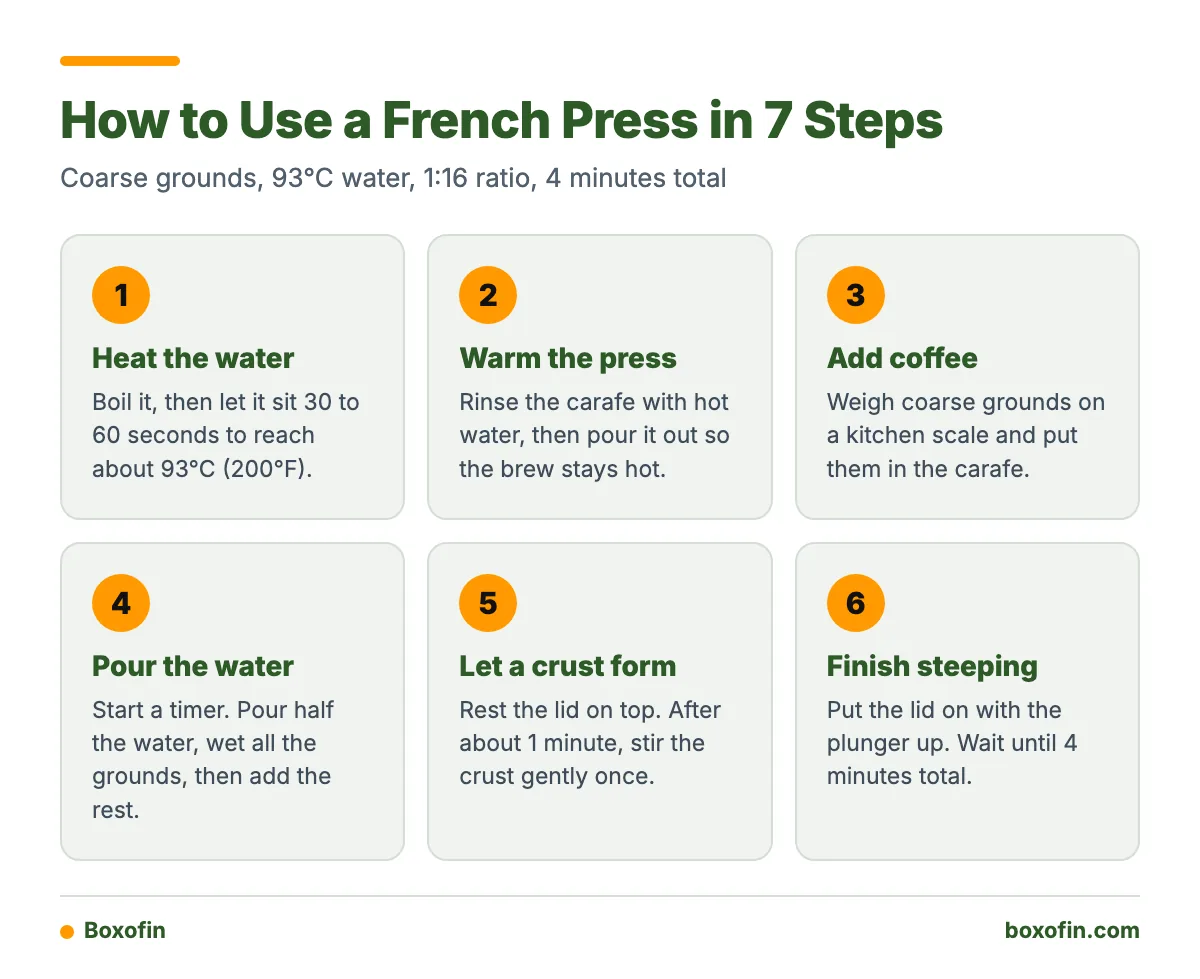
- Heat the water. Boil it, then let it sit 30 to 60 seconds. You want about 93°C (200°F).
- Warm the press. Rinse the carafe with hot water, then pour it out. A warm carafe keeps the brew from cooling too fast.
- Add coffee. Weigh your coarse grounds with a kitchen scale and put them in the carafe.
- Pour the water. Start a timer. Pour about half the water over the grounds, making sure all of them get wet, then add the rest.
- Let a crust form. Rest the lid on top without pressing. After about 1 minute, stir the crust gently once.
- Finish steeping. Put the lid on with the plunger up. Wait until the timer hits 4 minutes total.
- Press and pour. Push the plunger down slowly, with steady pressure. Serve right away.

How much coffee and water do you use in a French press?
Start at 1 gram of coffee to 16 grams of water. The National Coffee Association gives a range of roughly 1:10 to 1:16 by weight, so 1:16 is the lighter end. Stronger coffee uses less water per gram.
Press sizes are sold in ounces, but the label is the carafe’s full capacity. Leave an inch or two of headspace. The table below uses a 1:16 ratio. The figures are my own calculations from that ratio, rounded for easy measuring.
| Press size | Coffee (coarse) | Water | Approx. servings |
|---|---|---|---|
| 12 oz (about 350 ml) | 20 g | 320 g | 1 mug |
| 17 oz (about 500 ml) | 28 g | 450 g | 1 to 2 cups |
| 34 oz (about 1 L) | 55 g | 880 g | 3 to 4 cups |
| 51 oz (about 1.5 L) | 80 g | 1,280 g | 5 to 6 cups |
For the 34 oz press, 55 g of coffee with about 880 g of water follows the common 1:16 starting point.
Worked example: 20 g of coffee
Say you have a small press and 20 g of coarse coffee.
- Standard (1:16): 20 × 16 = 320 g of water.
- Stronger (1:15): 20 × 15 = 300 g of water.
- Lighter (1:17): 20 × 17 = 340 g of water.
Change only one thing at a time. If the cup tastes thin, use less water before you change the grind or time.
How long should French press coffee steep, and what water temperature works?
Steep for about 4 minutes of total contact time, with water at about 93°C (200°F). The National Coffee Association gives 93 ± 3°C, and other brewing guides commonly recommend 90 to 96°C.
No thermometer? Boil the kettle and wait 30 to 60 seconds. Water that is too hot can taste harsh. Water that is too cool leaves the coffee sour and weak. Want to adjust the time? Move in 30-second steps, not whole minutes.
If the coffee tastes sour or thin: grind slightly finer, use hotter water, or steep 30 seconds longer.
If it tastes bitter or harsh: grind coarser, shorten the steep by 30 seconds, or let the water cool a little.
If it tastes fine but weak: use more coffee, not more time.
How do you avoid gritty or bitter French press coffee?
Use a coarse grind, press slowly, and pour everything out as soon as you plunge. Most bad cups come from one of those three habits going wrong.
Troubleshooting checklist
- Gritty: grind is too fine, or you plunged too fast. Use a coarser grind. Let the cup sit a minute before drinking, and leave the last sip in the mug.
- Bitter: over-extracted. Shorten the steep, coarsen the grind, or pour out all the coffee right after pressing.
- Weak: too little coffee or too short a steep. Try 1:15 and check that your grounds are not too coarse.
- Lukewarm: the carafe was cold, or the water had cooled too much. Preheat the press. Pour into a warmed mug. Thin single-wall glass loses heat fast.
- Hard to plunge: the grind is too fine, or the press is overfilled. Use a coarser grind and leave headspace. Never force it. Pull the plunger up a little and press again.
Can you use a French press for tea?
Yes. A press works well for loose-leaf tea because the leaves have room to open. Use about 1 teaspoon (2 to 3 g) of leaf per 8 oz (240 ml) of water, then steep by tea type. Black tea takes about 3 to 5 minutes in water just off the boil. Green tea does better at around 75 to 80°C for 2 to 3 minutes.
Plunge gently when time is up, then pour all of it out. If you leave the leaves in the water, the tea turns bitter. Rinse the press well afterward so tea does not flavor your next coffee.
Can you use a French press for cold brew?
Yes. Cold brew in a press is easy. Mix coarse coffee with cold water, cover, and steep in the fridge for 12 to 16 hours. A common starting ratio for a concentrate is about 1:8, which you then dilute with water or milk to taste. Plunge slowly, then pour the whole batch into a clean jar so it stops extracting.
| Method | Grind or leaf | Water temperature | Steep time | Cleanup note |
|---|---|---|---|---|
| Hot coffee | Coarse ground coffee | About 93°C (200°F) | About 4 minutes | Rinse well; coffee oils build up |
| Loose-leaf tea | Whole or broken leaf | 75 to 100°C by tea type | 2 to 5 minutes | Wash with soap to avoid flavor carryover |
| Cold brew | Coarse ground coffee | Cold or room-temperature water | 12 to 16 hours | Fine sludge settles; rinse mesh thoroughly |
How do you clean and store a French press?
Clean it right after you pour. Wet grounds dry into a film that clogs the mesh and turns stale.

- Scoop the grounds into the trash or compost. Do not wash them down the drain, since they can clog pipes.
- Fill the carafe halfway with warm water and a drop of dish soap. Plunge up and down a few times.
- Unscrew the mesh disc and rinse both sides. Fine grounds hide between the layers.
- Rinse everything, dry it, and store it with the lid off so air can move through.
Handle glass carefully. Pouring boiling water into a cold glass carafe can cause thermal shock and cracks, which is another reason to rinse it with hot tap water first. Check the frame and glass for chips before each use. A tea-flavored press is a common complaint, so wash it well between uses.
Why use a French press for coffee?
A French press gives you full-bodied coffee with simple gear, and you control strength and time yourself. It needs no electricity, no paper filters, and no pods. Brewing steps are covered in more detail in guides from Breville and Peet’s Coffee.
Compared with other makers, the trade-offs are clear:
- Versus drip: a press gives a heavier, oilier cup because there is no paper filter. A drip machine is more hands-off and cleaner in the cup.
- Versus pod machines: a press costs far less per cup and lets you pick any beans. Pods are faster and tidier.
- Limits: there is some sediment, it takes about 4 minutes plus cleanup, and glass models can lose heat or break.
What do owners say?
Owners like
- Simple brewing process with no electricity required
- Easy control over coffee strength and steeping time
- Full-bodied flavor from immersion brewing
- Reusable metal filter, so no paper filters to buy
- Useful for brewing more than one cup at a time
Common complaints
- Fine sediment or grit can remain in the cup
- Glass carafes can crack or break if dropped or exposed to thermal shock
- Coffee can cool quickly in single-wall glass models
- Plungers and mesh filters can become difficult to clean or operate
- Leaving coffee in the press can produce a bitter, over-extracted taste
Summarised from owner reviews and long-term user reports; individual experiences vary.
Frequently Asked Questions
How do you use a French press?
Add coarse-ground coffee to the carafe, pour in water at about 93°C (200°F), and steep for about 4 minutes. Then press the plunger down slowly and pour right away. Start with a 1:16 ratio of coffee to water by weight.
How do you use a French press coffee maker?
Preheat the carafe, add the coffee, and pour in the water. Let the crust form for about 1 minute, stir it gently, and finish steeping to 4 minutes total. Plunge slowly and serve.
How do you use French press coffee?
Grind whole beans coarse, weigh them, and use roughly 20 g for every 320 g of water. Pour the finished coffee into cups soon after pressing so it does not turn bitter in the carafe.
What can you use a French press for?
Mostly hot coffee. It also makes loose-leaf tea and cold brew. Some people use it to froth warm milk, but coffee, tea, and cold brew are the dependable uses.
What coffee should you use in a French press?
Coarse-ground coffee, ideally ground fresh with a burr grinder. Medium and dark roasts are common picks. Avoid fine or espresso grinds because they make gritty, bitter cups.
Can you use a French press for tea?
Yes. Use about 1 teaspoon of loose-leaf tea per 8 oz of water and steep for 2 to 5 minutes, depending on the tea. Plunge, then pour out all the tea so it does not over-steep.
Can you use a French press for cold brew?
Yes. Combine coarse coffee with cold water, usually about 1:8 for a concentrate, and chill for 12 to 16 hours. Press slowly, pour into a clean jar, and dilute to taste.
Why use a French press?
It makes rich, full-bodied coffee with a simple process and no paper filters. You control the ratio, water temperature, and steep time. It also needs no power, which suits travel and small kitchens.
Sources