
This guide is for home coffee drinkers who brew in a French press and get weak, bitter, gritty, or stale cups. Choose fresh whole beans, ideally a medium roast, grind them coarse and even, and start with a 1:15 coffee-to-water ratio and a four-minute steep. Pour the coffee out right after pressing so it does not sit on the grounds.
Quick answer
Buy fresh whole beans and grind them just before brewing, coarse and even like coarse sea salt. Medium roast is the safest start. Use 30 g of coffee for 450 mL of water, steep four minutes, press, and pour it all out.
- Best for beginners: medium roast, balanced and forgiving
- Best for bold, heavy cups: dark roast, gentler extraction
- Best for bright flavor: light roast, hotter water
- Whole beans, ground right before brewing, beat pre-ground coffee for flavor.
- Medium roast is a balanced starting point. Adjust from there.
- Grind size matters, and so does grind evenness.
- Weigh your coffee. Scoops vary too much.
- Four minutes is a baseline, not a law.
- Pour the coffee out of the press right after plunging.
- How do I choose coffee beans for a French press?
- Is light, medium, or dark roast best?
- Should I buy whole beans or pre-ground coffee?
- What grind size should I use?
- How much coffee and water should I use?
- How long should coffee steep?
- How long does coffee stay in a French press?
- How is French press coffee different?
- How can I fix bitter, weak, or gritty coffee?
- What do owners say?
- Frequently Asked Questions
How do I choose coffee beans for a French press?
Pick fresh whole beans with a roast date printed on the bag, and favor a medium roast to start. Then use flavor notes to match your taste.
A French press uses full immersion. The grounds sit in hot water the whole time, so the coffee tastes rich and full. That style suits beans with chocolate, nut, caramel, or toasted-grain notes. Fruity, floral beans also work, but they need careful brewing to stay bright instead of sour.
Origin gives a rough guide. Beans from Central and South America often taste nutty and chocolatey. African beans lean fruity and floral. Indonesian beans tend to be earthy and heavy. These are general trends, so read the bag description.
Is light, medium, or dark roast best for French press coffee?
Medium roast is the best starting point because it is balanced and forgiving. Light and dark roasts work well too, but each needs a small change in water temperature or steep time.
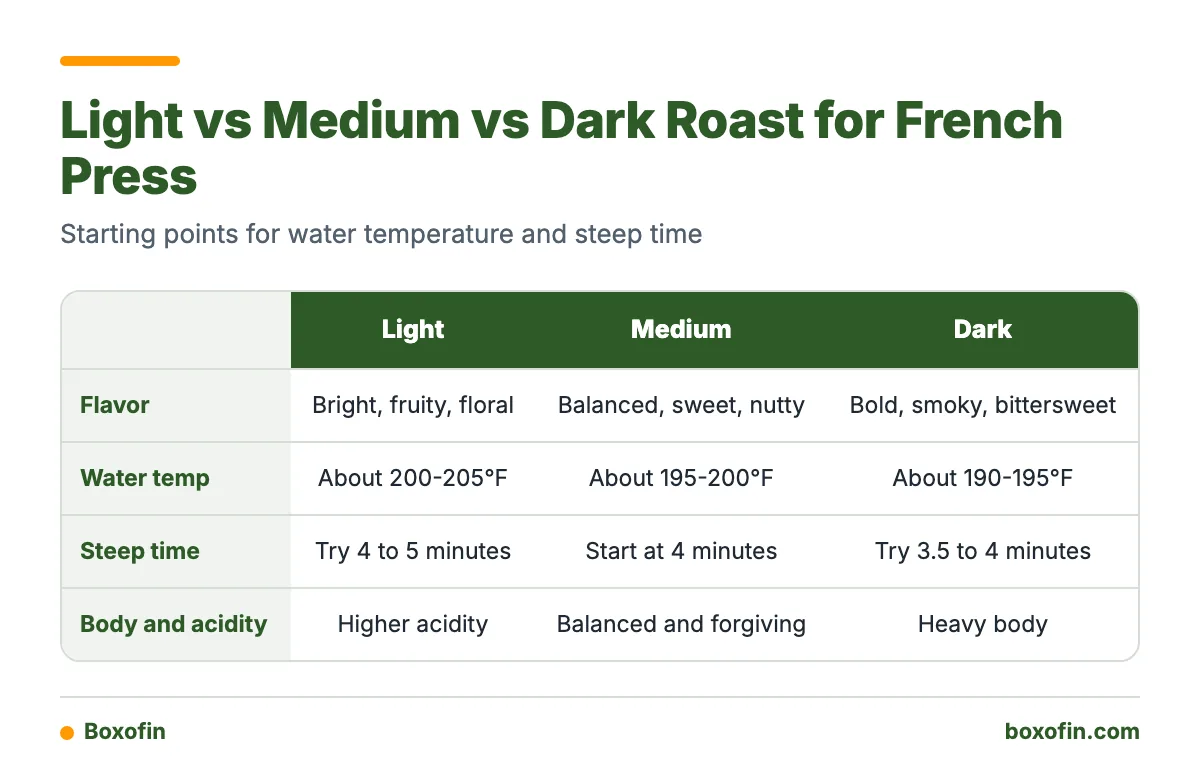
| Roast | Expected flavor | Starting water temp | Steep-time adjustment |
|---|---|---|---|
| Light | Bright, fruity, floral, higher acidity | Just off the boil, about 200-205°F | Try 4 to 5 minutes |
| Medium | Balanced, sweet, nutty, chocolatey | About 195-200°F | Start at 4 minutes |
| Dark | Bold, smoky, bittersweet, heavy body | About 190-195°F | Try 3.5 to 4 minutes |
The temperatures are starting points, not rules. Light roasts are dense and extract slowly, so they like more heat or time. Dark roasts are brittle and give up their flavor fast, so they turn bitter if pushed. These adjustments follow the guidance in the French press brew guide from Coffee Gear Hub.

Should I buy whole beans or pre-ground coffee?
Buy whole beans. Coffee starts losing aroma soon after grinding because far more surface touches the air. Stale coffee tastes flat, papery, or dull. The Online Coffee Guide on stale coffee covers the causes and fixes.
Store beans in an airtight container away from light, heat, and moisture. Buy amounts you can finish in a few weeks. Pre-ground coffee is also rarely cut for a French press. It is often too fine, which brings sludge.
What grind size should I use for a French press?
Use a coarse grind, close to coarse sea salt or breadcrumbs. Finer particles slip through the metal mesh and add sediment, as the French Press Guide from Coffee Studies explains.
Many guides stop there, but two details matter:
- Evenness: A cheap blade grinder smashes beans into a mix of dust and boulders. The dust over-extracts and turns bitter. The boulders under-extract and taste sour. A burr grinder gives a more uniform result.
- Not too coarse: Grind that is far too chunky lets water pass over the surface only. The coffee tastes thin and weak. If your cup is watery, go one step finer.
How much coffee and water should I use in a French press?
Start with 1:15 by weight, meaning 1 gram of coffee to 15 grams (about 15 mL) of water. Use a kitchen scale. A scoop of dark roast weighs less than a scoop of light roast, so scoops give uneven results.
| Water | Coffee (1:15) | Typical use |
|---|---|---|
| 300 mL | 20 g | 1 large mug |
| 450 mL | 30 g | 2 smaller cups |
| 600 mL | 40 g | 2 to 3 cups |
To scale any batch, divide the water in mL by 15. For 750 mL, that is 50 g. Want it stronger? Move toward 1:13. Want it lighter? Try 1:17.
How long should coffee steep in a French press?
Steep for four minutes as a baseline. Add the grounds, pour in the water, stir gently, and set the lid on top. After the timer, press slowly and pour. The whole process takes about five minutes.
Four minutes is not rigid. Roast level, grind, dose, and your taste all change extraction. Taste first, then adjust by 30 seconds at a time:
- If the cup tastes bitter or harsh: shorten the steep or grind coarser.
- If it tastes sour or thin: steep longer, use hotter water, or grind slightly finer.
- If it tastes right: write down the recipe and repeat it.

How long does coffee stay in a French press?
Coffee should leave the press the moment you finish plunging. Left on the grounds, it keeps extracting and turns harsher and more bitter. Pressing only slows that process. It does not stop it.
Can I leave coffee and grounds in a French press overnight?
Do not. The flavor will be poor by morning, and the grounds are tough to clean after sitting. Pour the finished coffee into a thermal carafe or a clean, airtight container instead. Brewed coffee tastes best soon after brewing, so drink it within a few hours.
Do not confuse flavor with safety. Coffee that has gone stale is unpleasant but not always unsafe. Safety depends on time, temperature, and any added milk. For more on spoilage, see this piece on whether brewed coffee spoils without refrigeration. Milk-added coffee should be treated like any dairy.
How is French press coffee different from drip or pour-over?
French press coffee is heavier, oilier, and more textured. Its metal mesh lets coffee oils and fine particles into the cup. Paper filters trap them, which gives a cleaner, lighter drink.
| French press | Drip | Pour-over | |
|---|---|---|---|
| Filter | Metal mesh | Usually paper | Usually paper |
| Body | Full, heavy | Medium | Light to medium |
| Oils | Most pass through | Mostly trapped | Mostly trapped |
| Sediment | Some fine silt | Very little | Very little |
| Clarity | Lower, rounder | Moderate | High, crisp |
The oils carry flavor and add a silky feel. The fine particles add thickness, and they keep extracting while you drink. That is why the last sip can taste gritty and strong.
How can I reduce bitterness, weakness, or sediment?
Match the symptom to one change, and change one thing per brew.
| Symptom | Likely cause | Fix |
|---|---|---|
| Bitter | Over-extraction | Shorten the steep or grind coarser. Check for dust from a blade grinder. |
| Sour | Under-extraction | Use hotter water or steep longer. |
| Weak | Too little coffee or too coarse | Add coffee or grind slightly finer. |
| Too strong | Too much coffee | Move toward 1:17 or add hot water to the cup. |
| Gritty | Fine particles, rough pour | Grind coarser and more evenly. Press slowly and pour gently. |
To cut sediment further, let the pressed coffee rest for a minute before pouring. Leave the last sip in the press. If the plunger fights you, your grind is probably too fine. Do not force it.
What do owners say?
Owners like
- Full-bodied flavor and a stronger mouthfeel than paper-filtered coffee
- A simple process with no paper filters
- Easy brewing of several cups at once
- Metal or insulated models that hold heat well
- Coarse-ground coffee that is easy to brew and adjust
Common complaints
- Fine sediment or gritty sludge in the cup
- Glass carafes that can crack or break if dropped
- Coffee that cools before the batch is finished, especially in glass presses
- Plungers and filters that get stiff, fussy, or hard to clean
- Fine grinds that make pressing hard or jam the filter
Summarised from owner reviews and long-term user reports; individual experiences vary.
Frequently Asked Questions
How to choose coffee for french press?
Choose fresh whole beans, preferably medium roast, and grind them coarse and even just before brewing. Use a 1:15 ratio by weight and steep for four minutes. Adjust roast, time, and grind based on taste.
How long does coffee stay in a french press?
Pour it out right after pressing. Contact with the grounds makes coffee harsher and more bitter. If you want to keep it, move it to a thermal carafe or a clean, airtight container, and drink it soon.
How is french press coffee different?
The metal mesh filter lets oils and fine particles pass into the cup. The result has more body, a richer texture, and some sediment. Paper-filtered drip and pour-over coffee taste cleaner and lighter.
Sources