Induction cooking is safe for most people, including families with young children. It uses low-energy magnetic fields and keeps the cooktop surface cooler than a gas flame or electric coil. The main exception is anyone with a pacemaker or similar implanted device, who should check device-specific advice before using one.
- Induction uses non-ionizing fields. They do not have enough energy to damage DNA the way X-rays or UV light can.
- Official bodies expect no health effects at common cooking distances, but they say exposure can be higher right next to the hob.
- People with pacemakers or other implants should ask their doctor and read the device maker’s guidance first.
- Centering the pan, matching pan size to the zone, and standing a little back all cut exposure.
- Induction has a lower burn and fire risk than gas and no combustion fumes in your kitchen.
- How Induction Cooking Works
- Is Induction Cooking Safe Radiation?
- What Official Bodies Say
- Pacemakers and Implanted Devices
- Does Standing Close Increase Exposure?
- Burns and Fires
- Induction vs Gas vs Radiant Electric
- Pregnancy and Induction Cooking
- Myth vs Fact
- Safety Checklist for Everyday Use
- Frequently Asked Questions
How Induction Cooking Works
An induction cooktop has a copper coil under the glass. When you turn it on, the coil makes a fast-changing magnetic field, usually in the tens of kilohertz. That field passes through the glass and into a magnetic pan, such as cast iron or magnetic stainless steel. The field makes electric currents in the pan base, and the pan heats itself.
The glass does not heat directly. It only warms from contact with the hot pan. This is why induction reacts fast and why the surface around a pan stays cooler than a coil or flame. It is also why a cooktop needs the right cookware. No magnetic pan, no heat.
Is Induction Cooking Safe Radiation?
The word radiation scares people, so the type matters. Ionizing radiation, such as X-rays and UV light, carries enough energy to break chemical bonds and damage DNA. Non-ionizing fields carry far less energy. They cannot do that. Induction cooktops make non-ionizing electromagnetic fields, the same broad family as the fields around wiring, motors and many other appliances.
The field from a cooktop is strongest at the glass and drops fast with distance. GE Appliances notes that the level falls significantly above the cooking surface. Cooktops are also tested against human-exposure and interference standards, including IEEE C95.1, FCC Part 18 and ICES-001. You can read the maker’s explanation in the GE Appliances EMF guidance for induction cooktops.
What Official Bodies Say
Official guidance is calm but not absolute, and that is worth knowing. The German Federal Office for Radiation Protection says induction hobs generally meet the ICNIRP reference value of 27 µT at common distances. It expects no health effects at those distances. It also says effects cannot be ruled out if reference values are reached. See its page on the induction hob and radiation protection.
The Swiss Federal Office of Public Health is more cautious about close range. It says exposure can be within or above a limit meant to prevent health risks, and it advises keeping at least 15 cm (about 6 inches) of distance where possible. Its induction hob fact sheet explains this.
Can Induction Cookers Affect Pacemakers or Other Implanted Devices?
This is a separate question from general health, and it deserves its own answer. Safety guidance notes that induction cooktops can interfere with pacemakers and similar implanted devices. Interference is about how a device’s electronics respond to a nearby field. It is not about DNA damage.
Devices differ by model, age and how they are set up. So no single rule fits everyone. If you have a pacemaker, defibrillator, insulin pump or other implant, ask your cardiologist or care team before you cook on induction. Also check the device maker’s manual for a stated safe distance.
- No implanted device: Follow the everyday checklist below.
- You have an implant: Ask your doctor and the device maker before first use.
- Someone else in the house has one: Ask them to check, and keep them back from the hob while it runs.
- You feel dizzy or notice odd symptoms near the hob: Step away, turn it off, and contact your doctor.
Does Standing Close to an Induction Hob Increase Exposure?
Yes, closer means higher exposure. The field is strongest near the glass and weakens quickly as you move away. Two things help: where the pan sits, and where you stand.
A pan that is off-center, or smaller than the cooking zone, leaves part of the coil uncovered. That lets more stray field escape. Keeping the pan centered and using cookware that covers the zone reduces it.
Can Induction Cooking Cause Burns or Fires?
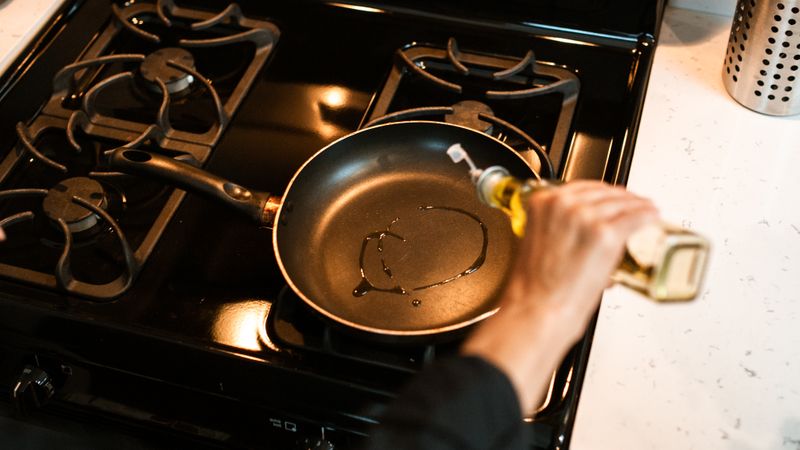
It can, but the risk is lower than with other fuels. There is no open flame. The glass heats only from the pan, so it is cooler than a gas grate or electric coil. Many cooktops also shut off when you lift the pan, and many have child locks and hot-surface lights.
Still, the glass gets hot under a hot pan and stays warm after cooking. Oil can still ignite in a pan. Treat the cooktop with respect. Do not leave hot oil unattended, and do not rest metal tools or foil on the glass, as they can heat up too.
Why Is Induction Cooking Often Considered Safer Than Gas?
The gap comes down to burns, fire and air quality. Gas burns fuel in your kitchen, which releases combustion products such as nitrogen dioxide. A flame can also ignite loose sleeves and towels. Induction makes no combustion fumes. Gas has no meaningful EMF concern. Induction does, which is why the distance advice exists.
| Concern | Induction | Gas | Radiant Electric |
|---|---|---|---|
| Burn risk | Lower surface heat; glass warms from the pan | Open flame and hot grates | Hot coils or glass that stay hot for a while |
| Fire risk | No flame; cuts off when pan is removed on most models | Flame can ignite nearby items | Hot element can ignite items left on it |
| Indoor air quality | No combustion fumes (cooking smoke still happens) | Combustion gases released indoors; ventilate | No combustion fumes (cooking smoke still happens) |
| EMF concern | Low-frequency magnetic field; stronger near the hob | None of note | Low |
| Implanted devices | Check with doctor and device maker | No interference concern | No interference concern |
Radiant electric avoids both flame and strong magnetic fields, but its surface stays hot for a long time. Each type has a tradeoff. For most households, induction wins on burns, fire and air quality. Its one extra step is the distance habit.
Is Induction Cooking Safe During Pregnancy?
The official guidance covered here does not single out pregnancy as a special risk at normal cooking distances. The same advice applies to everyone: center the pan, use the right pan size, and stay back from the hob where you can. If you want extra reassurance, take that question to your doctor or midwife. Pregnant cooks who want a bit more caution can simply keep a little more distance and use back burners when it is easy to do so.
Myth vs Fact
| Myth | Fact |
|---|---|
| Induction gives off harmful radiation like X-rays. | It makes non-ionizing fields, which lack the energy to damage DNA like X-rays or UV light. |
| Induction causes cancer. | The official sources used here expect no health effects at common distances. They note effects cannot be excluded if reference values are reached. |
| Induction is unsafe in pregnancy. | The guidance here names no pregnancy-specific risk at normal use. Ask your doctor if you are unsure. |
| Induction is harmless to pacemakers. | Interference with pacemakers and similar devices is possible. Check device guidance. |
| The field is the same everywhere. | It drops quickly with distance from the glass. |
Safety Checklist for Everyday Use
- Center every pan on its cooking zone.
- Match pan size to the zone so the coil is covered.
- Use flat-bottomed, magnetic cookware that sits snug on the glass.
- Stand back where you can. Aim for about 15 cm (6 inches) or more from the pan.
- Use back burners when children or others are close by.
- Do not lean on or press against the cooktop while it runs.
- Keep metal tools, foil and lids off the glass.
- Check for hot-surface lights before wiping the glass.
- Ask your doctor and the device maker first if anyone nearby has an implant.
- Run your range hood when frying or searing to clear smoke.
Frequently Asked Questions
Is induction cooking safe?
For most people, yes. It uses non-ionizing fields, has no flame, and keeps the glass cooler than gas or coils. The main caution is for people with pacemakers or similar implants, who should get device-specific advice.
How safe is induction cooking?
German and Swiss authorities expect low risk at common distances. Cooktops are also tested against standards such as IEEE C95.1, FCC Part 18 and ICES-001. Exposure is higher close to the hob, so distance and pan placement matter.
Is induction cooking safe for health?
The official guidance used here expects no health effects at common cooking distances. It also says effects cannot be excluded if reference values are reached. Kitchen air quality is a plus, since induction makes no combustion fumes.
Is induction cooking safe radiation?
Induction makes non-ionizing electromagnetic fields. These do not carry enough energy to damage DNA like X-rays or UV light. The field is strongest at the glass and drops with distance.
What makes induction cooking safe and healthy?
There is no open flame, the surface stays cooler, many models switch off when the pan is lifted, and no combustion gases are released indoors. Good habits, such as a centered pan and a short step back, reduce field exposure.
Why is induction cooking considered safe and healthy?
Mainly because of lower burn and fire risk and cleaner indoor air than gas. Its fields are low-energy and weaken fast with distance. The open question is implanted devices, which need a doctor’s check.
Is an induction cooker safe to use every day?
Yes for most households, if you follow simple habits: right-size cookware, a centered pan, and some distance from the hob. Anyone with an implanted medical device should confirm with their doctor and the device maker first.