Mason jars belong in the fridge, not on your Ninja blade, whatever their size. Ninja containers are model-specific, so use the original container and blade assembly unless Ninja names a jar or adapter as compatible. Here is how to find your official size, stay under the fill limit, and still store your smoothie in a jar.
Quick answer
Do not blend in any mason jar, whether it is a pint, quart, regular-mouth, or wide-mouth. Blend in the cup or pitcher made for your model, then pour into a jar.
- Best for one smoothie: Your model’s single-serve cup, which locks onto its matching blade.
- Best for storage: A 32-ounce quart jar, filled after blending.
- Best for big batches: Your Ninja pitcher, then several jars.
- A jar that threads onto a blade is not proven safe to blend in.
- Label size is not the fill limit: Ninja’s BL640 24-ounce cup has a 22-ounce maximum liquid line.
- Portable Ninja Blast models have separate vessels and limits.
- Blend first, then transfer to a jar.
- Will a regular-mouth or wide-mouth mason jar fit a Ninja blade?
- Why may a mason jar that physically fits still not be safe?
- What are the official container sizes for popular Ninja blender models?
- How do I identify my Ninja model before buying a replacement container?
- Can a Ninja blender blend directly into a jar for storage?
- What should I use instead of a mason jar for smoothies and sauces?
- What do owners say?
- Frequently Asked Questions
Will a regular-mouth or wide-mouth mason jar fit a Ninja blade?
Either jar may appear to line up, but neither is a confirmed match. US canning jars come in two standard mouth sizes: regular, about 70 mm across, and wide, about 86 mm. Those numbers describe the opening and nothing else.
Safe blending also needs:
- Secure locking: The container must lock onto the base as designed.
- Blade engagement: The blade’s drive gear must meet the motor at the right point.
- A proper seal: The gasket, the rubber ring that stops leaks, must press evenly on the rim.
Ninja states that certain attachments are not interchangeable and that programs are designed for particular containers and blade assemblies, as Ninja’s BL250 FAQ explains.
Why may a mason jar that physically fits still not be safe?
A snug thread only holds a jar in place while nothing is moving. Blending adds high speed, vibration, and ice striking the walls.

Canning jars are made for storing and preserving food, not for surrounding a spinning blade. A cracked jar can put glass in your food. A loose jar can leak or shift during blending. The curved shoulder below the neck can also change how food moves around the blade.
What are the official container sizes for popular Ninja blender models?
Official sizes run from 16-ounce cups to 72-ounce pitchers, and they change by model. These figures come from Ninja’s support FAQs and product pages. “Not listed” means the Ninja documents used here do not list a mason jar as a supported container.
| Ninja model | Supplied container | Nominal capacity | Maximum liquid | Mason jar supported? |
|---|---|---|---|---|
| BL250 | Single-serve cup; processor bowl | 16 oz; 40 oz | Follow marked line | Not listed |
| BL660 | Single-serve cups; processor bowl; XL pitcher | 16 oz; 40 oz; 72 oz | Follow marked lines | Not listed |
| NJ600 | Pitcher | 72 oz | Follow marked line | Not listed |
| BL640 | Nutri Ninja cups | 24 oz | 22 oz | Not listed |
| BL640 | Pitcher | 72 oz | 64 oz | Not listed |
| Professional Plus DUO | Single-serve cups | 24 oz | Follow marked line | Not listed |
| Professional Plus DUO | Pitcher | 72 oz | 64 oz | Not listed |
| Blast Max | Portable vessel | 22 oz | 18 oz | Not listed |
| Other listed Blast models | Portable vessel | 20 oz | 16 oz | Not listed |
Worked example
Using the limits in Ninja’s BL640 FAQ, subtract the maximum liquid figure from the label size. The result is the space that must stay empty.
- BL640 cup: 24 – 22 = 2 ounces empty
- BL640 pitcher: 72 – 64 = 8 ounces empty
A recipe with 23 ounces of liquid is under the cup’s label size but 1 ounce over its limit. Cut 1 ounce or use the pitcher.
Do not apply countertop cup sizes to portable Ninja Blast models. The Ninja Blast Max FAQ gives their own vessel limits.
How do I identify my Ninja model before buying a replacement container?
Check the label on the motor base, usually underneath, and copy the full model number. Then confirm it in your manual. Looks can fool you: BL640 and BL660 differ by one digit, yet Ninja lists 24-ounce cups for one and 16-ounce cups for the other.
Buy only replacement cups that name your model. An adapter from another seller is not Ninja approval, so skip it unless Ninja lists it for your machine.
Safety checklist before you press start
- The model number matches the container.
- The blade assembly is approved for that container.
- The container locks firmly into place.
- The gasket is seated and has no cracks or tears.
- Ingredients sit below the maximum line.
- No loose or improvised jar is on the blender.
Can a Ninja blender blend directly into a jar for storage?
Blend in the Ninja container first. The jar comes last.
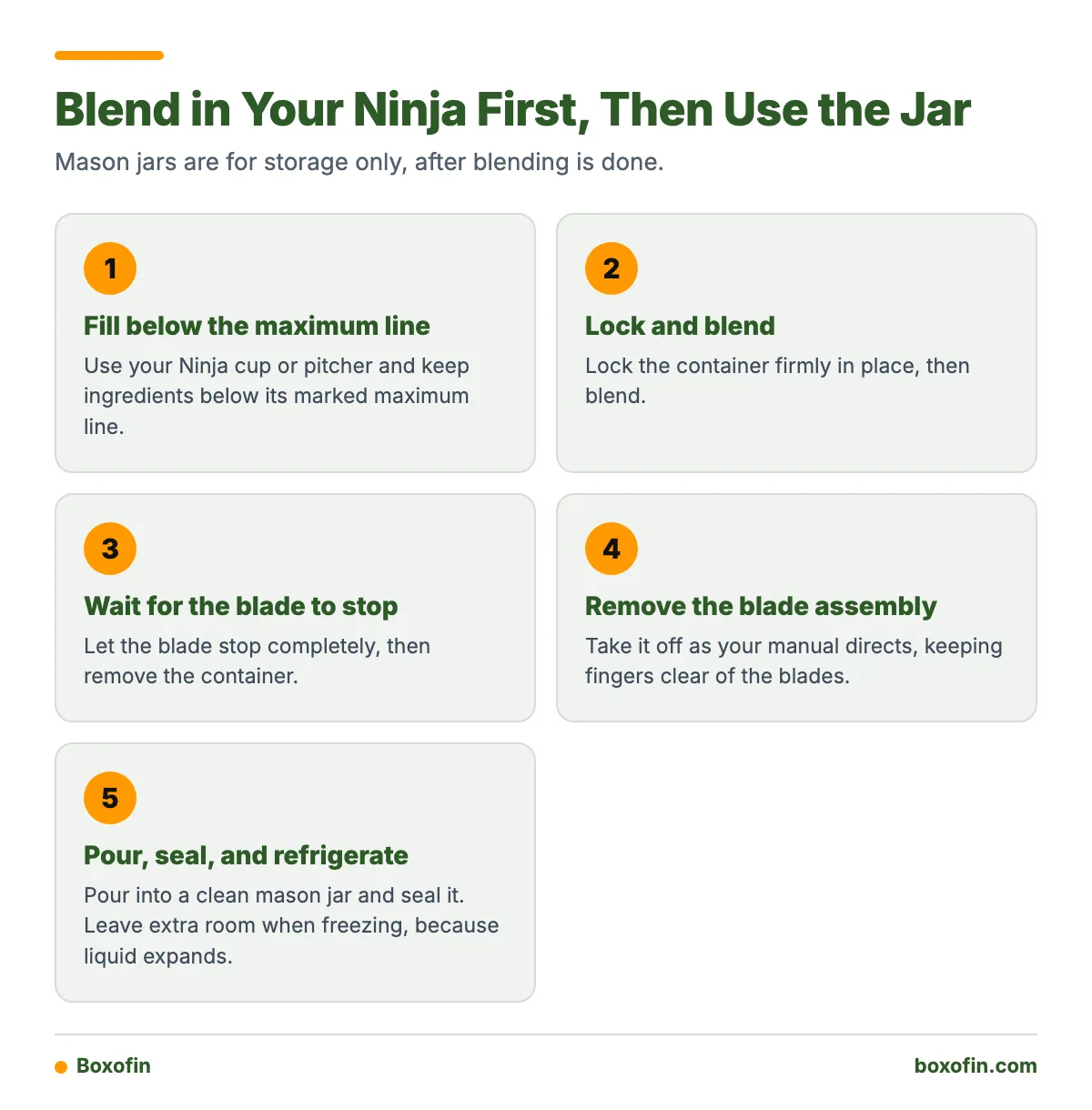
- Fill your Ninja cup or pitcher below the maximum line.
- Lock it in place and blend.
- Wait for the blade to stop, then remove the container.
- Take off the blade assembly as your manual directs, keeping fingers clear of the blades.
- Pour into a clean mason jar, seal it, and refrigerate.

| Batch size | Storage jar | Space left |
|---|---|---|
| 14 ounces | One 16-ounce pint | 2 ounces |
| 22 ounces | One 32-ounce quart | 10 ounces |
| 64 ounces | Three 32-ounce quarts | 32 ounces in total |
Two quarts would hold 64 ounces with no space left, so use three. Leave extra room when freezing, because liquid expands.
What should I use instead of a mason jar for smoothies and sauces?
Use the container Ninja supplied for your model.
- One smoothie: Use the single-serve cup and drink from it.
- Family-size or frozen drinks: Use the 72-ounce pitcher, if your model has one.
- Salsa or chunky sauce: Use the 40-ounce processor bowl on models such as the BL250 and BL660.
- Warm sauce: Check your manual first, because a sealed cup can trap pressure.
- Lost or cracked cup: Order the replacement listed for your model number.
What do owners say?
Owners like
- Blending and drinking from the same single-serve cup
- Big pitchers for family smoothies and frozen drinks
- Simple routine blending with matched containers and presets
- Easier pouring and cleaning with removable blades, used as directed
Common complaints
- Replacement cups and blades can be hard to swap between models
- Label capacity is easy to mistake for the lower fill limit
- Large pitchers and stacked blades can be awkward to clean
- The blender may not run if the container is not seated or locked
Summarised from owner reviews and long-term user reports; individual experiences vary.
Frequently Asked Questions
What size mason jar fits a Ninja blender?
The Ninja documents used here do not list any mason jar size for blending. For storage afterward, a 16-ounce pint suits a small drink and a 32-ounce quart suits a full 24-ounce cup batch.
Can you use a mason jar on a Ninja blender?
Use one for storage only, unless Ninja names that jar or an adapter as compatible with your exact model.
Can I screw a Ninja blade assembly directly onto a Mason jar?
Do not do this. Even if the threads catch, the pair has no confirmed locking, seal, or blade fit.
What Ninja container replaces a 16-ounce mason jar?
On models such as the BL250 and BL660, the 16-ounce single-serve cup is the direct swap. Models such as the BL640 use 24-ounce cups instead.