Sharpening a Ninja blade with a file or stone sounds cheaper than buying a new one, but Ninja tells owners not to do it. If your blender blends poorly, clean it, check how you load it, and replace the blade assembly if the metal is bent, corroded, loose, or damaged.
Quick answer
Do not sharpen Ninja blades at home. Ninja’s manuals say not to attempt it. Clean the blades first, fix your loading habits, then replace the full blade assembly if damage is real.
- Best for residue or film: clean and test
- Best for bent or rusty metal: replace the assembly
- Best for leaks or odd noise: stop and contact support
- Ninja manuals say not to sharpen the blades.
- Most “dull” blades are dirty, overloaded, or short on liquid.
- Bent, cracked, rusty, or loose blades need a matching replacement assembly.
- Never test a loose blade with your fingers.
- Match your full model number before you buy a replacement.
- Can you sharpen Ninja blender blades at home?
- Why should you not sharpen Ninja blender blades?
- What should you do if Ninja blades seem dull?
- How do you clean Ninja blades without damaging them?
- How can you tell whether a Ninja blade needs replacement?
- How do you replace a Ninja blade assembly safely?
- Can you sharpen regular blender blades?
- How can you reduce blade wear?
- Frequently Asked Questions
Can you sharpen Ninja blender blades at home?
You should not. Ninja’s instruction manuals state: do not attempt to sharpen the blades. You can read the safety guidance in the Ninja blender instruction manual.
Many web pages suggest a file or whetstone. They skip the manufacturer’s warning. Based on the manuals, the safe path is cleaning, inspection, and replacement.
Why should you not sharpen Ninja blender blades?
Sharpening risks injury and can make the blade worse. Ninja warns that blade assemblies are sharp and may not be locked into the container, so they can fall out when you handle the parts. That is a bad moment to be holding a file.
- Injury risk: Loose, sharp blades slip. Fingers are the usual casualty.
- Uneven balance: Grinding removes metal unevenly. An off-balance blade can wobble and shake the unit.
- Weaker metal: Heat and filing can damage the surface and the finish.
- Seal damage: Slipping tools can nick the gasket or the base around the blades.
Blender blades also do not work like kitchen knives. Many are not razor-sharp on purpose. They rely on speed, blade shape, and the vortex the container creates. That is why a blade that looks blunt may still work well.
What should you do if Ninja blades seem dull?
Diagnose first. Poor blending often has nothing to do with sharpness. Do blades need sharpening? In most cases, no. Check these causes before you blame the metal:
- Overfilling: Food packed past the max line cannot circulate.
- Too little liquid: Dry mixes sit on top of the blades and stall.
- Wrong order: Liquid goes in first, then soft items, then hard or frozen items.
- Buildup: Dried residue or film on the blades and base slows them.
- Worn drive parts: A damaged coupling or base can spin poorly even with good blades.
- Bad seal: A damaged gasket can leak and change how the cup performs.
Troubleshooting flow
- Film or residue on the metal? Clean it, then test again.
- Bent, cracked, pitted, or rusty metal? Replace the assembly.
- Leak at the base? Stop using it. Check the gasket and fit.
- Grinding, rattling, or burning smell? Stop and contact Ninja support.
- Everything looks fine, but results are chunky? Fix your loading: less food, more liquid, correct order.

How do you clean Ninja blades without damaging them?
Use warm water, dish soap, and a long-handled brush. Keep your hands away from the edges. Ninja directs users to hold applicable blade assemblies only by the shaft or the outer perimeter of the base, depending on the model.
- Unplug the blender.
- Remove the container from the motor base.
- Fill the pitcher partway with warm water and a drop of dish soap, then run the blender if your manual allows self-cleaning.
- For stuck residue, soak the parts, then scrub with a brush.
- Rinse and let everything dry fully.
Check your model’s manual for which parts are dishwasher-safe. Avoid steel wool, harsh scrubbing pads, and abrasive powders. They scratch metal and can speed up rust.
How can you tell whether a Ninja blade needs replacement?
Replace it when you see damage. Ninja says to inspect blade assemblies before each use. If a blade is bent or damage is suspected, Ninja directs users to arrange replacement instead of continuing to use it. A damaged assembly can cause cuts, harm the appliance, or lead to unsafe operation, according to the Ninja safety and maintenance instructions.
| What you see | Action | Why |
|---|---|---|
| Film, stains, dried food | Clean and test | Residue can look like wear and slows blending |
| Chunky results, no visible damage | Check loading, then inspect | Overfilling and low liquid are common causes |
| Bent, cracked, pitted, or rusty metal | Replace the assembly | Damaged blades are unsafe to run |
| Loose blade or wobble | Replace the assembly | Poor fit causes vibration and leaks |
| Leaking at the base | Stop using it, check the gasket | A failed seal can leak into the base |
| Grinding noise or burning smell | Stop and contact support | The problem may be in the motor or drive |
- If it is only dirty: clean it and run a test batch.
- If the metal is damaged: replace the full assembly.
- If you are unsure: stop using it and contact Ninja support.
How do you replace a Ninja blade assembly safely?
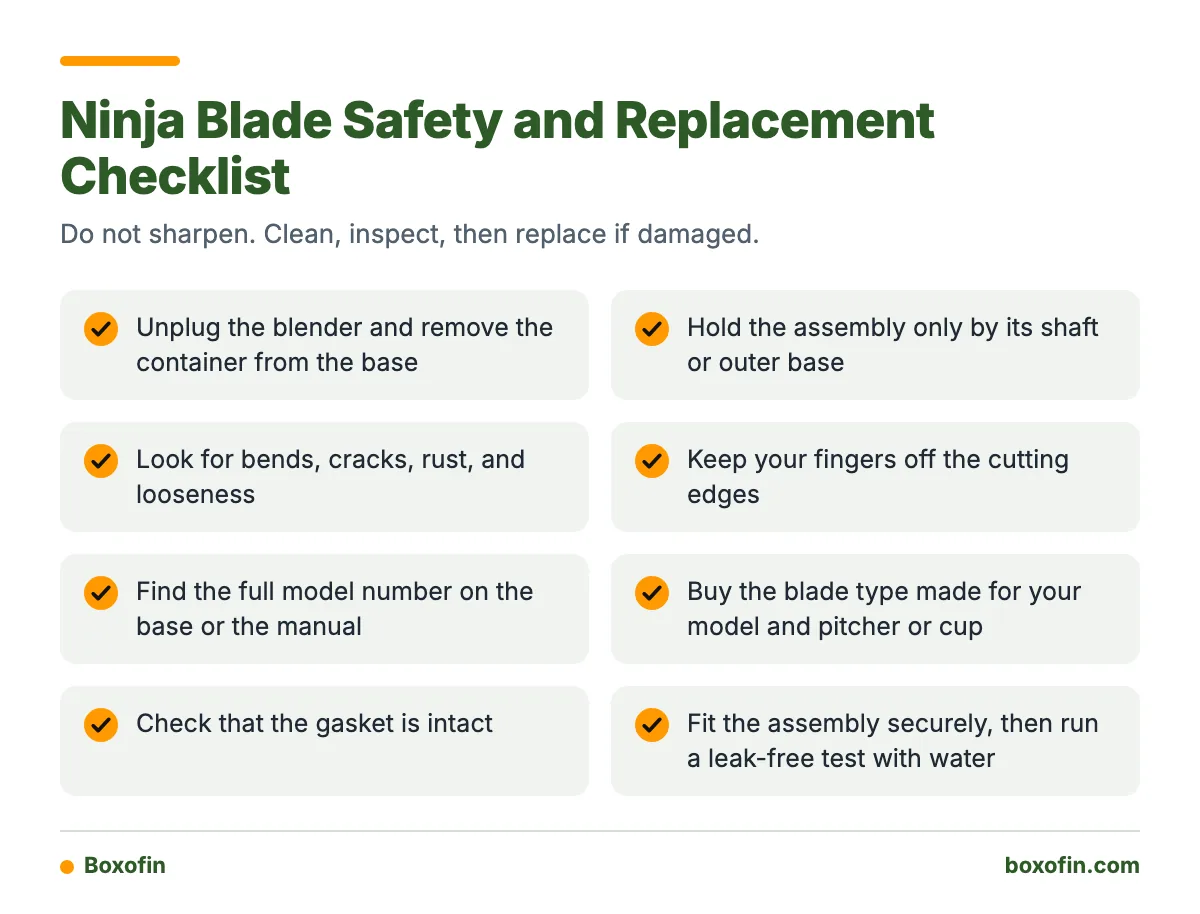
Unplug the blender, remove the container, and handle the assembly only by the shaft or outer base. Never test a loose blade with your hand.
Safety checklist
- Unplug the blender.
- Remove the container from the base.
- Hold the assembly only by its shaft or designated outer base.
- Look for bends, cracks, rust, and looseness.
- Keep your fingers off the cutting edges.
Replacement checklist
- Find the full model number on the base or the manual.
- Buy the blade type made for that model and pitcher or cup. Ninja sells many shapes and sizes.
- Check that the gasket is intact.
- Fit the assembly securely, following your manual.
- Run a leak-free test with water before normal use.
Do not guess based on a similar-looking part. Match the full model and the assembly type, since cups, pitchers, and blade stacks differ.

Can you sharpen regular blender blades?
Some brands may allow it, but you must follow the manufacturer’s guidance. Many makers recommend replacement instead. For Ninja, the answer is already clear from the manuals. Do not use files, whetstones, or grinders on any model unless your own manual permits it.
Also avoid running abrasive materials in the pitcher to “sharpen” the blades, such as sand or rice. Ninja’s instructions specifically prohibit grinding operations with the cup and blade assembly in relevant models.
How can you reduce blade wear?
- Stay under the max fill line.
- Add enough liquid for the recipe.
- Cut hard food into smaller pieces.
- Clean after each use so residue does not harden.
- Dry the parts fully to limit rust.
- Keep hands and utensils out while it runs. Use a scraper only when the blender is off.
- Inspect the assembly before every use.
Frequently Asked Questions
How to sharpen Ninja blender blades?
Ninja says not to. The safe alternative is to clean the blades, check your loading method, and replace the blade assembly if it is damaged or no longer works properly.
Can you sharpen Ninja blender blades?
Not safely. Ninja’s manuals state: do not attempt to sharpen the blades. Sharpening can unbalance the assembly, weaken the metal, and raise your injury risk.
How to sharpen Ninja blender blades at home?
Do not use files, stones, or grinders. If the blender seems weak, clean it, load it correctly, and replace the full assembly if you find bends, cracks, rust, or looseness.
Do you need to sharpen Ninja blender blades?
Usually not. Blender blades work through speed and blade design, not razor edges. Dirt, overfilling, or too little liquid often cause poor results.
How to sharpen blender blades at home?
Check your own blender’s manual first. Many makers advise against it. A damaged blade is safer to replace than to grind.
Can you sharpen blender blades?
Only if the manufacturer allows it. Ninja does not. Blades can be sharp, loose, and hard to hold safely, so replacement is the better choice.
Sources