The best juicer for oranges is a dedicated electric citrus juicer, because it is built to press halved citrus quickly with little effort. Based on the specifications and buyer ratings below, the Vinci Hands-Free Electric Citrus Juicer is the best overall pick, while the Elite Gourmet ETS623 is the easiest way to start on a small budget.
This guide covers five citrus juicers, explains which juicer type suits oranges best, and answers common questions about whole oranges, foam, pulp, and nutrition.
Our Winner: Vinci Electric Juicer, Hands Free Automatic Compact Citrus Press Machine
The Vinci is fully enclosed and fully automatic. You place a halved orange on the reamer, close the lid, and press one button. Its pressure-sensitive pressing adjusts to rind thickness, and it includes Fine and Coarse pulp filters. Wirecutter also named the Vinci Hands-Free Electric Citrus Juicer its best electric citrus juicer in 2026.
How We Compared These Models
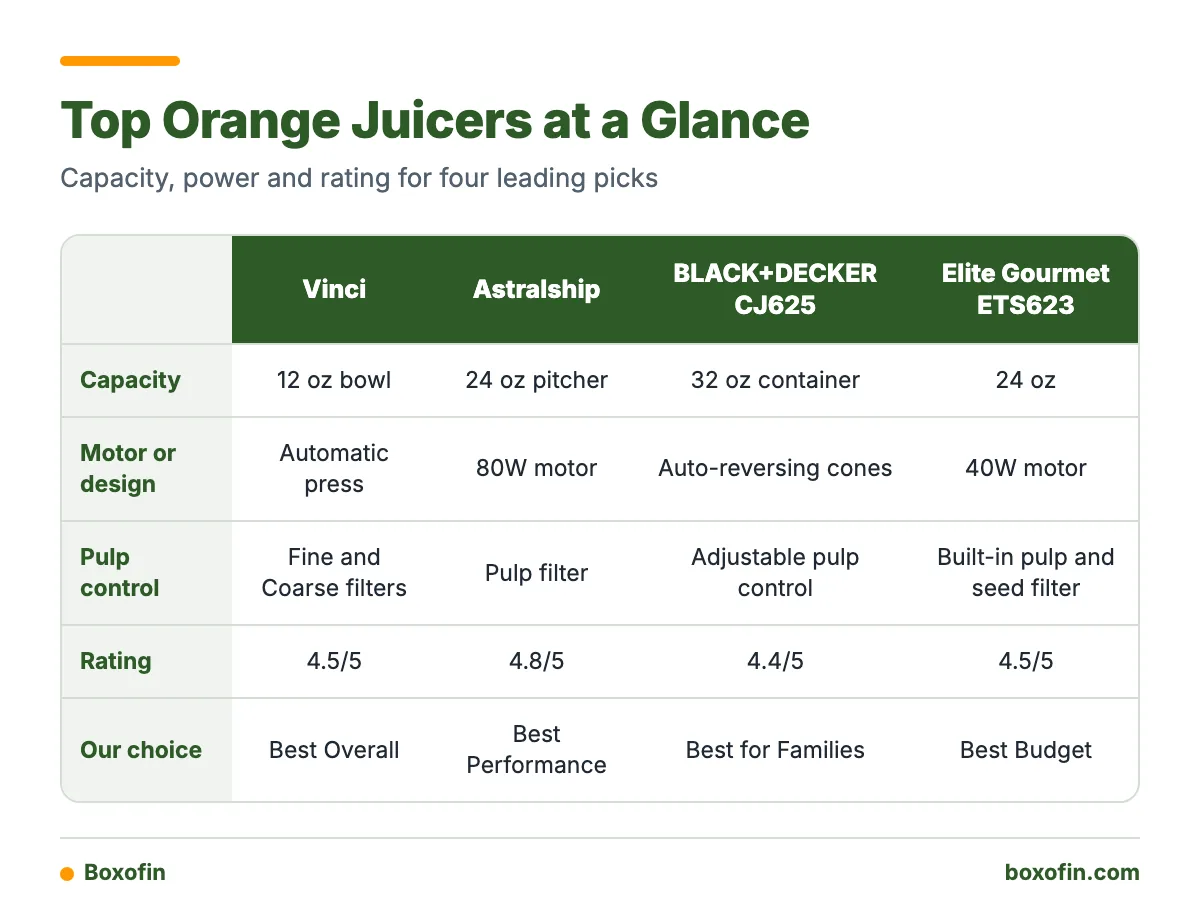
We compared the listings on four criteria: pulp control, capacity, cleanup, and motor or pressing design. These matter most for oranges because pulp level changes the texture of the juice, capacity decides whether a model suits one glass or a family batch, and sticky pulp makes dishwasher-safe parts valuable. This comparison is based on listed features and Amazon ratings, not personal use.
| Product | Key Specs | Our Choice | Action |
|---|---|---|---|
| Vinci Hands Free Citrus Press | Automatic press, 12 oz bowl, Fine and Coarse filters, fits fruit up to 4.5 in. | Best Overall | |
| Astralship Citrus Juicer Machine | 80W motor, 24 oz pitcher, two cones, pulp filter | Best Performance | |
| BLACK+DECKER CJ625 | 32 oz container, adjustable pulp control, auto-reversing cones | Best for Families | |
| Elite Gourmet ETS623 | 40W motor, 24 oz capacity, auto-reversing reamer | Best Budget | |
| Dace Rechargeable Citrus Squeezer | Rechargeable, one-touch operation | Best for Portability |
In-Depth Reviews

1. Vinci Electric Juicer, Hands Free Automatic Compact Citrus Press Machine – Best Overall
Our Verdict: The Vinci is the most automated option here, so it suits people who juice oranges often and want the least effort.
Based on the listing, the juicer presses a halved orange inside a fully enclosed chamber in about 10 seconds. That design keeps splashing down. The pressure-sensitive mechanism adjusts to rind thickness, which helps limit bitter rind scraping. The reamer handles fruit up to 4.5 inches across, so large navel oranges and grapefruit fit.
The 12 oz Tritan bowl is the main limit. It holds about two glasses, so a family breakfast means emptying it a few times. The lid, bowl, reamer, and filters are top-rack dishwasher safe. It carries a 4.5/5 rating and is the highest-priced model in this group.
Why We Like It
- One-button automatic pressing with no squeezing
- Fine and Coarse pulp filters for texture control
- Locking spout lets you pour straight into a glass
- Recognized as Wirecutter’s best electric citrus juicer
Pros & Cons
Pros
- Fully enclosed, low-mess pressing
- Adjustable pulp control
- Dishwasher-safe parts
- Fits oranges and grapefruit
Cons
- Highest price of the five
- 12 oz bowl is small for big batches

2. Astralship Citrus Juicer Machine – Best Performance
Our Verdict: The Astralship pairs a strong motor with a two-cone system, which makes it a good fit for households that juice both oranges and lemons.
The listing describes an 80W high-torque motor with pressure-activated starting. That is notably more power than the 40W Elite Gourmet. It includes a small cone for limes and lemons and a large cone that snaps on top for oranges and grapefruit, addressing the orange-specific sizing concern.
The 24 oz pitcher has measurement markings and a handle. The stainless steel base is weighted for stability. Pitcher, cones, filter, and dust cover are listed as top-rack dishwasher safe. It has the highest rating of the group at 4.8/5, but the listing is new, so check how many reviews support that score.
Why We Like It
- 80W motor for quick pressing
- Two nesting cones for different fruit sizes
- 24 oz pitcher with built-in strainer
- Stable weighted base
Pros & Cons
Pros
- Powerful motor
- Cone sizing suits oranges and limes
- Dishwasher-safe parts
Cons
- Newer listing with a less established track record
- Pulp control is a filter, not adjustable levels

3. BLACK+DECKER 32oz Electric Citrus Juicer, CJ625 – Best for Families
Our Verdict: The CJ625 has the largest container here, which makes it the practical choice for family batches.
The 32 oz clear container doubles as a pitcher with a drip-free spout and handle. Markings let you measure juice for recipes, and the clear walls show yield as you go. Auto-reversing cones help extract more from each half, and a removable pulp basket lets you control how much pulp reaches the glass. Parts are listed as dishwasher safe.
The listing shows a 4.4/5 rating. Pricing was not shown in the data, so check the current price on Amazon.
Why We Like It
- 32 oz capacity for multiple servings
- Adjustable pulp control
- Auto-reversing cones
- Pitcher-style container with spout
Pros & Cons
Pros
- Largest capacity
- Clear measurement markings
- Pulp can be reused in recipes
Cons
- Takes more counter and cabinet space
- Single cone design may feel less tailored to small limes

4. Elite Gourmet ETS623 Electric Citrus Juicer, 24 oz – Best Budget
Our Verdict: The ETS623 is the lowest-priced model in this data set and covers the basics well for one to three servings.
The listing describes a 40W motor, which it compares favorably to typical 25W citrus juicers. The auto-reversing reamer rotates in both directions to help pull more juice from oranges, lemons, limes, and grapefruit. The 24 oz capacity has a pour spout and an integrated pulp and seed filter. It is ETL listed and BPA-free, with a compact footprint for small kitchens.
It has a 4.5/5 rating. The maker recommends hand washing for the longest product life, even though parts are top-rack dishwasher safe.
Why We Like It
- Lowest price of the five
- Auto-reversing reamer
- 24 oz capacity with built-in filter
- Compact for apartments and dorms
Pros & Cons
Pros
- Very affordable
- Easy push-down activation
- Small footprint
Cons
- Less powerful than the 80W Astralship
- No adjustable pulp levels

5. Dace Rechargeable Citrus Squeezer – Best for Portability
Our Verdict: The Dace is a cordless option for occasional use, but its rating is the weakest here.
The title describes a rechargeable squeezer with one-touch operation for oranges, lemons, grapefruit, watermelon, and pomegranates. Cordless power makes it easy to move or store. However, the listing provided no feature details, and the 3.3/5 rating is well below the others. Treat it as a light-duty pick and read recent buyer reviews before purchasing.
Why We Like It
- Rechargeable, so no cord is needed
- One-touch operation
- Low price compared to the premium models
Pros & Cons
Pros
- Portable and cordless
- Simple controls
Cons
- Lowest rating at 3.3/5
- Limited listing detail on capacity and cleanup
What Is the Best Type of Juicer for Oranges?
A citrus juicer is optimized for squeezing citrus pulp rather than liquefying whole fruit. TechRadar notes that citrus juicers are limited to citrus such as oranges, grapefruit, lemons, and limes, which is the tradeoff for that specialization.
| Juicer Type | Speed | Effort | Cleanup | Best Use Case |
|---|---|---|---|---|
| Manual citrus press | Slow | High | Easy | Occasional lemons and limes |
| Electric citrus juicer | Fast | Low | Easy to moderate | Regular orange juice |
| Multipurpose (centrifugal or slow) | Moderate | Moderate, needs peeling and cutting | More parts to wash | Mixed fruit and vegetable juice |
Business Insider notes that oranges juice well in general, but high-speed juicers tend to produce a lot of foam with them. A citrus juicer turns slowly against the fruit, so foam is usually less of an issue.
How to Juice Oranges Correctly
Here is a worked example for 4 medium oranges with an electric citrus juicer:
- Wash the oranges and roll each on the counter to loosen the pulp.
- Cut each one in half across the middle, not through the stem.
- Remove any visible seeds and fit the pulp filter you prefer.
- Press each half onto the reamer and let the motor run until the half is spent.
- Stir and pour.
Expect roughly 1.5 to 3 oz per orange depending on size and juiciness, so 4 oranges should give about 6 to 12 oz. These are estimates, not measured results. Tom’s Guide reported juicing 25 oranges in under 15 minutes for about 28 oz, which shows how much yield varies with fruit and equipment.
Which Oranges Work Best for Juicing?
Valencia oranges are a common juicing choice because they are juicy and sweet. Navel oranges juice fine but can turn bitter if the juice sits for a while. Heavy fruit with thin, smooth skin generally holds more juice than light, thick-skinned fruit.
Buying Checklist for Orange Juicing
- Batch size: 12 oz for one or two glasses, 24 to 32 oz for families.
- Reamer size: Look for a cone or second cone made for oranges and grapefruit. Good Housekeeping’s tested juicers include separate reamers sized for lemons and limes and for oranges and grapefruit.
- Pulp control: Filters or baskets let you choose smooth or pulpy juice.
- Dishwasher-safe parts: Orange pulp clings to filters, so removable top-rack parts save time.
- Motor power: Higher wattage presses faster, though design matters as much as watts.
Frequently Asked Questions
Can you put oranges in a juicer?
Oranges work in citrus juicers, and a citrus juicer is the type designed for them. Multipurpose juicers can handle oranges, but they usually need peeling and cutting first.
Can you put a whole orange in a juicer?
A whole orange will not fit a citrus juicer, which needs it halved. Some multipurpose juicers accept peeled segments, but the chute is often too small for a whole fruit. Peel is also bitter, so removing it is the safer choice.
How do you use a juicer with oranges?
With a citrus juicer, halve the orange, press the cut side onto the reamer, and let the motor extract the juice. With a multipurpose juicer, peel the orange, split it into segments, and feed them through the chute.
How do you use a Breville juicer with oranges?
Breville makes both citrus presses and multipurpose models. On a citrus press, halve the fruit and press it down on the cone. On a centrifugal or cold-press model, peel the orange, cut it to fit the chute, and feed it slowly. Check your model’s manual for fruit prep guidance. No Breville model is included in this guide.
What are juicing oranges called?
Juicing oranges are simply oranges chosen for their juice, such as Valencia. They are the same fruit you can eat, just selected for juiciness and sweetness. They are also good to eat fresh.
Can you make an Orange Julius with orange juice?
Fresh orange juice works as the base for a homemade version. Blend it with ice, milk, a little sugar, and vanilla until frothy. The result will taste slightly different from the original drink, which is traditionally made with orange concentrate.
Is juicing oranges good for you?
Orange juice provides vitamin C, potassium, and hydration. It also delivers sugar without the full fiber of the fruit, so portion size matters. Vitamin D appears mainly in fortified juices, not in freshly squeezed juice.
Does juicing oranges remove fiber?
Yes, in part. Straining removes much of the pulp, and pulp holds some of the fiber. Keeping the pulp in the glass retains more. Eating a whole orange gives the most fiber.
Does orange juice help with constipation?
Orange juice may help modestly through fluid and some pulp fiber, but whole oranges, water, and other high-fiber foods are more reliable. Talk with a healthcare provider if constipation is persistent.
Conclusion
For most buyers, the Vinci is the best juicer for oranges thanks to its automatic pressing and pulp filters. The Astralship is the stronger choice for power and two-cone flexibility, the BLACK+DECKER suits families, and the Elite Gourmet is the budget pick. The Dace is best reserved for light use until you have checked its reviews. For more background, see Wirecutter’s citrus juicer review and Tom’s Guide’s juicer roundup.
Affiliate Disclosure: As an Amazon Associate, we may earn commissions from qualifying purchases from Amazon.com. This comes at no extra cost to you and helps support our research.