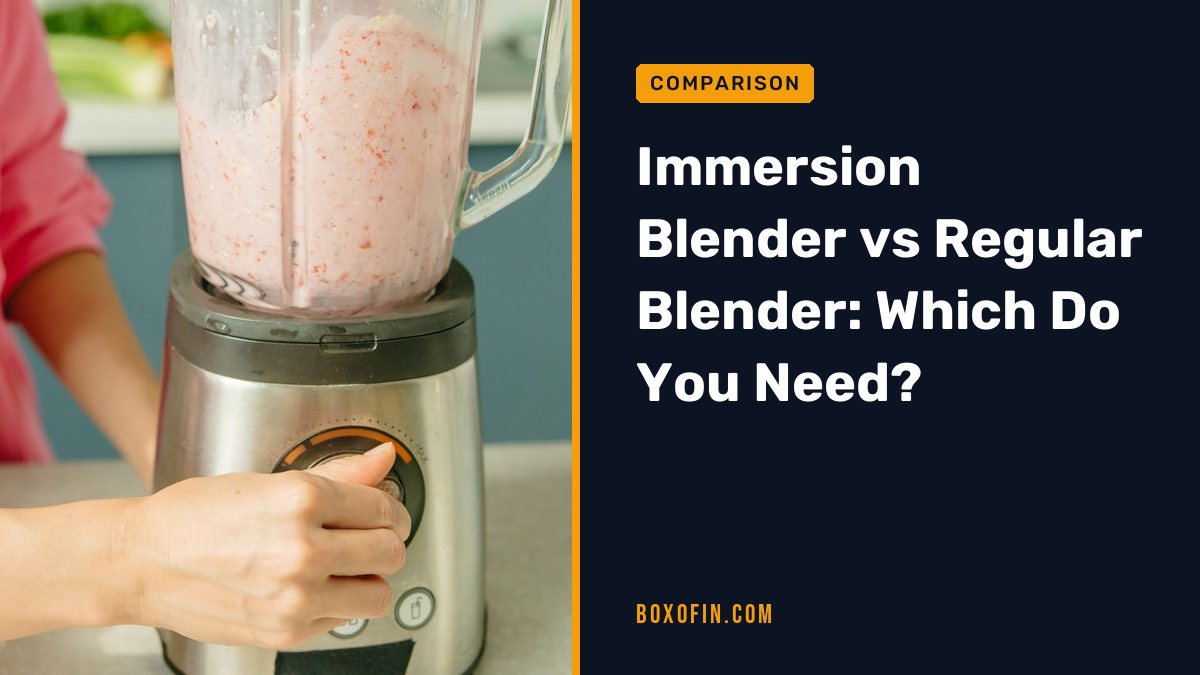
An immersion blender is best for blending right in a pot, bowl, or jar, so it suits soups, sauces, and small batches. A regular countertop blender is better for smoothies, crushed ice, and large batches. Here is how the two differ, so you can pick the one that fits how you cook.
- Choose an immersion blender for soups, sauces, and quick jobs in the pot.
- Choose a countertop blender for smoothies, ice, and thick or large blends.
- Immersion blenders cost less and store in a drawer.
- Countertop blenders are generally more powerful.
- Many kitchens do well with both, but one can cover most people.
What Is the Difference Between an Immersion Blender and a Regular Blender?
A regular blender has a jar that sits on a motorized base. You pour food into the jar, lock the lid, and run it. An immersion blender is a handheld stick with a blade at the bottom. It has no jar. You put the stick into whatever you are blending.
That one change shapes everything else. According to KitchenAid, you can use an immersion blender directly in the bowl, pot, or cup of your choice. Because there is no fixed jar, it can handle a little or a lot at once.

Which Is Better for Soup, Smoothies, and Crushed Ice?
The workflow explains the answer, not just the power.
Soup: With a stick blender, you cook the soup, turn off the heat, and blend in the same pot. No ladling, no transfer, no steam pushing at a lid. Fewer dishes, too.
Smoothies: A countertop blender wins. The jar holds frozen fruit against the blades and pulls it down into a vortex. A stick blender tends to push chunks around in a cup. Consumer Reports notes that immersion blenders are not as quick as personal blenders.
Crushed ice: Go with the countertop. KitchenAid says regular blenders are better suited to crushing ice than stick blenders. Ice can also dull or stress a small stick blade.
How Powerful Are Immersion Blenders Compared With Regular Blenders?
Countertop blenders are generally more powerful. Consumer Reports says immersion blenders are space-savers and cost less than premium blenders, but they are not as powerful. For a sense of scale, Vitamix lists one immersion model at 625 watts, measuring 18 x 3 x 3 inches and weighing 2.86 pounds.
Watts are only part of it. A jar gives the blade a closed space and a steady vortex. A stick has to work against whatever container you choose. So texture differs. Soups, hummus, pancake batter, and whipped cream come out well from a stick. Nut butters, frozen drinks, and silky green smoothies come out better from a jar.
What Container Sizes and Opening Widths Work With an Immersion Blender?
This is the limit many buyers miss. A stick blender needs room around the blade guard. Vitamix says its immersion blender works in containers with a 3-inch-wide opening or larger. A narrow glass or small jar will not fit.
- Width: Check the guard diameter of your model before you buy. Aim for a container wider than that.
- Depth: The blade must stay covered. Shallow bowls splatter. Tall, wide jars and stockpots work best.
- Pot type: Non-stick pots can scratch from a metal guard. Use a plastic-guard model or a different container.
- Batch size: A very small amount in a big pot leaves the blade exposed. Use a narrow, tall beaker for one serving.
Which One Is Easier to Clean and Store?
Immersion blenders are easier on both. You rinse the stick under the tap or run it in warm soapy water. No jar, lid, or gasket to take apart. Most store in a drawer. That is why KitchenAid calls them a compact option for small kitchens.
A countertop blender takes more work. The jar, lid, and seal need washing, and the base takes counter or cabinet space. A quick blend of water and a drop of dish soap helps, but it is still more to handle. Also, a stick blender works one-handed, leaving your other hand free to hold the pot.
Cost follows the same pattern. Immersion blenders usually cost less. Premium countertop blenders can cost a lot more, though budget jars exist too.
Side-by-Side Comparison
| Feature | Immersion Blender | Regular Blender |
|---|---|---|
| Best use | Soups, sauces, batters, dips | Smoothies, ice, nut butters |
| Batch size | Small to large, depends on your pot | Limited by jar size |
| Power | Lower overall | Generally higher |
| Cleanup | Quick rinse of one part | Jar, lid, and seal |
| Storage | Drawer | Counter or cabinet |
| Cost | Usually lower | Wider range, higher at the top |

Worked Example: A Soup Week vs a Smoothie Week
From the Shop
Picture two routines. Based on how each tool works, here is where each fits.
Weeknight soup routine: You make butternut squash soup in a 6-quart pot. With a stick blender, you blend it in place in about a minute, rinse the stick, and you are done. With a countertop blender, you ladle hot soup into the jar in two or three rounds, vent the lid, blend, and pour back. More steps, more dishes.
Morning smoothie routine: You blend frozen berries, ice, and yogurt for one. The countertop blender handles this in one run. The stick blender may stall on the frozen chunks and take longer.
Same kitchen, different winners. Match the tool to what you make most.
Buy an immersion blender if: you make soups and sauces, have little storage, want low cost, or want easy cleanup.
Buy a regular blender if: you make smoothies, crush ice, blend nut butters, or need big, smooth batches.
Do You Need Both?
Is an immersion blender enough for everyday cooking? For soups, sauces, and dips, yes. For daily frozen smoothies or ice, it falls short. If you do both often, buy both. A budget stick blender costs little and takes almost no space.
With limited space, pick one by your top task. Soup and sauce cook? Stick blender. Smoothie drinker? Countertop or personal blender.
Frequently Asked Questions
What is the difference between an immersion blender and a regular blender?
A regular blender has a jar on a motorized base. An immersion blender is a handheld stick with no jar that you put into a pot, bowl, or cup.
Which blender is better for soup, smoothies, and crushed ice?
Immersion blenders suit soup because you blend in the pot. Countertop blenders are better for smoothies and crushed ice.
Can you use an immersion blender for hot liquids?
Yes. It avoids transferring hot soup to a jar. Keep the blade fully under the surface and check the manual for heat limits.
Is an immersion blender enough for everyday cooking, or do you still need a countertop blender?
It is enough for soups, sauces, dips, and batters. You still want a countertop blender for ice, frozen smoothies, and thick blends.
Which blender is better for small batches versus large batches?
An immersion blender handles both, since the container sets the size. For small amounts, use a narrow, tall cup. A countertop jar is best for medium, smooth batches.
Which one is easier to clean and store?
The immersion blender. It has one part to rinse and fits in a drawer.