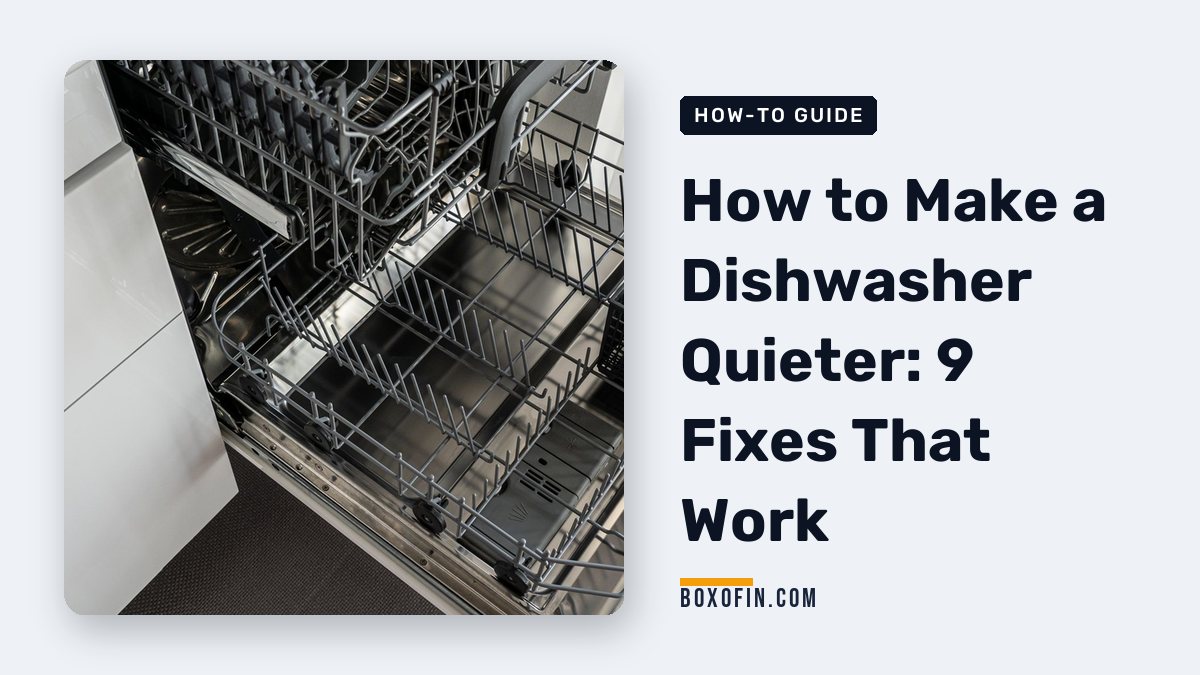
Most loud dishwashers need a free fix, not a new machine. Level the unit, clean the filter and spray arms, and reload the dishes so nothing rattles or blocks the arms. If it is still loud after that, add insulation or shop for a model rated around 44 dBA or lower.
- Try the free fixes first: level, clean, reload.
- The type of noise points to the cause: rattling, humming, tapping, or grinding.
- Insulation and mounting brackets help, but they take more effort.
- 44 dBA or lower is quiet. 40 dBA or lower is very quiet.
- Grinding or loud humming that will not go away usually needs a repair.
- Why Is My Dishwasher So Noisy?
- Troubleshooting by Noise Type
- Leveling, Mounting, and Vibration Control
- Cleaning the Filter, Spray Arms, and Pump Area
- Does How I Load Dishes Affect Noise?
- Insulation and Sound Dampening
- Noise-Reduction Methods Compared
- What dBA Rating Should I Look For?
- When Noise Means a Repair
- Frequently Asked Questions
Why Is My Dishwasher So Noisy?
Four things cause most dishwasher noise: loose or unlevel mounting, dirty parts, poor loading, and a worn motor or pump. Water spraying, the drain pump, and the soap dispenser all make some sound. That part is normal.
How can you tell if the noise is normal? Normal sounds are steady: water swishing, a hum at the start of a drain, a click when the dispenser opens. Problem sounds are new, sharp, or getting worse. Scraping, grinding, banging, and loud buzzing are not normal.
Troubleshooting by Noise Type
Work down this list. Start with the noise you hear, and try the first fix before the last.
| Noise | Likely cause | What to try |
|---|---|---|
| Rattling | Loose dishes, loose rack parts, unlevel unit | Reload, check rack wheels, level the unit |
| Humming | Debris in the drain pump, or normal motor sound | Clean the filter and check below it |
| Buzzing | Blocked pump or failing motor | Clear debris; call for service if it continues |
| Tapping | Spray arm hitting a dish or tall item | Spin the arms by hand and rearrange items |
| Grinding | Glass, bone, or a hard object near the pump | Remove the filter and look for debris; service if it stays |
| Splashing | Water hitting open space or low water level | Fill gaps in the load; try adding two quarts of water as GE suggests |
Samsung says humming, buzzing, or grinding can mean something is caught in the drain pump impeller, which sits below the filter. Its noisy dishwasher support page covers the check.
Leveling, Mounting, and Vibration Control
Will leveling reduce rattling? Yes, often. An unlevel tub shakes against the cabinet and makes the pump work unevenly. Put a bubble level inside the tub, front to back and side to side. Adjust the front feet until the bubble centers.
Then check the mounting brackets. The dishwasher should be fixed to the underside of the countertop or the side cabinet, depending on the model. A loose bracket lets the whole unit buzz against the wood. Tighten the screws. Also check that the drain and supply lines do not touch the cabinet or the tub wall. A line that rubs will hum and tap.
Cleaning the Filter, Spray Arms, and Pump Area
Can cleaning make a dishwasher quieter? It can. A clogged filter and blocked spray holes force the pump to strain. Debris near the pump can cause the humming and grinding noted above.
- Remove the bottom rack.
- Twist out the filter and rinse it under warm water with a soft brush.
- Look in the sump below it for glass chips, seeds, or bits of label.
- Take off the spray arms if they release easily. Clear the holes with a toothpick.
- Spin each arm by hand. Bosch says arms should turn fully with nothing in the way, or loading may be the cause of the noise.
From the Shop
A common pattern in buyer reviews and support forums: a sudden loud hum or grind shows up after a broken glass or a small hard object gets past the dish. The fix is usually a clear sump, not a new pump. If you find nothing and the sound stays, stop and call service.

Does How I Load Dishes Affect Noise?
Yes. Loading is the cheapest fix there is.
- Keep tall items away from the spray arm path.
- Do not let cups and bowls touch. They clink as the water hits them.
- Lean plates at the angle the rack was built for.
- Put lightweight plastics where they cannot flip over.
- Do not pack the racks so tight that water splashes off the walls.
Run a quick test. Close the door, then spin each arm by hand. If it hits anything, move it.
Insulation and Sound Dampening
Do insulation and brackets help? Yes, though less than the basic fixes. Samsung notes that cabinet insulation helps dampen sound and hold in heat. Many dishwashers already ship with an insulation blanket. Check that it is still in place and not sagging or torn.
If yours has none, you can add a dishwasher-rated insulation blanket made for your size. Do not wrap any material near heating parts or wiring. Follow your manual. Many people also fit a rubber or foam pad under the feet, or place foam strips where the cabinet touches the tub. These cut vibration, not water noise.
- If you hear clinking or tapping: reload and spin the arms.
- If the unit shakes or buzzes against the cabinet: level it and tighten the brackets.
- If you hear humming or grinding: clean the filter and check the sump.
- If it is a steady whoosh through the cabinet: add or replace insulation.
- If the sound is loud, new, and still there after all of this: call for repair.
Noise-Reduction Methods Compared
| Method | Effort | Cost | Expected impact |
|---|---|---|---|
| Reload dishes | Low | Free | Stops rattling and tapping |
| Clean filter and arms | Low | Free | Reduces humming and strain |
| Level the unit | Medium | Free to low | Cuts vibration and cabinet rattle |
| Tighten brackets | Medium | Free | Stops buzzing against cabinets |
| Add insulation | Medium to high | Low to moderate | Softer overall sound |
| Use a quiet cycle | Low | Free | Lower spray noise, longer runtime |
| Replace the unit | High | High | Biggest drop in sound |
Some brands offer a quiet cycle. Bosch says its silence program uses an adapted Eco 50 °C program, lower spray pressure, and a longer cleaning phase. Quiet cycles trade speed for lower noise.

What dBA Rating Should I Look For?
dBA measures sound level. A lower number is quieter. Most buyers can use three simple thresholds:
- 44 dBA or lower: generally counts as quiet.
- 40 dBA or lower: often described as nearly silent.
- About 3 dBA difference: usually a noticeable change in sound.
So a 42 dBA model will sound clearly quieter than a 48 dBA one. If your kitchen is open to a living room or bedroom, aim for 40 dBA or lower. For a closed kitchen, 44 dBA is fine. For more on how the ratings work, see Whirlpool’s dBA explainer.
When Noise Means a Repair
Call a technician if you hear any of these:
- Grinding or loud buzzing that stays after you clean the filter and sump.
- A motor hum with no water movement.
- Banging inside the tub that gets worse.
- Leaks along with any new noise.
If the dishwasher is old and the repair quote is high, compare it to the price of a quieter new model. Use the dBA thresholds above to choose.
Frequently Asked Questions
How to make dishwasher quieter?
Level it, tighten the mounting, clean the filter and spray arms, and reload so dishes do not touch or block the arms. Then add insulation or switch to a quiet cycle if noise remains.
How can I make my dishwasher quieter?
Follow the order in this guide: reload, clean, level, then insulate. Each step costs little. If the noise is grinding or heavy buzzing, check the pump area or call service. If nothing helps, look for a model at 44 dBA or lower.
How to make laundry quieter?
The same basics apply to a washer. Level the machine, place anti-vibration pads under the feet, balance the loads, and check that nothing is loose in the drum. This guide focuses on dishwashers, so see your washer manual for model-specific steps.