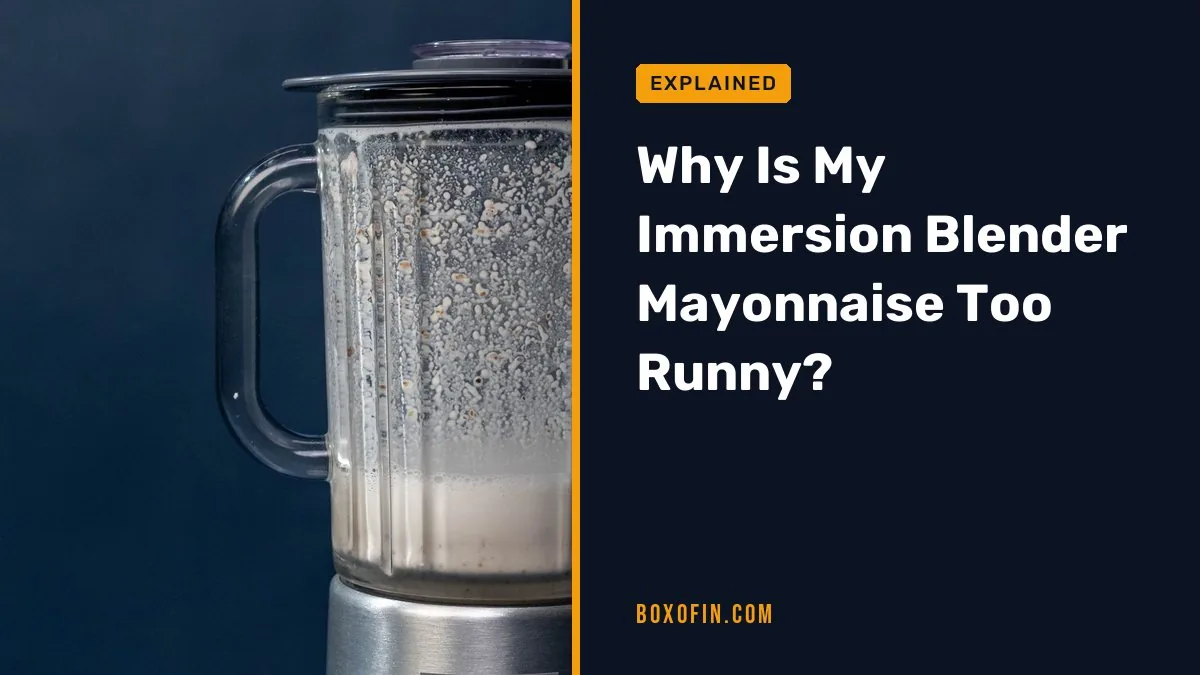
Traditional mayonnaise is about 70% to 80% oil, so a thin batch usually means the oil never became a stable emulsion. The usual causes are adding oil too fast, using too much oil for the yolk, or lifting the blender head before the bottom layer thickened. The fix is simple: blend a fresh egg yolk in a narrow jar, then slowly work the runny mayonnaise into it.
Quick answer
Runny mayonnaise means the oil droplets did not stay evenly spread through the yolk and acid. Start over with one fresh yolk in a narrow jar. Blend it briefly, then add the thin mayonnaise a spoonful at a time, keeping the blender head at the bottom until it thickens.
- Best for thin but mixed sauce: fresh-yolk rescue
- Best for thick sauce that is only a bit loose: a little extra oil
- Thickness comes from tightly packed oil droplets, so too little emulsified oil means a thin sauce.
- Use a tall, narrow container that the blender head just fits into.
- Keep the head flat on the bottom until white cream rises, then lift slowly.
- Add more oil only to mayonnaise that has already emulsified.
- If it is thin or split, rescue it with a fresh yolk rather than adding more oil.
- What makes mayonnaise thick?
- Why is my immersion blender mayonnaise too runny?
- What container and blender position work best?
- How slowly should I add oil?
- Is it thin or separated?
- How do I fix runny homemade mayonnaise?
- How can I thicken mayonnaise that is too thin?
- Do lemon, vinegar, and mustard matter?
- Food safety and storage
- How can I prevent runny mayonnaise next time?
- What do owners say?
- Frequently Asked Questions
What makes mayonnaise thick?
Mayonnaise is an oil-in-water emulsion. Tiny oil droplets are spread through a watery base of egg yolk and acid such as vinegar or lemon juice, according to this ScienceDirect overview of mayonnaise. Egg yolk helps keep those droplets apart because its emulsifying compounds coat them.
Thickness comes from crowding. As oil droplet concentration rises, the sauce becomes very viscous. Formulations near 80% oil approach the practical stability limit. Too few droplets, or droplets that merge back into pools, and you get a loose, pale sauce.
Why is my immersion blender mayonnaise too runny?
The three most common causes are oil added too quickly, too much oil for the yolk, and a blender head that left the bottom too early. Each one stops the emulsion from building a tight droplet structure.
- Oil poured in too fast. Research on emulsion formation notes that the oil addition rate must match the mixing. Too fast, and the emulsion can invert or break, leaving a low-viscosity mixture.
- Too much oil per yolk. A traditional guideline is about 180 to 240 mL of oil per egg yolk, though it varies with yolk size.
- Wrong container. A wide bowl lets oil spread out where the blade cannot catch it.
- Lifting too soon. If the bottom has not emulsified, raising the head just stirs loose oil into loose base.
- Watery extras. Too much lemon juice, vinegar, or water thins the base.
What container and blender position work best?
Use a tall, narrow jar or the beaker that came with your blender. The head should fit with only a small gap around it. This forces the oil to meet the blades in a small zone, so the emulsion starts quickly.

Should the blender head stay still or move while the mayonnaise starts emulsifying?
Keep it still, flat on the bottom. The blades pull oil down and shear it into droplets right at the base. Moving early drags unmixed oil into the zone before a stable seed of emulsion exists. Once thick white cream climbs the blades, lift very slowly so new oil meets the blades as it rises.
How slowly should I add oil when making mayonnaise?
Slow at the start, faster once it thickens. With the one-jar method, the oil sits on top and the blades draw it down. If you add oil separately, use drops, then a thin stream. Add the next bit only when the last has vanished into the sauce.
Ratio matters too. One study describes suitable emulsions at roughly 1 part liquid egg to 10 parts oil. A single yolk can usually take about 180 to 240 mL of oil. Go beyond that and the yolk cannot coat the droplets.
Is my mayonnaise thin or separated?
The two look different and need slightly different thinking, though the rescue is much the same. Thin mayonnaise is still mixed but loose. Separated mayonnaise shows pooled oil or curdled streaks.
| Symptom | Likely cause | Fix |
|---|---|---|
| Watery texture, no body | Too much liquid or oil added too fast | Fresh-yolk rescue |
| Oil pooling on top or sides | Emulsion broke or never formed | Fresh-yolk rescue, slower addition |
| Pale, thin sauce | Head lifted early, wide container | Move to a narrow jar and restart |
| Thick at first, then suddenly loose | Oil added faster than it could be absorbed | Rescue with a fresh yolk |
| Thick but slightly loose | Emulsion is fine, just short on oil | Blend in a little more oil |
How do I fix runny homemade mayonnaise?
Start a new emulsion with a fresh yolk, then feed the failed batch into it. This also answers “can I fix mayonnaise that has separated or looks watery?” Yes, the method works for both. Reported rescue methods match this approach: keep the blender at the bottom of a narrow container until thickening begins.
Worked example: the fresh-yolk rescue
- Put one fresh egg yolk in a clean, narrow jar. Add a teaspoon of the runny mayonnaise.
- Set the blender head flat on the bottom. Blend for 10 to 15 seconds until the yolk mixture looks creamy.
- Add the runny mayonnaise one spoonful at a time. Keep the head at the bottom.
- When the mix thickens and turns pale, lift the blender slowly.
- Add the rest in larger spoonfuls. Blend after each addition.
Do not pour the failed batch in all at once. That repeats the original problem.
How can I thicken mayonnaise that is already too thin?
Should I add another egg yolk to runny mayonnaise?
Yes, if it is truly thin or split. A yolk adds emulsifier and a fresh base, but only if you start the new emulsion first. Dropping a yolk into a big batch rarely works. Using it as the starter does.
When is extra oil the better choice?
Extra oil helps only when the emulsion has formed and is merely a little loose. Adding oil to a broken batch makes it worse, because the yolk is already overloaded.
- Smooth, white, but a bit loose: blend in 1 to 2 tablespoons of oil, slowly.
- Watery or pale: use the fresh-yolk rescue.
- Oil pooling or curdled: use the fresh-yolk rescue and add the batch slowly.
- Already thick but too oily-tasting: stop adding oil, since you may be near the 80% limit.
Do lemon, vinegar, and mustard matter?
They do. Lemon juice and vinegar are part of the watery phase, so too much dilutes the base. Start with a small amount, then thin the finished sauce at the end if you want more tang. Mustard is a common helper, since it can add to the emulsifying effect, but it is not a replacement for yolk. Cold yolks, wet jars, and added water also loosen the mix. Use room-temperature eggs and a dry jar.
Food safety and storage
Homemade mayonnaise usually contains raw egg. Use fresh, clean eggs, or pasteurized eggs if you serve young children, older adults, or anyone vulnerable. Keep the sauce refrigerated, use clean spoons, and eat it within a few days. Research on mayonnaise quality and storage stability shows that quality changes over time. If it smells off or separates after storage, throw it out.
How can I prevent runny mayonnaise next time?
Follow this checklist and the sauce usually comes together in under a minute.
- Container: tall and narrow, just wider than the blender head.
- Order: yolk, acid, mustard, salt first, then oil on top.
- Ratio: one yolk for about 180 to 240 mL of oil, at most.
- Head position: flat on the bottom before switching on.
- Blending time: hold still until thick white cream rises.
- Lifting: raise the head slowly, only after the bottom has emulsified.

| Method | Use when | Risk |
|---|---|---|
| Prevention (narrow jar, slow oil) | Starting a new batch | Low |
| Add a little oil | Emulsion is formed but loose | Can break it if rushed |
| Fresh-yolk rescue | Thin, watery, or split | Uses one extra yolk |
What do owners say?
Owners like
- Fast emulsification when the blender head stays at the bottom of a narrow jar
- Minimal splashing compared with whisking by hand
- Very smooth, thick mayonnaise with little active effort
- Easy cleanup when the container is tall and narrow
Common complaints
- Mayonnaise can stay watery if the blender is lifted before the bottom emulsifies
- Wide containers make it harder for the head to draw oil into the emulsion
- Moving the blender too aggressively can cause separation or uneven blending
- Different head designs give inconsistent results
- Thick mayonnaise can get lodged around the blade guard
Summarised from owner reviews and long-term user reports; individual experiences vary.
Frequently Asked Questions
Why is my immersion blender mayonnaise too runny?
Most often the oil went in too fast, there was too much oil for the yolk, or the blender left the bottom too early. A wide container can also stop the blades from catching the oil. Restart with a fresh yolk in a narrow jar.
How to fix runny homemade mayonnaise?
Blend one fresh yolk in a clean narrow jar. Add the runny mayonnaise a spoonful at a time, with the blender head on the bottom. Once it thickens, add the rest in larger amounts.
How to thicken runny mayonnaise?
If it is smooth but loose, blend in a little more oil slowly. If it is watery, pale, or split, thicken it by starting a new emulsion with a fresh yolk instead.
Why is my homemade mayo runny?
The emulsion did not hold enough oil droplets. Fast oil, too much acid or water, cold or wet equipment, and too little yolk are common reasons. Past the 180 to 240 mL per yolk guideline, it can also thin out.
My mayonnaise is too runny. Can I save it?
Yes. Do not toss it. The fresh-yolk method reuses the oil and base, so you only lose one yolk.
Fix mayonnaise too runny: should I just keep blending?
Not for long. Extra blending will not rebuild a broken emulsion, and it can warm the sauce. Start a new emulsion instead.
Mayonnaise with immersion blender: what is the simplest method?
Put the yolk, acid, mustard, and salt in a narrow jar. Pour the oil on top, set the head flat on the bottom, and blend without moving until the cream rises. Then lift slowly. For more on the science, see this review of mayonnaise ingredients and emulsification.
Sources