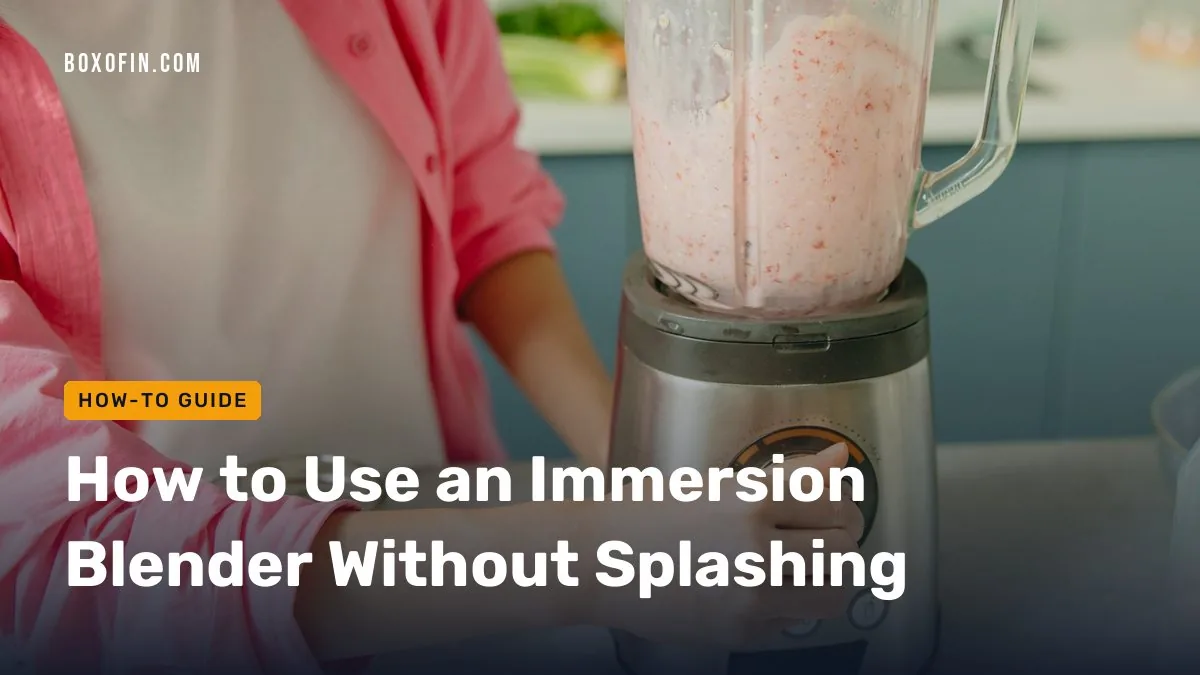
Starting an immersion blender before its head is in the food is the most common cause of splatter, and manufacturer manuals warn against it. To blend without splashing, put the blending head fully into the food first, start on low speed, keep the guard under the surface, and switch the motor off before you lift it out.
Quick answer
Insert the blender before you press the power button. Start slow, keep the guard below the surface, and move gently. Release the button before lifting. Use a tall, narrow container or a deep pot with plenty of empty space.
- Best for small batches: a tall, narrow container
- Best for big pots of soup: a deep pot off the heat
- Guard under the food first, then power on. Power off, then lift.
- Start at low speed and increase slowly.
- Tall, narrow containers and small batches reduce spills.
- Take hot pots off the heat and let them cool slightly before blending.
- Never immerse the blender past the seam of the attachment.
- How do you use an immersion blender without splashing?
- Why does an immersion blender splash?
- Which container works best?
- How do you blend hot soup safely?
- Worked example: tomato soup
- Can you use an immersion blender in a glass bowl?
- What if you don’t have an immersion blender?
- How do you clean it without making a mess?
- Troubleshooting checklist
- What do owners say?
- Frequently Asked Questions
How do you use an immersion blender without splashing?
Follow the same order every time. The sequence matters more than any gadget you buy.
- Choose a deep container or pot.
- Add food below the fill limit. Leave lots of empty space at the top.
- Lower the blender until the blade guard is under the surface.
- Press the power button on low speed.
- Move the blender slowly up, down, and in small circles.
- Release the button and wait for the blade to stop.
- Lift the blender out.
Manuals from makers such as KitchenAid advise inserting the blender before starting it. They also say to release the power button before removing it. Many guides say “submerge the blade” but skip this timing. The motor starts only after the guard is under. It stops before the guard leaves.
What speed should you use to prevent splattering?
Low speed. Manufacturers recommend starting low and raising the speed gradually. High speed throws liquid outward before the food has broken down. Once the mix is smooth and thick enough, you can speed up a little.
Should the blender be on before or after putting it into the food?
After. Switch it on only once the head is below the surface. Starting it in the air flings food in every direction.
Why does an immersion blender splash, and how can you stop it?
Splashing happens when the blade spins in air, in a thin layer of food, or at too high a speed. The fix is almost always one of these:
- Starting early: turn it on only after the guard is under.
- Lifting while running: the blade pulls liquid up and out. Stop first.
- Shallow food: the guard breaks the surface. Use a deeper container.
- Overfilling: blended food rises and spills. Leave headroom.
- Too much speed: begin low.
Which container works best?
A tall, narrow container works best for small batches. Manufacturer guidance says a tall container or a small batch reduces spillage. For cold ingredients, Breville suggests a tall cup or a large blending pitcher to cut overflow.
The container should fit the blender head with only a little room around it. A wide, shallow bowl lets the food spread thin, and that is where splashes begin.

How do you blend hot soup safely without splashing?
Take the pot off the heat first. Let it cool a little. Hot liquid makes steam, and steam makes splashes. Breville’s guidance is to remove the pot from the heat and let it cool slightly before blending.
Use a deep pot with the soup well below the rim. Keep your hand and arm away from the opening. Blend low and slow, and keep the guard under the surface the whole time.
Worked example: tomato soup
Say you have a pot of cooked tomato soup. Here are two ways to handle it.
- Small batch, tall container: Ladle a few cups into a tall, narrow jug. Lower the blender, start low, and move it gently. Pour the smooth soup back into the pot. This takes a couple of extra steps, but the splash risk is lowest.
- Large batch, deep pot: Pull the pot off the burner. Make sure it has generous empty space above the soup. Lower the blender to the bottom, start low, and tilt the pot slightly to catch chunks. Keep the guard under at all times.
From the Shop
The usual mistake with tomato soup is lifting the blender to “check” the texture while it runs. Red soup goes everywhere. Release the button, look, then start again.
Can you use an immersion blender in a glass bowl?
Often yes, but check your manual first. Use thick, sturdy glass and keep the blade off the bottom. A metal guard can scratch glass, non-stick pans, and some plastics. Some models have plastic guards made for coated cookware. A stainless pot or a tall plastic jug is a safer choice for most cooks.

What if you don’t have an immersion blender?
You can use a regular blender, but work in small batches, and follow its manual for hot liquids. A countertop blender is often the safer choice for large amounts of very hot soup, because the lid contains the splash. Other tools work too, depending on the texture you want.
| Tool | Mess | Hot food | Batch size | Texture |
|---|---|---|---|---|
| Immersion blender | Low if used correctly | Yes, off the heat | Small to large | Smooth or chunky |
| Countertop blender | Low with lid on | Small portions, vent per manual | Medium | Very smooth |
| Food processor | Medium, can leak with liquids | Not ideal | Medium | Chunky to smooth |
| Potato masher | Low | Yes | Small to medium | Rustic, lumpy |
| Whisk | Medium | Yes | Small | Mixing, not pureeing |
When should you use the whisk attachment?
Use it for cream, eggs, or light batters. Manufacturer guidance says to use a whisk in a deep container or pan to prevent splattering. Never use the whisk for heavy, thick mixes.
How do you clean it without making a mess?
Right after blending, fill a tall glass with warm, soapy water. Lower the blender in, staying below the seam, and run it briefly. That flushes food from the guard. Then unplug it and rinse the shaft. If the shaft detaches, wash it separately. Wipe the motor housing with a damp cloth. Never soak it.
Food often hides inside the bell housing, so check there before drying. Dried tomato or pureed vegetables are much harder to remove later.
Troubleshooting checklist
| Problem | Likely cause | Fix |
|---|---|---|
| Splashes at start | Powered on too early or too fast | Insert first, start low |
| Splashes mid-blend | Guard breaks the surface | Use a deeper container, add liquid |
| Splashes when removing | Lifted while running | Release the button first |
| Food spills over | Overfilled | Blend smaller batches |
| Whisk sprays | Shallow pan or wrong attachment | Use a deep container |
What do owners say?
Owners like
- Fast pureeing of soups and sauces without moving food to a countertop blender
- Easier cleanup than a full-size blender
- Removable shafts that make washing simple
- Stainless-steel shafts that resist stains and food odors
- Long service life on models from established brands
Common complaints
- Unexpected splashing when started too quickly or lifted while running
- Food trapped inside the blade guard or bell housing
- Motor wear after heavy or continuous use
- Shafts that are not detachable or not dishwasher safe
- Budget models with weaker motors or shorter lifespans
Summarised from owner reviews and long-term user reports; individual experiences vary.
Frequently Asked Questions
How to use immersion blender without splashing?
Put the head fully into the food, start on low speed, and keep the guard under the surface. Move it slowly, then release the button before lifting it out. A tall container or deep pot helps.
How to use hand blender without splashing?
It works the same way. A hand blender is another name for an immersion blender. Insert first, start low, and stop before removing.
Can you use a blender instead of immersion blender?
Yes. A countertop blender works well, especially for large batches of hot soup. Blend in small portions and follow the manual for hot liquids.
How to use an immersion blender without making a mess?
Use a deep container, keep the food well below the rim, and avoid lifting the blender while it runs. Rinse it right away in a tall glass of warm, soapy water.
What can I do if I don’t have an immersion blender?
Use a countertop blender, a food processor, a potato masher, or a whisk. The table above shows which suits each texture and batch size.
Can you use an immersion blender in a glass bowl?
Often yes, if the glass is thick and the blade stays off the bottom. Check your manual first, since metal guards can scratch glass and coated pans.
Sources